

18
1 Polar Flocks
obstacles or repulsive interaction. A positive feedback between slowdown-induced
accumulation and accumulation-induced slowdown leads to motility-induced phase
separation (MIPS)2, just as particles stuck in jams create dense regions, while others
move more or less freely in any remaining voids (Cates and Tailleur, 2015).
Phase-separated domains tend to coarsen, just like liquid and gas phases in equilibrium systems, but this process may not lead to complete phase separation. Equilibrium systems are symmetric under time reversal, and the key to the unparalleled
behavior of active particles is in abandoning this principle. Tjhung et al (2018) modified the standard statistical model of phase separation (Hohenberg and Halperin,
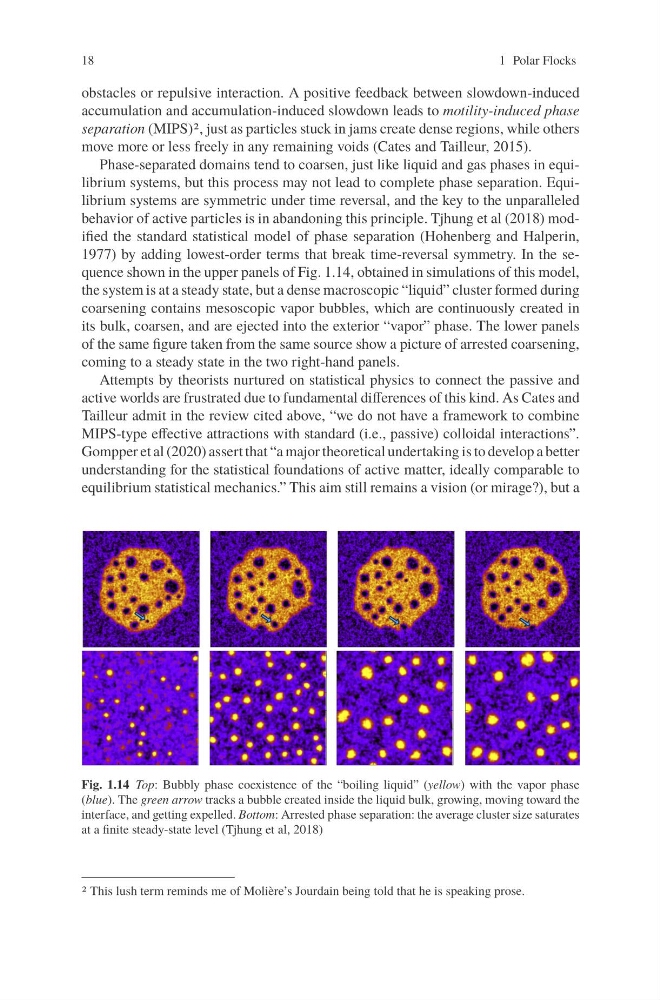
1977) by adding lowest-order terms that break time-reversal symmetry. In the sequence shown in the upper panels of Fig. 1.14, obtained in simulations of this model,
the system is at a steady state, but a dense macroscopic “liquid” cluster formed during
coarsening contains mesoscopic vapor bubbles, which are continuously created in
its bulk, coarsen, and are ejected into the exterior “vapor” phase. The lower panels
of the same figure taken from the same source show a picture of arrested coarsening,
coming to a steady state in the two right-hand panels.
Attempts by theorists nurtured on statistical physics to connect the passive and
active worlds are frustrated due to fundamental differences of this kind. As Cates and
Tailleur admit in the review cited above, “we do not have a framework to combine
MIPS-type effective attractions with standard (i.e., passive) colloidal interactions”.
Gompper et al (2020) assert that “a major theoretical undertaking is to develop a better
understanding for the statistical foundations of active matter, ideally comparable to
equilibrium statistical mechanics.” This aim still remains a vision (or mirage?), but a
Fig. 1.14 Top: Bubbly phase coexistence of the “boiling liquid” (yellow) with the vapor phase
(blue). The green arrow tracks a bubble created inside the liquid bulk, growing, moving toward the
interface, and getting expelled. Bottom: Arrested phase separation: the average cluster size saturates
at a finite steady-state level (Tjhung et al, 2018)
2 This lush term reminds me of Molière’s Jourdain being told that he is speaking prose.
1 Polar Flocks
obstacles or repulsive interaction. A positive feedback between slowdown-induced
accumulation and accumulation-induced slowdown leads to motility-induced phase
separation (MIPS)2, just as particles stuck in jams create dense regions, while others
move more or less freely in any remaining voids (Cates and Tailleur, 2015).
Phase-separated domains tend to coarsen, just like liquid and gas phases in equilibrium systems, but this process may not lead to complete phase separation. Equilibrium systems are symmetric under time reversal, and the key to the unparalleled
behavior of active particles is in abandoning this principle. Tjhung et al (2018) modified the standard statistical model of phase separation (Hohenberg and Halperin,
1977) by adding lowest-order terms that break time-reversal symmetry. In the sequence shown in the upper panels of Fig. 1.14, obtained in simulations of this model,
the system is at a steady state, but a dense macroscopic “liquid” cluster formed during
coarsening contains mesoscopic vapor bubbles, which are continuously created in
its bulk, coarsen, and are ejected into the exterior “vapor” phase. The lower panels
of the same figure taken from the same source show a picture of arrested coarsening,
coming to a steady state in the two right-hand panels.
Attempts by theorists nurtured on statistical physics to connect the passive and
active worlds are frustrated due to fundamental differences of this kind. As Cates and
Tailleur admit in the review cited above, “we do not have a framework to combine
MIPS-type effective attractions with standard (i.e., passive) colloidal interactions”.
Gompper et al (2020) assert that “a major theoretical undertaking is to develop a better
understanding for the statistical foundations of active matter, ideally comparable to
equilibrium statistical mechanics.” This aim still remains a vision (or mirage?), but a
Fig. 1.14 Top: Bubbly phase coexistence of the “boiling liquid” (yellow) with the vapor phase
(blue). The green arrow tracks a bubble created inside the liquid bulk, growing, moving toward the
interface, and getting expelled. Bottom: Arrested phase separation: the average cluster size saturates
at a finite steady-state level (Tjhung et al, 2018)
2 This lush term reminds me of Molière’s Jourdain being told that he is speaking prose.