

1.7 Active Dipolar Rollers
19
phenomenological picture is nevertheless emerging from numerous simulations and
carefully designed experiments.
1.7 Active Dipolar Rollers
The crowding phenomenon has also been observed on a microscopic scale. Bricard
et al (2013) experimented with inanimate polar walkers – rollers invented by Quincke
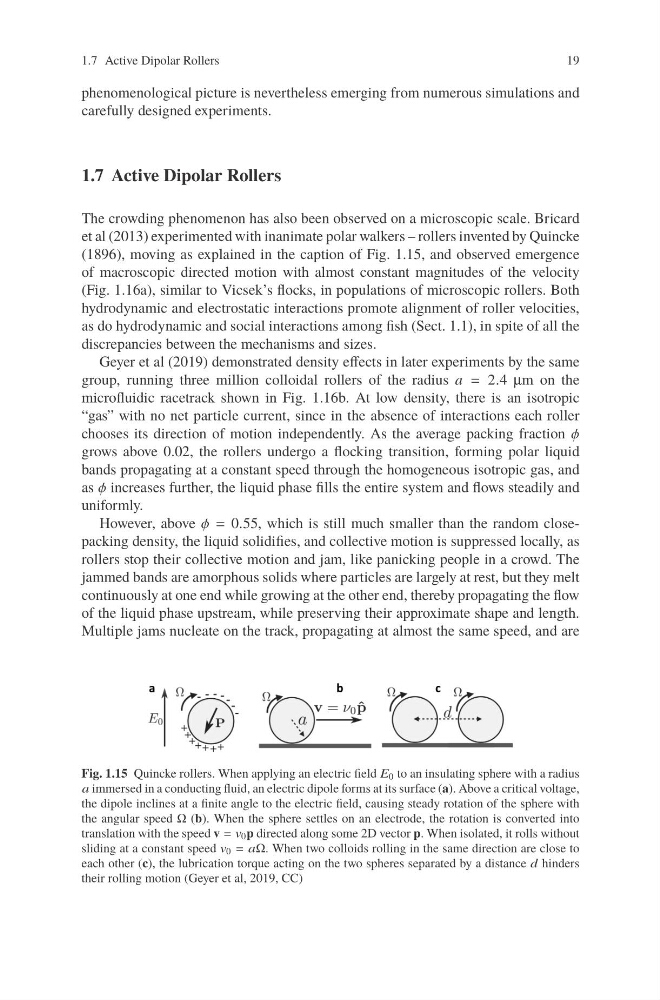
(1896), moving as explained in the caption of Fig. 1.15, and observed emergence
of macroscopic directed motion with almost constant magnitudes of the velocity
(Fig. 1.16a), similar to Vicsek’s flocks, in populations of microscopic rollers. Both
hydrodynamic and electrostatic interactions promote alignment of roller velocities,
as do hydrodynamic and social interactions among fish (Sect. 1.1), in spite of all the
discrepancies between the mechanisms and sizes.
Geyer et al (2019) demonstrated density effects in later experiments by the same
group, running three million colloidal rollers of the radius a = 2.4 μm on the
microfluidic racetrack shown in Fig. 1.16b. At low density, there is an isotropic
“gas” with no net particle current, since in the absence of interactions each roller
chooses its direction of motion independently. As the average packing fraction φ
grows above 0.02, the rollers undergo a flocking transition, forming polar liquid
bands propagating at a constant speed through the homogeneous isotropic gas, and
as φ increases further, the liquid phase fills the entire system and flows steadily and
uniformly.
However, above φ = 0.55, which is still much smaller than the random closepacking density, the liquid solidifies, and collective motion is suppressed locally, as
rollers stop their collective motion and jam, like panicking people in a crowd. The
jammed bands are amorphous solids where particles are largely at rest, but they melt
continuously at one end while growing at the other end, thereby propagating the flow
of the liquid phase upstream, while preserving their approximate shape and length.
Multiple jams nucleate on the track, propagating at almost the same speed, and are
Fig. 1.15 Quincke rollers. When applying an electric field E 0 to an insulating sphere with a radius
a immersed in a conducting fluid, an electric dipole forms at its surface (a). Above a critical voltage,
the dipole inclines at a finite angle to the electric field, causing steady rotation of the sphere with
the angular speed Ω (b). When the sphere settles on an electrode, the rotation is converted into
translation with the speed v = v 0 p directed along some 2D vector p. When isolated, it rolls without
sliding at a constant speed v 0 = aΩ. When two colloids rolling in the same direction are close to
each other (c), the lubrication torque acting on the two spheres separated by a distance d hinders
their rolling motion (Geyer et al, 2019, CC)
19
phenomenological picture is nevertheless emerging from numerous simulations and
carefully designed experiments.
1.7 Active Dipolar Rollers
The crowding phenomenon has also been observed on a microscopic scale. Bricard
et al (2013) experimented with inanimate polar walkers – rollers invented by Quincke
(1896), moving as explained in the caption of Fig. 1.15, and observed emergence
of macroscopic directed motion with almost constant magnitudes of the velocity
(Fig. 1.16a), similar to Vicsek’s flocks, in populations of microscopic rollers. Both
hydrodynamic and electrostatic interactions promote alignment of roller velocities,
as do hydrodynamic and social interactions among fish (Sect. 1.1), in spite of all the
discrepancies between the mechanisms and sizes.
Geyer et al (2019) demonstrated density effects in later experiments by the same
group, running three million colloidal rollers of the radius a = 2.4 μm on the
microfluidic racetrack shown in Fig. 1.16b. At low density, there is an isotropic
“gas” with no net particle current, since in the absence of interactions each roller
chooses its direction of motion independently. As the average packing fraction φ
grows above 0.02, the rollers undergo a flocking transition, forming polar liquid
bands propagating at a constant speed through the homogeneous isotropic gas, and
as φ increases further, the liquid phase fills the entire system and flows steadily and
uniformly.
However, above φ = 0.55, which is still much smaller than the random closepacking density, the liquid solidifies, and collective motion is suppressed locally, as
rollers stop their collective motion and jam, like panicking people in a crowd. The
jammed bands are amorphous solids where particles are largely at rest, but they melt
continuously at one end while growing at the other end, thereby propagating the flow
of the liquid phase upstream, while preserving their approximate shape and length.
Multiple jams nucleate on the track, propagating at almost the same speed, and are
Fig. 1.15 Quincke rollers. When applying an electric field E 0 to an insulating sphere with a radius
a immersed in a conducting fluid, an electric dipole forms at its surface (a). Above a critical voltage,
the dipole inclines at a finite angle to the electric field, causing steady rotation of the sphere with
the angular speed Ω (b). When the sphere settles on an electrode, the rotation is converted into
translation with the speed v = v 0 p directed along some 2D vector p. When isolated, it rolls without
sliding at a constant speed v 0 = aΩ. When two colloids rolling in the same direction are close to
each other (c), the lubrication torque acting on the two spheres separated by a distance d hinders
their rolling motion (Geyer et al, 2019, CC)