

1.6 Crowding Impedes Motion
17
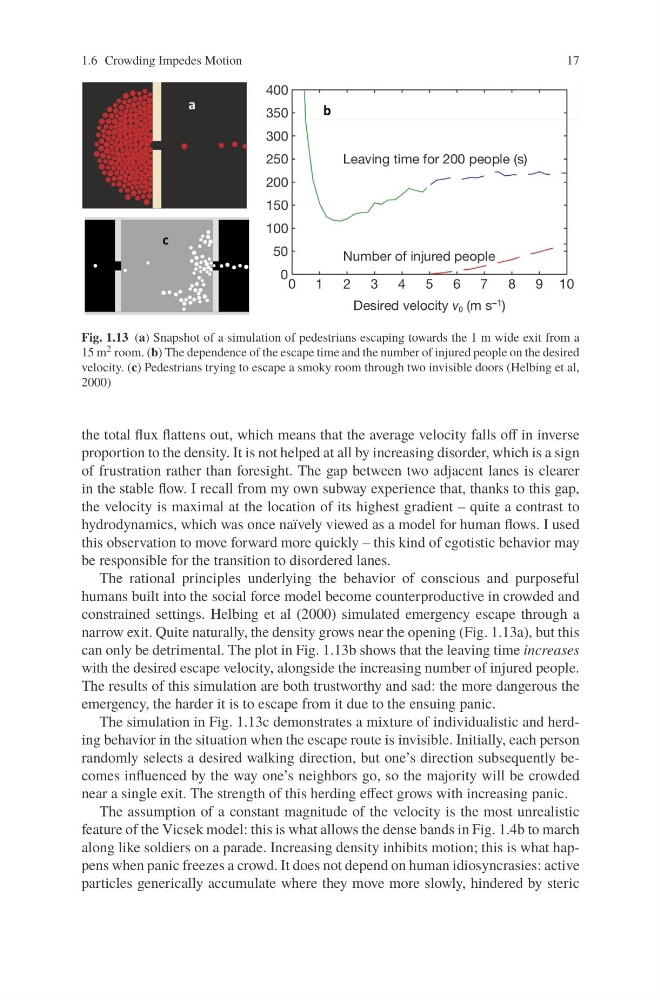
Fig. 1.13 (a) Snapshot of a simulation of pedestrians escaping towards the 1 m wide exit from a
15 m 2 room. (b) The dependence of the escape time and the number of injured people on the desired
velocity. (c) Pedestrians trying to escape a smoky room through two invisible doors (Helbing et al,
2000)
the total flux flattens out, which means that the average velocity falls off in inverse
proportion to the density. It is not helped at all by increasing disorder, which is a sign
of frustration rather than foresight. The gap between two adjacent lanes is clearer
in the stable flow. I recall from my own subway experience that, thanks to this gap,
the velocity is maximal at the location of its highest gradient – quite a contrast to
hydrodynamics, which was once naïvely viewed as a model for human flows. I used
this observation to move forward more quickly – this kind of egotistic behavior may
be responsible for the transition to disordered lanes.
The rational principles underlying the behavior of conscious and purposeful
humans built into the social force model become counterproductive in crowded and
constrained settings. Helbing et al (2000) simulated emergency escape through a
narrow exit. Quite naturally, the density grows near the opening (Fig. 1.13a), but this
can only be detrimental. The plot in Fig. 1.13b shows that the leaving time increases
with the desired escape velocity, alongside the increasing number of injured people.
The results of this simulation are both trustworthy and sad: the more dangerous the
emergency, the harder it is to escape from it due to the ensuing panic.
The simulation in Fig. 1.13c demonstrates a mixture of individualistic and herding behavior in the situation when the escape route is invisible. Initially, each person
randomly selects a desired walking direction, but one’s direction subsequently becomes influenced by the way one’s neighbors go, so the majority will be crowded
near a single exit. The strength of this herding effect grows with increasing panic.
The assumption of a constant magnitude of the velocity is the most unrealistic
feature of the Vicsek model: this is what allows the dense bands in Fig. 1.4b to march
along like soldiers on a parade. Increasing density inhibits motion; this is what happens when panic freezes a crowd. It does not depend on human idiosyncrasies: active
particles generically accumulate where they move more slowly, hindered by steric
17
Fig. 1.13 (a) Snapshot of a simulation of pedestrians escaping towards the 1 m wide exit from a
15 m 2 room. (b) The dependence of the escape time and the number of injured people on the desired
velocity. (c) Pedestrians trying to escape a smoky room through two invisible doors (Helbing et al,
2000)
the total flux flattens out, which means that the average velocity falls off in inverse
proportion to the density. It is not helped at all by increasing disorder, which is a sign
of frustration rather than foresight. The gap between two adjacent lanes is clearer
in the stable flow. I recall from my own subway experience that, thanks to this gap,
the velocity is maximal at the location of its highest gradient – quite a contrast to
hydrodynamics, which was once naïvely viewed as a model for human flows. I used
this observation to move forward more quickly – this kind of egotistic behavior may
be responsible for the transition to disordered lanes.
The rational principles underlying the behavior of conscious and purposeful
humans built into the social force model become counterproductive in crowded and
constrained settings. Helbing et al (2000) simulated emergency escape through a
narrow exit. Quite naturally, the density grows near the opening (Fig. 1.13a), but this
can only be detrimental. The plot in Fig. 1.13b shows that the leaving time increases
with the desired escape velocity, alongside the increasing number of injured people.
The results of this simulation are both trustworthy and sad: the more dangerous the
emergency, the harder it is to escape from it due to the ensuing panic.
The simulation in Fig. 1.13c demonstrates a mixture of individualistic and herding behavior in the situation when the escape route is invisible. Initially, each person
randomly selects a desired walking direction, but one’s direction subsequently becomes influenced by the way one’s neighbors go, so the majority will be crowded
near a single exit. The strength of this herding effect grows with increasing panic.
The assumption of a constant magnitude of the velocity is the most unrealistic
feature of the Vicsek model: this is what allows the dense bands in Fig. 1.4b to march
along like soldiers on a parade. Increasing density inhibits motion; this is what happens when panic freezes a crowd. It does not depend on human idiosyncrasies: active
particles generically accumulate where they move more slowly, hindered by steric