

16
1 Polar Flocks
Großmann et al (2015) modified the Vicsek model still more radically, combining
velocity alignment with nearest neighbors and anti-alignment with particles which
are further away, such as might be caused by some unspecified complex hydrodynamic interactions. The inspiration for this model was the symmetry-breaking in
reaction–diffusion systems due to competing short-range activation and long-range
inhibition (Turing, 1952). Replacing here activation for alignment and inhibition for
anti-alignment gives a ready recipe for complex patterning, and this is indeed what
this model provides. A variety of patterns coming up in simulations of this model
are shown in Fig. 1.11.
1.6 Crowding Impedes Motion
Physicists are not particularly interested in animal social relations, even when they
are trying to amend the basic model to fit field observations – but human crowds
behave in a special way, being driven by psychology rather than by mechanical forces.
Though vectorial in their orientation and motion, freely moving humans are largely
motivated by avoidance rather than alignment. Helbing and Molnár (1995) based their
model of pedestrian motion on the social force, including three principal components:
acceleration to the desired velocity of motion, avoiding other pedestrians and borders,
and attraction toward the target. The paper gained over 2000 citations, and the model
has been tested in both normal and emergency situations.
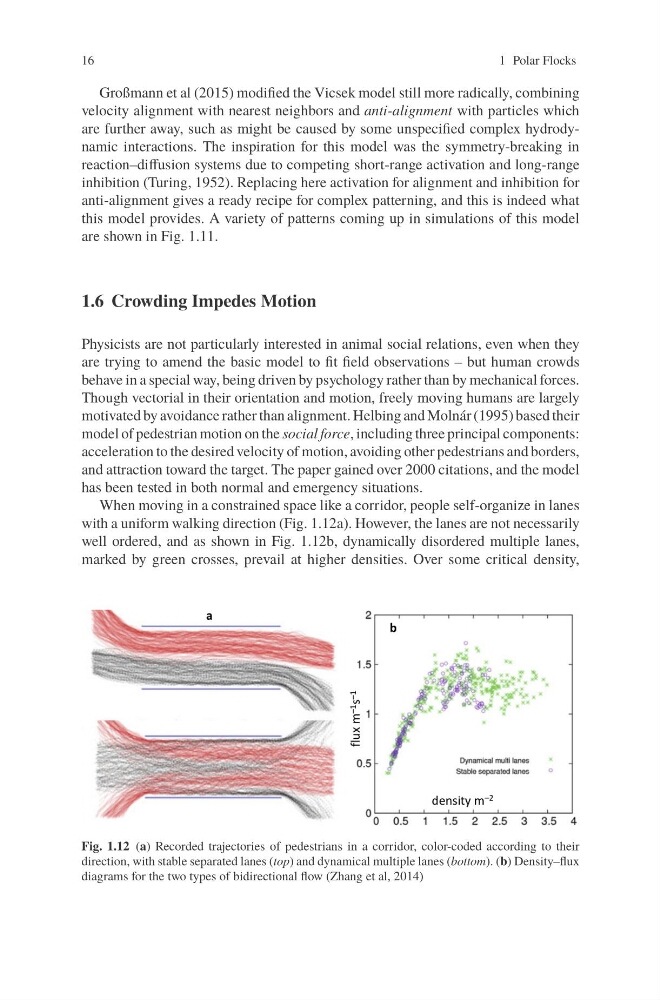
When moving in a constrained space like a corridor, people self-organize in lanes
with a uniform walking direction (Fig. 1.12a). However, the lanes are not necessarily
well ordered, and as shown in Fig. 1.12b, dynamically disordered multiple lanes,
marked by green crosses, prevail at higher densities. Over some critical density,
Fig. 1.12 (a) Recorded trajectories of pedestrians in a corridor, color-coded according to their
direction, with stable separated lanes (top) and dynamical multiple lanes (bottom). (b) Density–flux
diagrams for the two types of bidirectional flow (Zhang et al, 2014)
1 Polar Flocks
Großmann et al (2015) modified the Vicsek model still more radically, combining
velocity alignment with nearest neighbors and anti-alignment with particles which
are further away, such as might be caused by some unspecified complex hydrodynamic interactions. The inspiration for this model was the symmetry-breaking in
reaction–diffusion systems due to competing short-range activation and long-range
inhibition (Turing, 1952). Replacing here activation for alignment and inhibition for
anti-alignment gives a ready recipe for complex patterning, and this is indeed what
this model provides. A variety of patterns coming up in simulations of this model
are shown in Fig. 1.11.
1.6 Crowding Impedes Motion
Physicists are not particularly interested in animal social relations, even when they
are trying to amend the basic model to fit field observations – but human crowds
behave in a special way, being driven by psychology rather than by mechanical forces.
Though vectorial in their orientation and motion, freely moving humans are largely
motivated by avoidance rather than alignment. Helbing and Molnár (1995) based their
model of pedestrian motion on the social force, including three principal components:
acceleration to the desired velocity of motion, avoiding other pedestrians and borders,
and attraction toward the target. The paper gained over 2000 citations, and the model
has been tested in both normal and emergency situations.
When moving in a constrained space like a corridor, people self-organize in lanes
with a uniform walking direction (Fig. 1.12a). However, the lanes are not necessarily
well ordered, and as shown in Fig. 1.12b, dynamically disordered multiple lanes,
marked by green crosses, prevail at higher densities. Over some critical density,
Fig. 1.12 (a) Recorded trajectories of pedestrians in a corridor, color-coded according to their
direction, with stable separated lanes (top) and dynamical multiple lanes (bottom). (b) Density–flux
diagrams for the two types of bidirectional flow (Zhang et al, 2014)