

8.8 Biomorphs and Biohybrids
197
techniques make it possible to integrate different materials into emerging forms,
which can be as fantastic as any designer could imagine.
Incorporating geometrically active soft materials into a 3D-printed form led to
what is called 4D printing, adding time as the fourth dimension – of course, not on par
with spatial dimensions in relativity theory, since only the spatial form is printed, but
by allowing controllable reshaping under actuation. This method is most suitable for
fabricating layered and anisotropic structures. Gladman et al (2016) printed patterns
using hydrogel ink with imbedded fibrils, which aligned when passing the deposition
nozzle, as shown in Fig. 8.28a. This makes the material anisotropic, so that it swells
along the filament length rather than uniformly in all directions, imitating the effect
of the directional orientation of microtubules within plant cell walls (Fig. 8.27). In
a bilayer system, differential swelling between the top and bottom layers induces
curvature with the direction of bending determined by the way the swelling layer
is placed. In Fig. 8.28b, it is placed on the top or bottom sides of the two sets of
filaments, oriented perpendicularly to one another. Upon actuation, this leads to a
saddle-like form. In this way, a variety of shapes can be created, like the flower-like
forms in Fig. 8.28c.
The contraptions featured in Sect. 6.8, though imitating worms and caterpillars,
are biomorphic in a very restricted sense, as are the many versatile bilayer or patterned hydrogel structures reviewed by Erol et al (2019), but advanced engineering
design is bringing forward more sophisticated soft robots complete with autonomous
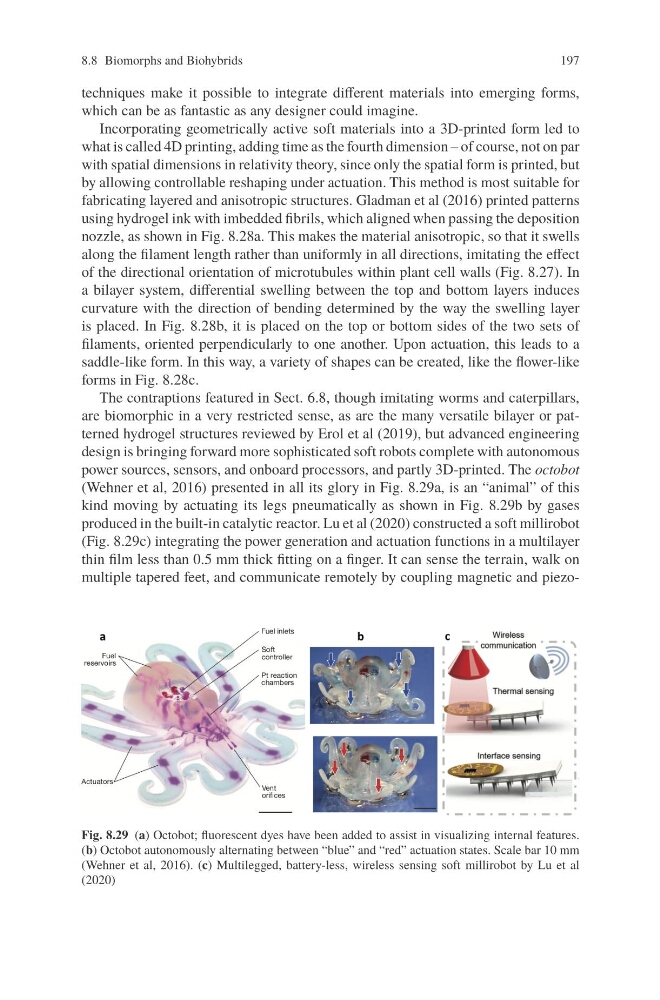
power sources, sensors, and onboard processors, and partly 3D-printed. The octobot
(Wehner et al, 2016) presented in all its glory in Fig. 8.29a, is an “animal” of this
kind moving by actuating its legs pneumatically as shown in Fig. 8.29b by gases
produced in the built-in catalytic reactor. Lu et al (2020) constructed a soft millirobot
(Fig. 8.29c) integrating the power generation and actuation functions in a multilayer
thin film less than 0.5 mm thick fitting on a finger. It can sense the terrain, walk on
multiple tapered feet, and communicate remotely by coupling magnetic and piezoFig. 8.29 (a) Octobot; fluorescent dyes have been added to assist in visualizing internal features.
(b) Octobot autonomously alternating between “blue” and “red” actuation states. Scale bar 10 mm
(Wehner et al, 2016). (c) Multilegged, battery-less, wireless sensing soft millirobot by Lu et al
(2020)
197
techniques make it possible to integrate different materials into emerging forms,
which can be as fantastic as any designer could imagine.
Incorporating geometrically active soft materials into a 3D-printed form led to
what is called 4D printing, adding time as the fourth dimension – of course, not on par
with spatial dimensions in relativity theory, since only the spatial form is printed, but
by allowing controllable reshaping under actuation. This method is most suitable for
fabricating layered and anisotropic structures. Gladman et al (2016) printed patterns
using hydrogel ink with imbedded fibrils, which aligned when passing the deposition
nozzle, as shown in Fig. 8.28a. This makes the material anisotropic, so that it swells
along the filament length rather than uniformly in all directions, imitating the effect
of the directional orientation of microtubules within plant cell walls (Fig. 8.27). In
a bilayer system, differential swelling between the top and bottom layers induces
curvature with the direction of bending determined by the way the swelling layer
is placed. In Fig. 8.28b, it is placed on the top or bottom sides of the two sets of
filaments, oriented perpendicularly to one another. Upon actuation, this leads to a
saddle-like form. In this way, a variety of shapes can be created, like the flower-like
forms in Fig. 8.28c.
The contraptions featured in Sect. 6.8, though imitating worms and caterpillars,
are biomorphic in a very restricted sense, as are the many versatile bilayer or patterned hydrogel structures reviewed by Erol et al (2019), but advanced engineering
design is bringing forward more sophisticated soft robots complete with autonomous
power sources, sensors, and onboard processors, and partly 3D-printed. The octobot
(Wehner et al, 2016) presented in all its glory in Fig. 8.29a, is an “animal” of this
kind moving by actuating its legs pneumatically as shown in Fig. 8.29b by gases
produced in the built-in catalytic reactor. Lu et al (2020) constructed a soft millirobot
(Fig. 8.29c) integrating the power generation and actuation functions in a multilayer
thin film less than 0.5 mm thick fitting on a finger. It can sense the terrain, walk on
multiple tapered feet, and communicate remotely by coupling magnetic and piezoFig. 8.29 (a) Octobot; fluorescent dyes have been added to assist in visualizing internal features.
(b) Octobot autonomously alternating between “blue” and “red” actuation states. Scale bar 10 mm
(Wehner et al, 2016). (c) Multilegged, battery-less, wireless sensing soft millirobot by Lu et al
(2020)