

196
8 Morphogenesis
Fig. 8.27 Linear growth directed by
transverse alignment of the microtubular cortex and growth with chirality opposite to that of the cortex, as indicated by the dashed line (Wada and Matsumoto, 2018)
and Domagalska, 2011). Removing the shoot apex results in activation of buds,
indicating that the shoot apex inhibits the formation of the buds below. When the
missing apex is replaced with an auxin source, branching inhibition is restored, but
applying an auxin transport inhibitor leads to bud outgrowth at nodes below the
application site.
Plant tissues may grow not only through cell division, but by cell enlargement,
and in linear structure elements, such as stalks and roots, the expansion of cells is
highly anisotropic. An individual cell in a root may grow at a rate of a few μm/min,
with no appreciable radial expansion. The latter is restricted by a cortex formed by
bundles of microtubules oriented transversely to the growth direction. The chirality
of such a bundle causes chiral growth with the opposite twist (Fig. 8.27).
8.8 Biomorphs and Biohybrids
In Sects. 6.7 and 7.8, we noted a similarity between plant tissues and synthetic
geometrically active materials. However, there is a considerable difference between
our traditional fabrication methods, by assembling parts or removing excess material,
and the way Nature actually operates, by growth and diversification. This contrast
has been mitigated with the spread of additive manufacturing through 3D printing,
guided by programming in lieu of genetic induction. Sophisticated microfluidic
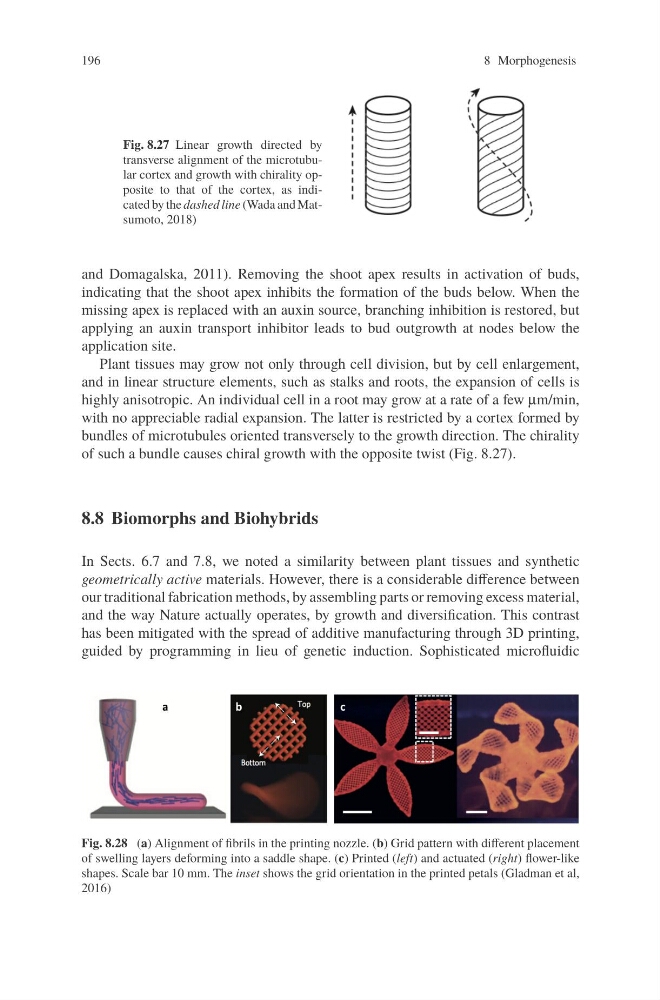
Fig. 8.28 (a) Alignment of fibrils in the printing nozzle. (b) Grid pattern with different placement
of swelling layers deforming into a saddle shape. (c) Printed (left) and actuated (right) flower-like
shapes. Scale bar 10 mm. The inset shows the grid orientation in the printed petals (Gladman et al,
2016)
8 Morphogenesis
Fig. 8.27 Linear growth directed by
transverse alignment of the microtubular cortex and growth with chirality opposite to that of the cortex, as indicated by the dashed line (Wada and Matsumoto, 2018)
and Domagalska, 2011). Removing the shoot apex results in activation of buds,
indicating that the shoot apex inhibits the formation of the buds below. When the
missing apex is replaced with an auxin source, branching inhibition is restored, but
applying an auxin transport inhibitor leads to bud outgrowth at nodes below the
application site.
Plant tissues may grow not only through cell division, but by cell enlargement,
and in linear structure elements, such as stalks and roots, the expansion of cells is
highly anisotropic. An individual cell in a root may grow at a rate of a few μm/min,
with no appreciable radial expansion. The latter is restricted by a cortex formed by
bundles of microtubules oriented transversely to the growth direction. The chirality
of such a bundle causes chiral growth with the opposite twist (Fig. 8.27).
8.8 Biomorphs and Biohybrids
In Sects. 6.7 and 7.8, we noted a similarity between plant tissues and synthetic
geometrically active materials. However, there is a considerable difference between
our traditional fabrication methods, by assembling parts or removing excess material,
and the way Nature actually operates, by growth and diversification. This contrast
has been mitigated with the spread of additive manufacturing through 3D printing,
guided by programming in lieu of genetic induction. Sophisticated microfluidic
Fig. 8.28 (a) Alignment of fibrils in the printing nozzle. (b) Grid pattern with different placement
of swelling layers deforming into a saddle shape. (c) Printed (left) and actuated (right) flower-like
shapes. Scale bar 10 mm. The inset shows the grid orientation in the printed petals (Gladman et al,
2016)