

8.7 Morphogenesis in Plants
195
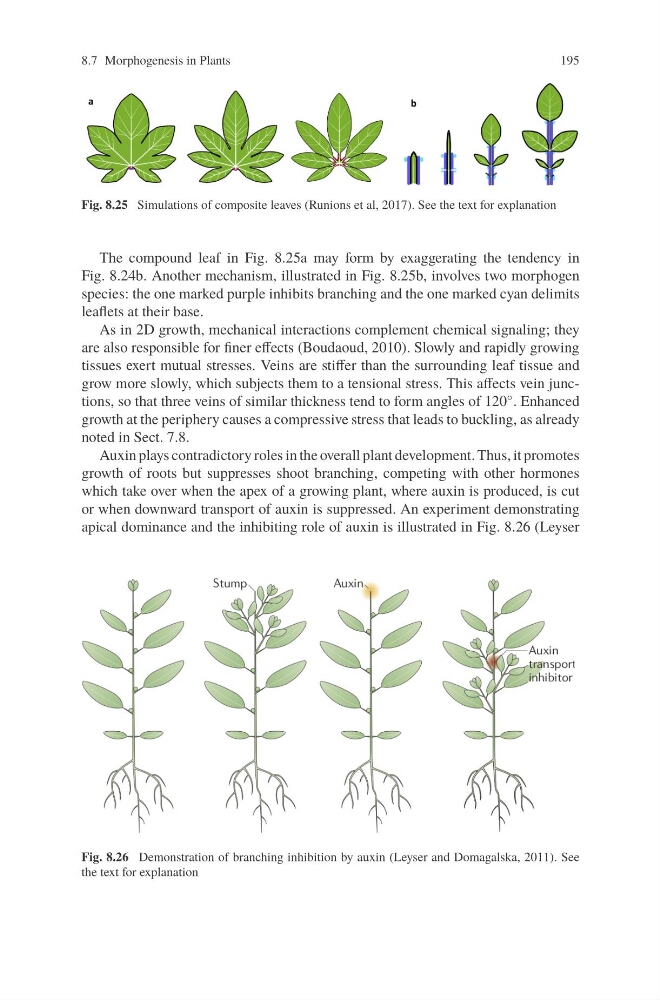
Fig. 8.25 Simulations of composite leaves (Runions et al, 2017). See the text for explanation
The compound leaf in Fig. 8.25a may form by exaggerating the tendency in
Fig. 8.24b. Another mechanism, illustrated in Fig. 8.25b, involves two morphogen
species: the one marked purple inhibits branching and the one marked cyan delimits
leaflets at their base.
As in 2D growth, mechanical interactions complement chemical signaling; they
are also responsible for finer effects (Boudaoud, 2010). Slowly and rapidly growing
tissues exert mutual stresses. Veins are stiffer than the surrounding leaf tissue and
grow more slowly, which subjects them to a tensional stress. This affects vein junctions, so that three veins of similar thickness tend to form angles of 120 ◦ . Enhanced
growth at the periphery causes a compressive stress that leads to buckling, as already
noted in Sect. 7.8.
Auxin plays contradictory roles in the overall plant development. Thus, it promotes
growth of roots but suppresses shoot branching, competing with other hormones
which take over when the apex of a growing plant, where auxin is produced, is cut
or when downward transport of auxin is suppressed. An experiment demonstrating
apical dominance and the inhibiting role of auxin is illustrated in Fig. 8.26 (Leyser
Fig. 8.26 Demonstration of branching inhibition by auxin (Leyser and Domagalska, 2011). See
the text for explanation
195
Fig. 8.25 Simulations of composite leaves (Runions et al, 2017). See the text for explanation
The compound leaf in Fig. 8.25a may form by exaggerating the tendency in
Fig. 8.24b. Another mechanism, illustrated in Fig. 8.25b, involves two morphogen
species: the one marked purple inhibits branching and the one marked cyan delimits
leaflets at their base.
As in 2D growth, mechanical interactions complement chemical signaling; they
are also responsible for finer effects (Boudaoud, 2010). Slowly and rapidly growing
tissues exert mutual stresses. Veins are stiffer than the surrounding leaf tissue and
grow more slowly, which subjects them to a tensional stress. This affects vein junctions, so that three veins of similar thickness tend to form angles of 120 ◦ . Enhanced
growth at the periphery causes a compressive stress that leads to buckling, as already
noted in Sect. 7.8.
Auxin plays contradictory roles in the overall plant development. Thus, it promotes
growth of roots but suppresses shoot branching, competing with other hormones
which take over when the apex of a growing plant, where auxin is produced, is cut
or when downward transport of auxin is suppressed. An experiment demonstrating
apical dominance and the inhibiting role of auxin is illustrated in Fig. 8.26 (Leyser
Fig. 8.26 Demonstration of branching inhibition by auxin (Leyser and Domagalska, 2011). See
the text for explanation