

198
8 Morphogenesis
electric effects. So far, these are just toys, but soft robotics is a hot topic. The number
of reviews alone exceeded 200 in the last five years, and whatever could be written
here will soon become obsolete.
A notable trend is combining natural and synthetic components in a biohybrid
device. Molecular motors are most efficient microscopic tools converting chemical
to mechanical energy, and they are simpler to operate when they remain within intact
cells and make use of their locomotive machinery. This suggests employing bacteria
as movers (Behkam and Sitti, 2007). They are not picky: a simple nutrient such
as glucose would suffice, there is no need for toxic fuels or catalysts, and benign
bacteria can be used for such fine tasks as intravenous drug delivery. The problem
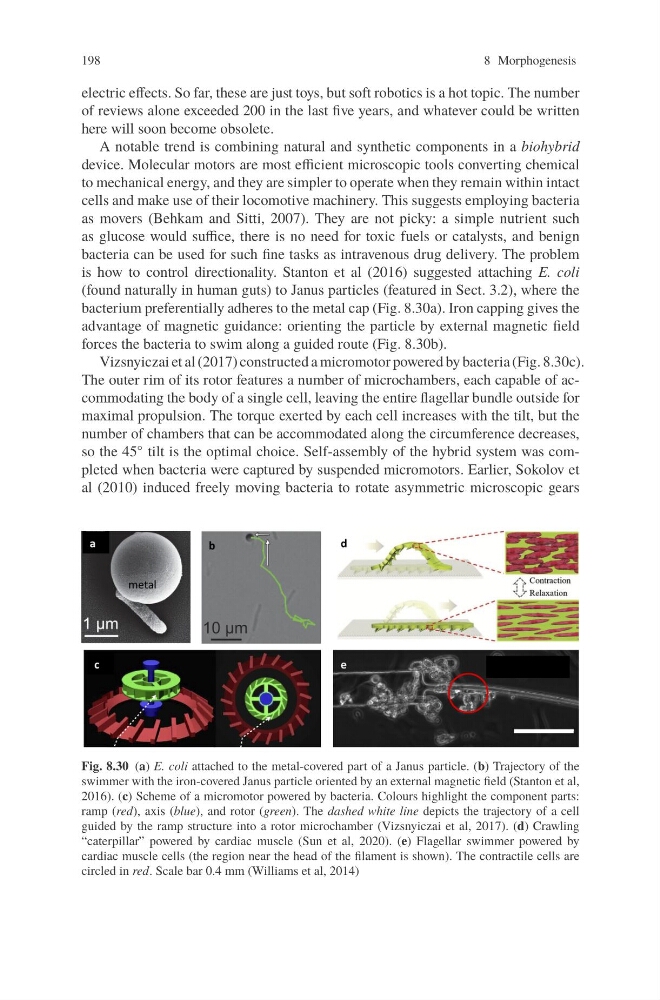
is how to control directionality. Stanton et al (2016) suggested attaching E. coli
(found naturally in human guts) to Janus particles (featured in Sect. 3.2), where the
bacterium preferentially adheres to the metal cap (Fig. 8.30a). Iron capping gives the
advantage of magnetic guidance: orienting the particle by external magnetic field
forces the bacteria to swim along a guided route (Fig. 8.30b).
Vizsnyiczai et al (2017) constructed a micromotor powered by bacteria (Fig. 8.30c).
The outer rim of its rotor features a number of microchambers, each capable of accommodating the body of a single cell, leaving the entire flagellar bundle outside for
maximal propulsion. The torque exerted by each cell increases with the tilt, but the
number of chambers that can be accommodated along the circumference decreases,
so the 45 ◦ tilt is the optimal choice. Self-assembly of the hybrid system was completed when bacteria were captured by suspended micromotors. Earlier, Sokolov et
al (2010) induced freely moving bacteria to rotate asymmetric microscopic gears
Fig. 8.30 (a) E. coli attached to the metal-covered part of a Janus particle. (b) Trajectory of the
swimmer with the iron-covered Janus particle oriented by an external magnetic field (Stanton et al,
2016). (c) Scheme of a micromotor powered by bacteria. Colours highlight the component parts:
ramp (red), axis (blue), and rotor (green). The dashed white line depicts the trajectory of a cell
guided by the ramp structure into a rotor microchamber (Vizsnyiczai et al, 2017). (d) Crawling
“caterpillar” powered by cardiac muscle (Sun et al, 2020). (e) Flagellar swimmer powered by
cardiac muscle cells (the region near the head of the filament is shown). The contractile cells are
circled in red. Scale bar 0.4 mm (Williams et al, 2014)
8 Morphogenesis
electric effects. So far, these are just toys, but soft robotics is a hot topic. The number
of reviews alone exceeded 200 in the last five years, and whatever could be written
here will soon become obsolete.
A notable trend is combining natural and synthetic components in a biohybrid
device. Molecular motors are most efficient microscopic tools converting chemical
to mechanical energy, and they are simpler to operate when they remain within intact
cells and make use of their locomotive machinery. This suggests employing bacteria
as movers (Behkam and Sitti, 2007). They are not picky: a simple nutrient such
as glucose would suffice, there is no need for toxic fuels or catalysts, and benign
bacteria can be used for such fine tasks as intravenous drug delivery. The problem
is how to control directionality. Stanton et al (2016) suggested attaching E. coli
(found naturally in human guts) to Janus particles (featured in Sect. 3.2), where the
bacterium preferentially adheres to the metal cap (Fig. 8.30a). Iron capping gives the
advantage of magnetic guidance: orienting the particle by external magnetic field
forces the bacteria to swim along a guided route (Fig. 8.30b).
Vizsnyiczai et al (2017) constructed a micromotor powered by bacteria (Fig. 8.30c).
The outer rim of its rotor features a number of microchambers, each capable of accommodating the body of a single cell, leaving the entire flagellar bundle outside for
maximal propulsion. The torque exerted by each cell increases with the tilt, but the
number of chambers that can be accommodated along the circumference decreases,
so the 45 ◦ tilt is the optimal choice. Self-assembly of the hybrid system was completed when bacteria were captured by suspended micromotors. Earlier, Sokolov et
al (2010) induced freely moving bacteria to rotate asymmetric microscopic gears
Fig. 8.30 (a) E. coli attached to the metal-covered part of a Janus particle. (b) Trajectory of the
swimmer with the iron-covered Janus particle oriented by an external magnetic field (Stanton et al,
2016). (c) Scheme of a micromotor powered by bacteria. Colours highlight the component parts:
ramp (red), axis (blue), and rotor (green). The dashed white line depicts the trajectory of a cell
guided by the ramp structure into a rotor microchamber (Vizsnyiczai et al, 2017). (d) Crawling
“caterpillar” powered by cardiac muscle (Sun et al, 2020). (e) Flagellar swimmer powered by
cardiac muscle cells (the region near the head of the filament is shown). The contractile cells are
circled in red. Scale bar 0.4 mm (Williams et al, 2014)