

8.7 Morphogenesis in Plants
193
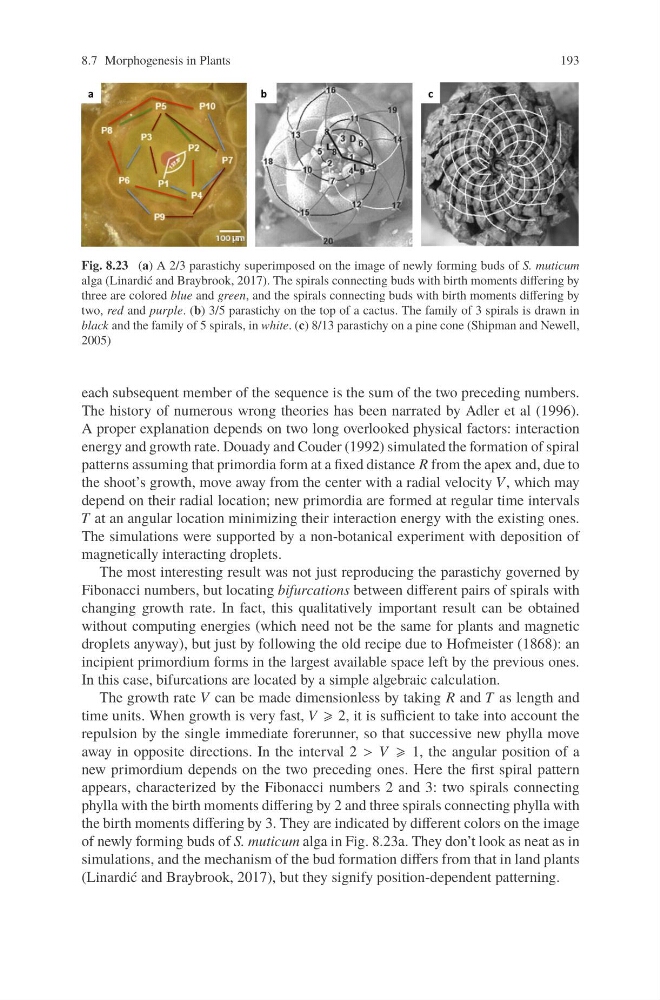
Fig. 8.23 (a) A 2/3 parastichy superimposed on the image of newly forming buds of S. muticum
alga (Linardić and Braybrook, 2017). The spirals connecting buds with birth moments differing by
three are colored blue and green, and the spirals connecting buds with birth moments differing by
two, red and purple. (b) 3/5 parastichy on the top of a cactus. The family of 3 spirals is drawn in
black and the family of 5 spirals, in white. (c) 8/13 parastichy on a pine cone (Shipman and Newell,
2005)
each subsequent member of the sequence is the sum of the two preceding numbers.
The history of numerous wrong theories has been narrated by Adler et al (1996).
A proper explanation depends on two long overlooked physical factors: interaction
energy and growth rate. Douady and Couder (1992) simulated the formation of spiral
patterns assuming that primordia form at a fixed distance R from the apex and, due to
the shoot’s growth, move away from the center with a radial velocity V, which may
depend on their radial location; new primordia are formed at regular time intervals
T at an angular location minimizing their interaction energy with the existing ones.
The simulations were supported by a non-botanical experiment with deposition of
magnetically interacting droplets.
The most interesting result was not just reproducing the parastichy governed by
Fibonacci numbers, but locating bifurcations between different pairs of spirals with
changing growth rate. In fact, this qualitatively important result can be obtained
without computing energies (which need not be the same for plants and magnetic
droplets anyway), but just by following the old recipe due to Hofmeister (1868): an
incipient primordium forms in the largest available space left by the previous ones.
In this case, bifurcations are located by a simple algebraic calculation.
The growth rate V can be made dimensionless by taking R and T as length and
time units. When growth is very fast, V 2, it is sufficient to take into account the
repulsion by the single immediate forerunner, so that successive new phylla move
away in opposite directions. In the interval 2 > V 1, the angular position of a
new primordium depends on the two preceding ones. Here the first spiral pattern
appears, characterized by the Fibonacci numbers 2 and 3: two spirals connecting
phylla with the birth moments differing by 2 and three spirals connecting phylla with
the birth moments differing by 3. They are indicated by different colors on the image
of newly forming buds of S. muticum alga in Fig. 8.23a. They don’t look as neat as in
simulations, and the mechanism of the bud formation differs from that in land plants
(Linardić and Braybrook, 2017), but they signify position-dependent patterning.
193
Fig. 8.23 (a) A 2/3 parastichy superimposed on the image of newly forming buds of S. muticum
alga (Linardić and Braybrook, 2017). The spirals connecting buds with birth moments differing by
three are colored blue and green, and the spirals connecting buds with birth moments differing by
two, red and purple. (b) 3/5 parastichy on the top of a cactus. The family of 3 spirals is drawn in
black and the family of 5 spirals, in white. (c) 8/13 parastichy on a pine cone (Shipman and Newell,
2005)
each subsequent member of the sequence is the sum of the two preceding numbers.
The history of numerous wrong theories has been narrated by Adler et al (1996).
A proper explanation depends on two long overlooked physical factors: interaction
energy and growth rate. Douady and Couder (1992) simulated the formation of spiral
patterns assuming that primordia form at a fixed distance R from the apex and, due to
the shoot’s growth, move away from the center with a radial velocity V, which may
depend on their radial location; new primordia are formed at regular time intervals
T at an angular location minimizing their interaction energy with the existing ones.
The simulations were supported by a non-botanical experiment with deposition of
magnetically interacting droplets.
The most interesting result was not just reproducing the parastichy governed by
Fibonacci numbers, but locating bifurcations between different pairs of spirals with
changing growth rate. In fact, this qualitatively important result can be obtained
without computing energies (which need not be the same for plants and magnetic
droplets anyway), but just by following the old recipe due to Hofmeister (1868): an
incipient primordium forms in the largest available space left by the previous ones.
In this case, bifurcations are located by a simple algebraic calculation.
The growth rate V can be made dimensionless by taking R and T as length and
time units. When growth is very fast, V 2, it is sufficient to take into account the
repulsion by the single immediate forerunner, so that successive new phylla move
away in opposite directions. In the interval 2 > V 1, the angular position of a
new primordium depends on the two preceding ones. Here the first spiral pattern
appears, characterized by the Fibonacci numbers 2 and 3: two spirals connecting
phylla with the birth moments differing by 2 and three spirals connecting phylla with
the birth moments differing by 3. They are indicated by different colors on the image
of newly forming buds of S. muticum alga in Fig. 8.23a. They don’t look as neat as in
simulations, and the mechanism of the bud formation differs from that in land plants
(Linardić and Braybrook, 2017), but they signify position-dependent patterning.