

192
8 Morphogenesis
reported antiphase correlations between neighbors, which are also reproduced in the
simulations (Fig. 8.21e). Sustained oscillations are possible even under conditions
when a single cell does not oscillate.
8.7 Morphogenesis in Plants
Plants, like animals, start their life with the merger of an egg and a sperm cell, and
meiosis. As an animal oocyte polarizes to form the antero-posterior axis (Sect. 8.2),
a plant seed polarizes to form its shoot and root – but plants are different. Their
morphogenesis never stops: phyllotaxis, the process of generating new phylla –
leaves, roots, stalks, florets – continues while they are alive. Throughout their lives,
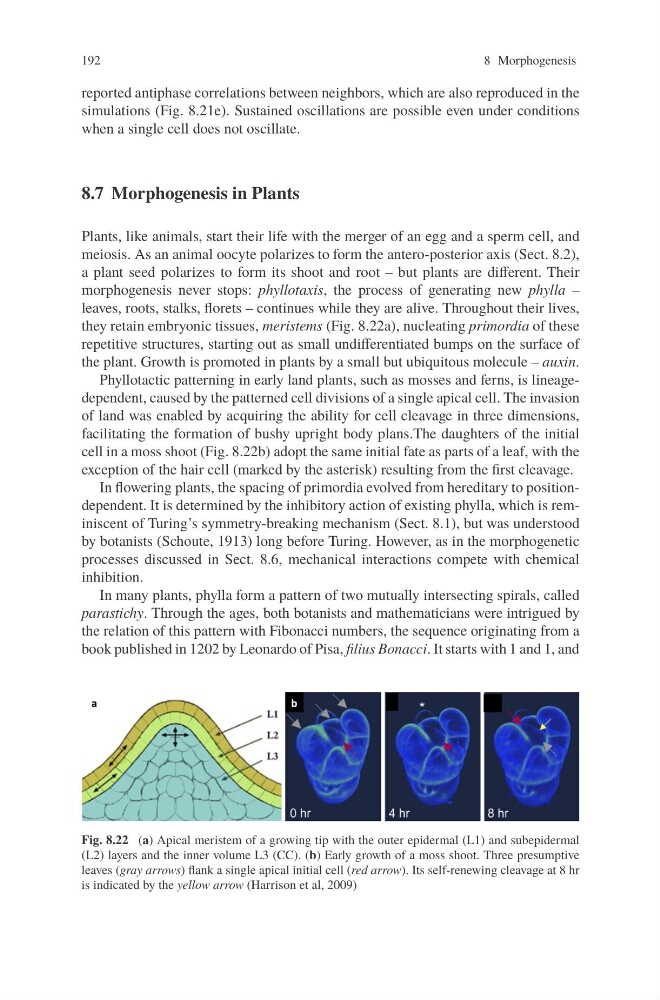
they retain embryonic tissues, meristems (Fig. 8.22a), nucleating primordia of these
repetitive structures, starting out as small undifferentiated bumps on the surface of
the plant. Growth is promoted in plants by a small but ubiquitous molecule – auxin.
Phyllotactic patterning in early land plants, such as mosses and ferns, is lineagedependent, caused by the patterned cell divisions of a single apical cell. The invasion
of land was enabled by acquiring the ability for cell cleavage in three dimensions,
facilitating the formation of bushy upright body plans.The daughters of the initial
cell in a moss shoot (Fig. 8.22b) adopt the same initial fate as parts of a leaf, with the
exception of the hair cell (marked by the asterisk) resulting from the first cleavage.
In flowering plants, the spacing of primordia evolved from hereditary to positiondependent. It is determined by the inhibitory action of existing phylla, which is reminiscent of Turing’s symmetry-breaking mechanism (Sect. 8.1), but was understood
by botanists (Schoute, 1913) long before Turing. However, as in the morphogenetic
processes discussed in Sect. 8.6, mechanical interactions compete with chemical
inhibition.
In many plants, phylla form a pattern of two mutually intersecting spirals, called
parastichy. Through the ages, both botanists and mathematicians were intrigued by
the relation of this pattern with Fibonacci numbers, the sequence originating from a
book published in 1202 by Leonardo of Pisa, filius Bonacci. It starts with 1 and 1, and
Fig. 8.22 (a) Apical meristem of a growing tip with the outer epidermal (L1) and subepidermal
(L2) layers and the inner volume L3 (CC). (b) Early growth of a moss shoot. Three presumptive
leaves (gray arrows) flank a single apical initial cell (red arrow). Its self-renewing cleavage at 8 hr
is indicated by the yellow arrow (Harrison et al, 2009)
8 Morphogenesis
reported antiphase correlations between neighbors, which are also reproduced in the
simulations (Fig. 8.21e). Sustained oscillations are possible even under conditions
when a single cell does not oscillate.
8.7 Morphogenesis in Plants
Plants, like animals, start their life with the merger of an egg and a sperm cell, and
meiosis. As an animal oocyte polarizes to form the antero-posterior axis (Sect. 8.2),
a plant seed polarizes to form its shoot and root – but plants are different. Their
morphogenesis never stops: phyllotaxis, the process of generating new phylla –
leaves, roots, stalks, florets – continues while they are alive. Throughout their lives,
they retain embryonic tissues, meristems (Fig. 8.22a), nucleating primordia of these
repetitive structures, starting out as small undifferentiated bumps on the surface of
the plant. Growth is promoted in plants by a small but ubiquitous molecule – auxin.
Phyllotactic patterning in early land plants, such as mosses and ferns, is lineagedependent, caused by the patterned cell divisions of a single apical cell. The invasion
of land was enabled by acquiring the ability for cell cleavage in three dimensions,
facilitating the formation of bushy upright body plans.The daughters of the initial
cell in a moss shoot (Fig. 8.22b) adopt the same initial fate as parts of a leaf, with the
exception of the hair cell (marked by the asterisk) resulting from the first cleavage.
In flowering plants, the spacing of primordia evolved from hereditary to positiondependent. It is determined by the inhibitory action of existing phylla, which is reminiscent of Turing’s symmetry-breaking mechanism (Sect. 8.1), but was understood
by botanists (Schoute, 1913) long before Turing. However, as in the morphogenetic
processes discussed in Sect. 8.6, mechanical interactions compete with chemical
inhibition.
In many plants, phylla form a pattern of two mutually intersecting spirals, called
parastichy. Through the ages, both botanists and mathematicians were intrigued by
the relation of this pattern with Fibonacci numbers, the sequence originating from a
book published in 1202 by Leonardo of Pisa, filius Bonacci. It starts with 1 and 1, and
Fig. 8.22 (a) Apical meristem of a growing tip with the outer epidermal (L1) and subepidermal
(L2) layers and the inner volume L3 (CC). (b) Early growth of a moss shoot. Three presumptive
leaves (gray arrows) flank a single apical initial cell (red arrow). Its self-renewing cleavage at 8 hr
is indicated by the yellow arrow (Harrison et al, 2009)