

186
8 Morphogenesis
Fig. 8.15 Simulation snapshots of the development
of a chemo-mechanical
instability
due
to
a
mechanochemical
feedback loop including basal
(top) and apical (bottom)
constriction. Darker shades
correspond to higher morphogen
concentrations
(Brinkmann et al, 2018)
more realistic that those in Fig. 7.32, but are no more closely related to actual
embryonic development than Turing’s original model.
A more persuasive piece of evidence is the emergence of a follicle pattern in the
avian skin (Shyer et al, 2017). Based on their observations, the authors questioned
the earlier notion of the guiding role of a molecular prepattern, which might be
established by the Turing instability, similar to Murray’s (1980) simulations of animal
fur patterns (Sect. 8.1). Instead, the mechanism turned out to be mechanical, which
should have pleased Murray, whose works on mechanically-induced morphogenetic
patterning coauthored with Oster featured in the citation list. In accordance with the
mechanical models, the follicle structure was proven to be initiated by compression
due to spontaneous mesenchymal cell aggregation within a skin layer. Moreover,
it turned out that cellular self-organization conveyed via mechanosensation directly
affects genetic expression.
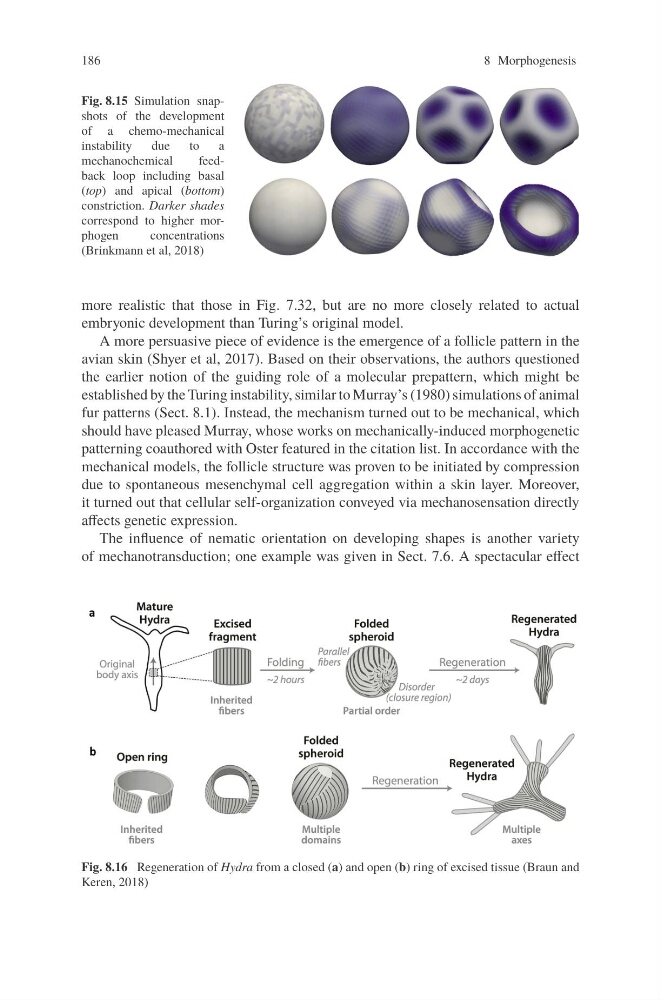
The influence of nematic orientation on developing shapes is another variety
of mechanotransduction; one example was given in Sect. 7.6. A spectacular effect
Fig. 8.16 Regeneration of Hydra from a closed (a) and open (b) ring of excised tissue (Braun and
Keren, 2018)
8 Morphogenesis
Fig. 8.15 Simulation snapshots of the development
of a chemo-mechanical
instability
due
to
a
mechanochemical
feedback loop including basal
(top) and apical (bottom)
constriction. Darker shades
correspond to higher morphogen
concentrations
(Brinkmann et al, 2018)
more realistic that those in Fig. 7.32, but are no more closely related to actual
embryonic development than Turing’s original model.
A more persuasive piece of evidence is the emergence of a follicle pattern in the
avian skin (Shyer et al, 2017). Based on their observations, the authors questioned
the earlier notion of the guiding role of a molecular prepattern, which might be
established by the Turing instability, similar to Murray’s (1980) simulations of animal
fur patterns (Sect. 8.1). Instead, the mechanism turned out to be mechanical, which
should have pleased Murray, whose works on mechanically-induced morphogenetic
patterning coauthored with Oster featured in the citation list. In accordance with the
mechanical models, the follicle structure was proven to be initiated by compression
due to spontaneous mesenchymal cell aggregation within a skin layer. Moreover,
it turned out that cellular self-organization conveyed via mechanosensation directly
affects genetic expression.
The influence of nematic orientation on developing shapes is another variety
of mechanotransduction; one example was given in Sect. 7.6. A spectacular effect
Fig. 8.16 Regeneration of Hydra from a closed (a) and open (b) ring of excised tissue (Braun and
Keren, 2018)