

8.6 Remodeling
187
of cell polarization was observed by Braun and Keren (2018) in experiments with
Hydra regeneration. This simple radially symmetric aquatic animal has been the
subject of numerous studies because of its ability to regenerate from almost any
piece of tissue; it owes its name to its resemblance to the mythical Lernaean Hydra,
which would regrow two heads for every head chopped off. Braun and Keren started
with a fragment of excised tissue that inherited a parallel array of actin fibers from
the parent Hydra. The tissue folded into a hollow spheroid, as shown in Fig. 8.16.
The parallel fiber array was partially retained in the spheroid but a perfect alignment
without defects is impossible on a spherical surface, so the area near the closure
region became disordered. When the initial fragment was a closed ring, the residual
actin fiber alignment in the folded spheroid induced order across the entire system
and led to the formation of a regenerated Hydra with a nematic order of fibers
throughout the animal, in the direction of the inherited fibers (Fig. 8.16a). But when
the regeneration started from an open ring, multiple domains appeared with different
fiber alignments, leading to the regeneration of a monstrous animal with multiple
axes (Fig. 8.16b).
8.6 Remodeling
The attention to early patterning of the embryo in Sect. 8.3 may appear excessive
in view of the diverse ultimate destinations of cells with different fates. Embryonic
tissue undergoes a topological transformation, so that cells in adjacent regions of the
fate map in Fig. 8.8b may end up in different germ layers of the final triploblastic
body plan. This extensive remodeling through collective cell migration has to be no
less precise than the primary plan. Whereas key genes and local cellular processes
in the development of model animals are quite well understood, very little is known
about global coordination of remodeling that would ensure the precision necessary
to deliver cells with designated fates to proper locations.
The routes of migration should follow genetically defined chemical cues. Cells
may navigate along pre-patterned chemoattractant gradients, but more likely they
are able to autonomously generate local gradients that travel with them, a strategy
allowing for self-determined directionality (Rørth, 2011). Remodeling, like any motion, involves mechanical forces, which are far less evident than the mere kinematics
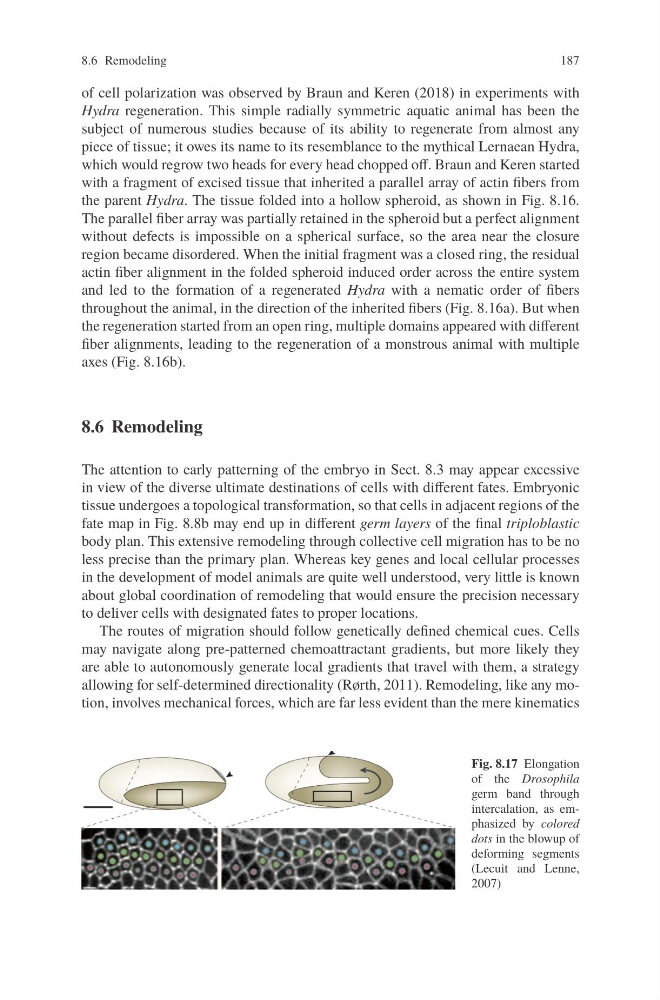
Fig. 8.17 Elongation
of the Drosophila
germ band through
intercalation, as emphasized by colored
dots in the blowup of
deforming segments
(Lecuit and Lenne,
2007)
187
of cell polarization was observed by Braun and Keren (2018) in experiments with
Hydra regeneration. This simple radially symmetric aquatic animal has been the
subject of numerous studies because of its ability to regenerate from almost any
piece of tissue; it owes its name to its resemblance to the mythical Lernaean Hydra,
which would regrow two heads for every head chopped off. Braun and Keren started
with a fragment of excised tissue that inherited a parallel array of actin fibers from
the parent Hydra. The tissue folded into a hollow spheroid, as shown in Fig. 8.16.
The parallel fiber array was partially retained in the spheroid but a perfect alignment
without defects is impossible on a spherical surface, so the area near the closure
region became disordered. When the initial fragment was a closed ring, the residual
actin fiber alignment in the folded spheroid induced order across the entire system
and led to the formation of a regenerated Hydra with a nematic order of fibers
throughout the animal, in the direction of the inherited fibers (Fig. 8.16a). But when
the regeneration started from an open ring, multiple domains appeared with different
fiber alignments, leading to the regeneration of a monstrous animal with multiple
axes (Fig. 8.16b).
8.6 Remodeling
The attention to early patterning of the embryo in Sect. 8.3 may appear excessive
in view of the diverse ultimate destinations of cells with different fates. Embryonic
tissue undergoes a topological transformation, so that cells in adjacent regions of the
fate map in Fig. 8.8b may end up in different germ layers of the final triploblastic
body plan. This extensive remodeling through collective cell migration has to be no
less precise than the primary plan. Whereas key genes and local cellular processes
in the development of model animals are quite well understood, very little is known
about global coordination of remodeling that would ensure the precision necessary
to deliver cells with designated fates to proper locations.
The routes of migration should follow genetically defined chemical cues. Cells
may navigate along pre-patterned chemoattractant gradients, but more likely they
are able to autonomously generate local gradients that travel with them, a strategy
allowing for self-determined directionality (Rørth, 2011). Remodeling, like any motion, involves mechanical forces, which are far less evident than the mere kinematics
Fig. 8.17 Elongation
of the Drosophila
germ band through
intercalation, as emphasized by colored
dots in the blowup of
deforming segments
(Lecuit and Lenne,
2007)