

7.8 Plant Tissues
167
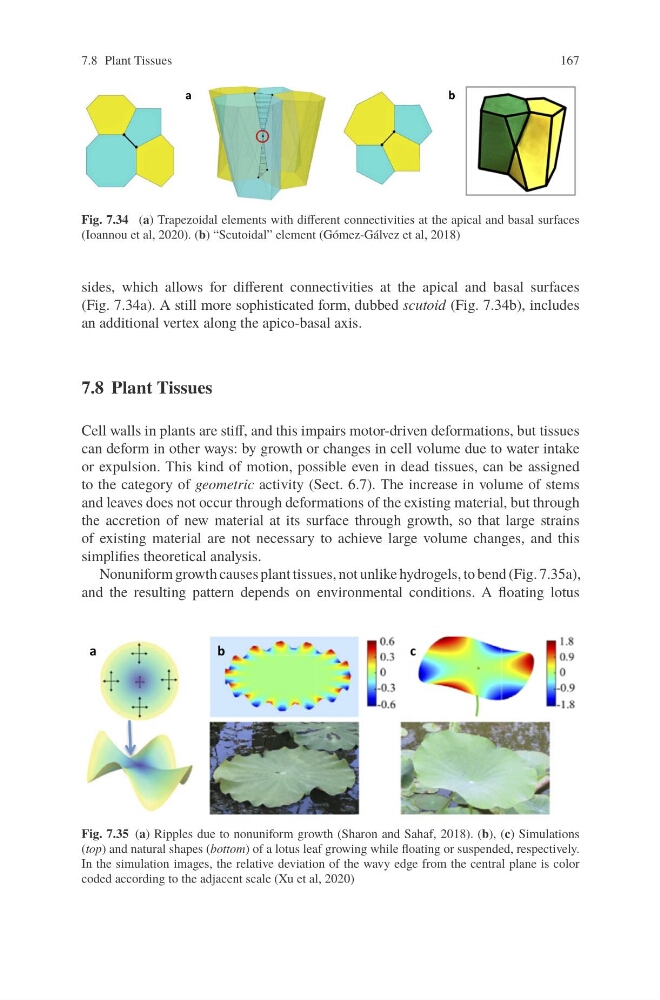
Fig. 7.34 (a) Trapezoidal elements with different connectivities at the apical and basal surfaces
(Ioannou et al, 2020). (b) “Scutoidal” element (Gómez-Gálvez et al, 2018)
sides, which allows for different connectivities at the apical and basal surfaces
(Fig. 7.34a). A still more sophisticated form, dubbed scutoid (Fig. 7.34b), includes
an additional vertex along the apico-basal axis.
7.8 Plant Tissues
Cell walls in plants are stiff, and this impairs motor-driven deformations, but tissues
can deform in other ways: by growth or changes in cell volume due to water intake
or expulsion. This kind of motion, possible even in dead tissues, can be assigned
to the category of geometric activity (Sect. 6.7). The increase in volume of stems
and leaves does not occur through deformations of the existing material, but through
the accretion of new material at its surface through growth, so that large strains
of existing material are not necessary to achieve large volume changes, and this
simplifies theoretical analysis.
Nonuniform growth causes plant tissues, not unlike hydrogels, to bend (Fig. 7.35a),
and the resulting pattern depends on environmental conditions. A floating lotus
Fig. 7.35 (a) Ripples due to nonuniform growth (Sharon and Sahaf, 2018). (b), (c) Simulations
(top) and natural shapes (bottom) of a lotus leaf growing while floating or suspended, respectively.
In the simulation images, the relative deviation of the wavy edge from the central plane is color
coded according to the adjacent scale (Xu et al, 2020)
167
Fig. 7.34 (a) Trapezoidal elements with different connectivities at the apical and basal surfaces
(Ioannou et al, 2020). (b) “Scutoidal” element (Gómez-Gálvez et al, 2018)
sides, which allows for different connectivities at the apical and basal surfaces
(Fig. 7.34a). A still more sophisticated form, dubbed scutoid (Fig. 7.34b), includes
an additional vertex along the apico-basal axis.
7.8 Plant Tissues
Cell walls in plants are stiff, and this impairs motor-driven deformations, but tissues
can deform in other ways: by growth or changes in cell volume due to water intake
or expulsion. This kind of motion, possible even in dead tissues, can be assigned
to the category of geometric activity (Sect. 6.7). The increase in volume of stems
and leaves does not occur through deformations of the existing material, but through
the accretion of new material at its surface through growth, so that large strains
of existing material are not necessary to achieve large volume changes, and this
simplifies theoretical analysis.
Nonuniform growth causes plant tissues, not unlike hydrogels, to bend (Fig. 7.35a),
and the resulting pattern depends on environmental conditions. A floating lotus
Fig. 7.35 (a) Ripples due to nonuniform growth (Sharon and Sahaf, 2018). (b), (c) Simulations
(top) and natural shapes (bottom) of a lotus leaf growing while floating or suspended, respectively.
In the simulation images, the relative deviation of the wavy edge from the central plane is color
coded according to the adjacent scale (Xu et al, 2020)