

168
7 Live Tissues
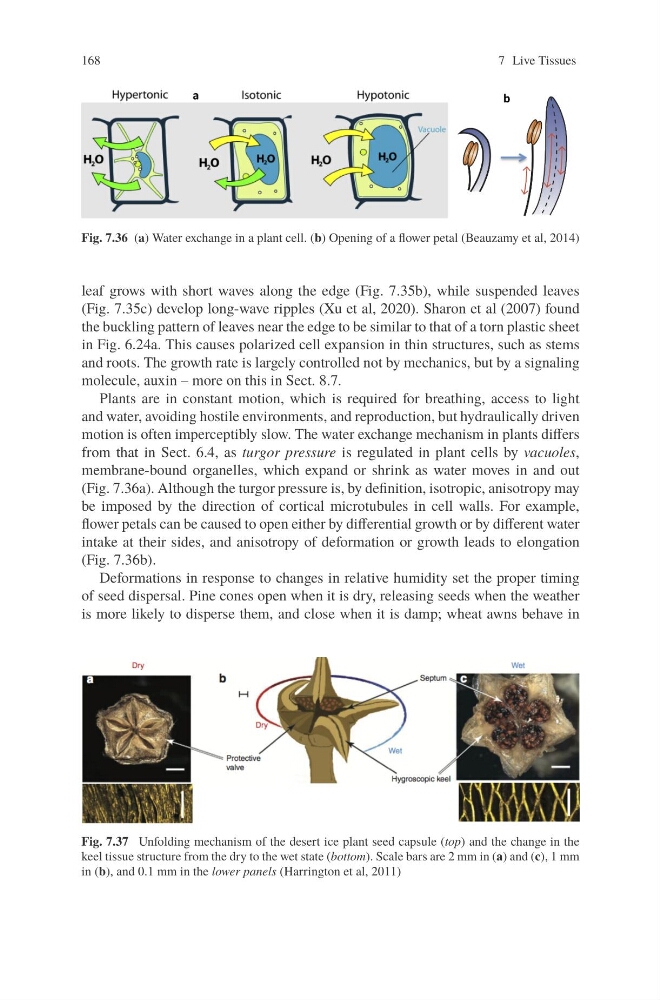
Fig. 7.36 (a) Water exchange in a plant cell. (b) Opening of a flower petal (Beauzamy et al, 2014)
leaf grows with short waves along the edge (Fig. 7.35b), while suspended leaves
(Fig. 7.35c) develop long-wave ripples (Xu et al, 2020). Sharon et al (2007) found
the buckling pattern of leaves near the edge to be similar to that of a torn plastic sheet
in Fig. 6.24a. This causes polarized cell expansion in thin structures, such as stems
and roots. The growth rate is largely controlled not by mechanics, but by a signaling
molecule, auxin – more on this in Sect. 8.7.
Plants are in constant motion, which is required for breathing, access to light
and water, avoiding hostile environments, and reproduction, but hydraulically driven
motion is often imperceptibly slow. The water exchange mechanism in plants differs
from that in Sect. 6.4, as turgor pressure is regulated in plant cells by vacuoles,
membrane-bound organelles, which expand or shrink as water moves in and out
(Fig. 7.36a). Although the turgor pressure is, by definition, isotropic, anisotropy may
be imposed by the direction of cortical microtubules in cell walls. For example,
flower petals can be caused to open either by differential growth or by different water
intake at their sides, and anisotropy of deformation or growth leads to elongation
(Fig. 7.36b).
Deformations in response to changes in relative humidity set the proper timing
of seed dispersal. Pine cones open when it is dry, releasing seeds when the weather
is more likely to disperse them, and close when it is damp; wheat awns behave in
Fig. 7.37 Unfolding mechanism of the desert ice plant seed capsule (top) and the change in the
keel tissue structure from the dry to the wet state (bottom). Scale bars are 2 mm in (a) and (c), 1 mm
in (b), and 0.1 mm in the lower panels (Harrington et al, 2011)
7 Live Tissues
Fig. 7.36 (a) Water exchange in a plant cell. (b) Opening of a flower petal (Beauzamy et al, 2014)
leaf grows with short waves along the edge (Fig. 7.35b), while suspended leaves
(Fig. 7.35c) develop long-wave ripples (Xu et al, 2020). Sharon et al (2007) found
the buckling pattern of leaves near the edge to be similar to that of a torn plastic sheet
in Fig. 6.24a. This causes polarized cell expansion in thin structures, such as stems
and roots. The growth rate is largely controlled not by mechanics, but by a signaling
molecule, auxin – more on this in Sect. 8.7.
Plants are in constant motion, which is required for breathing, access to light
and water, avoiding hostile environments, and reproduction, but hydraulically driven
motion is often imperceptibly slow. The water exchange mechanism in plants differs
from that in Sect. 6.4, as turgor pressure is regulated in plant cells by vacuoles,
membrane-bound organelles, which expand or shrink as water moves in and out
(Fig. 7.36a). Although the turgor pressure is, by definition, isotropic, anisotropy may
be imposed by the direction of cortical microtubules in cell walls. For example,
flower petals can be caused to open either by differential growth or by different water
intake at their sides, and anisotropy of deformation or growth leads to elongation
(Fig. 7.36b).
Deformations in response to changes in relative humidity set the proper timing
of seed dispersal. Pine cones open when it is dry, releasing seeds when the weather
is more likely to disperse them, and close when it is damp; wheat awns behave in
Fig. 7.37 Unfolding mechanism of the desert ice plant seed capsule (top) and the change in the
keel tissue structure from the dry to the wet state (bottom). Scale bars are 2 mm in (a) and (c), 1 mm
in (b), and 0.1 mm in the lower panels (Harrington et al, 2011)