

1.3 The Flock as a Continuum
9
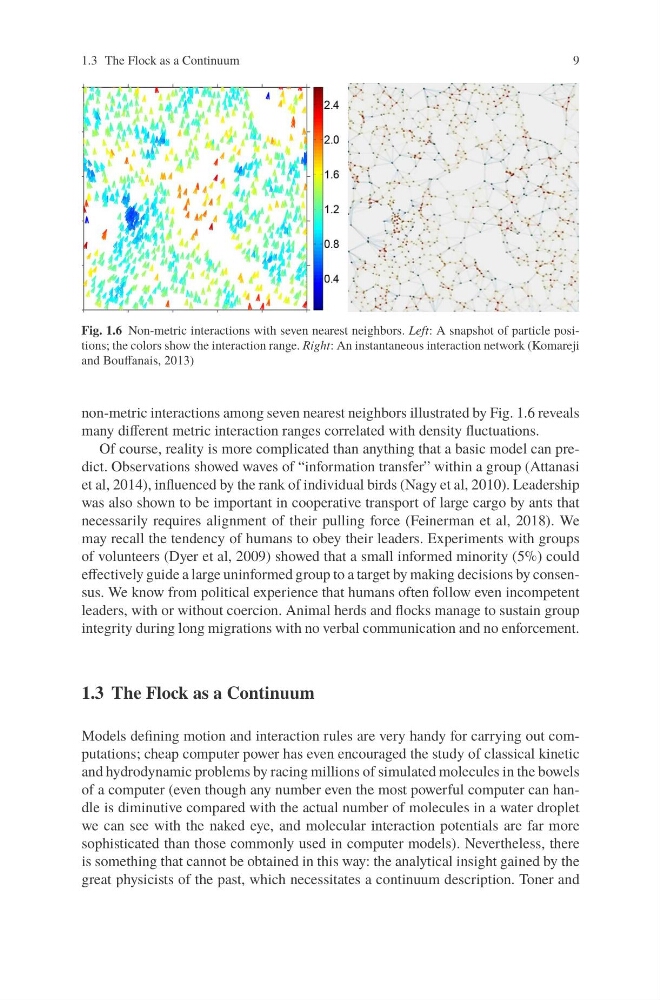
Fig. 1.6 Non-metric interactions with seven nearest neighbors. Left: A snapshot of particle positions; the colors show the interaction range. Right: An instantaneous interaction network (Komareji
and Bouffanais, 2013)
non-metric interactions among seven nearest neighbors illustrated by Fig. 1.6 reveals
many different metric interaction ranges correlated with density fluctuations.
Of course, reality is more complicated than anything that a basic model can predict. Observations showed waves of “information transfer” within a group (Attanasi
et al, 2014), influenced by the rank of individual birds (Nagy et al, 2010). Leadership
was also shown to be important in cooperative transport of large cargo by ants that
necessarily requires alignment of their pulling force (Feinerman et al, 2018). We
may recall the tendency of humans to obey their leaders. Experiments with groups
of volunteers (Dyer et al, 2009) showed that a small informed minority (5%) could
effectively guide a large uninformed group to a target by making decisions by consensus. We know from political experience that humans often follow even incompetent
leaders, with or without coercion. Animal herds and flocks manage to sustain group
integrity during long migrations with no verbal communication and no enforcement.
1.3 The Flock as a Continuum
Models defining motion and interaction rules are very handy for carrying out computations; cheap computer power has even encouraged the study of classical kinetic
and hydrodynamic problems by racing millions of simulated molecules in the bowels
of a computer (even though any number even the most powerful computer can handle is diminutive compared with the actual number of molecules in a water droplet
we can see with the naked eye, and molecular interaction potentials are far more
sophisticated than those commonly used in computer models). Nevertheless, there
is something that cannot be obtained in this way: the analytical insight gained by the
great physicists of the past, which necessitates a continuum description. Toner and
9
Fig. 1.6 Non-metric interactions with seven nearest neighbors. Left: A snapshot of particle positions; the colors show the interaction range. Right: An instantaneous interaction network (Komareji
and Bouffanais, 2013)
non-metric interactions among seven nearest neighbors illustrated by Fig. 1.6 reveals
many different metric interaction ranges correlated with density fluctuations.
Of course, reality is more complicated than anything that a basic model can predict. Observations showed waves of “information transfer” within a group (Attanasi
et al, 2014), influenced by the rank of individual birds (Nagy et al, 2010). Leadership
was also shown to be important in cooperative transport of large cargo by ants that
necessarily requires alignment of their pulling force (Feinerman et al, 2018). We
may recall the tendency of humans to obey their leaders. Experiments with groups
of volunteers (Dyer et al, 2009) showed that a small informed minority (5%) could
effectively guide a large uninformed group to a target by making decisions by consensus. We know from political experience that humans often follow even incompetent
leaders, with or without coercion. Animal herds and flocks manage to sustain group
integrity during long migrations with no verbal communication and no enforcement.
1.3 The Flock as a Continuum
Models defining motion and interaction rules are very handy for carrying out computations; cheap computer power has even encouraged the study of classical kinetic
and hydrodynamic problems by racing millions of simulated molecules in the bowels
of a computer (even though any number even the most powerful computer can handle is diminutive compared with the actual number of molecules in a water droplet
we can see with the naked eye, and molecular interaction potentials are far more
sophisticated than those commonly used in computer models). Nevertheless, there
is something that cannot be obtained in this way: the analytical insight gained by the
great physicists of the past, which necessitates a continuum description. Toner and