

10
1 Polar Flocks
Tu (1995) undertook to translate the Vicsek model (still fresh from the press at the
time) into the language of the continuum.
It is straightforward to write down hydrodynamic equations of motion with
anisotropic viscosity and added noise in such a way as to define the local velocity and density of a set of particles. The task is simplified by a special feature of
the Vicsek model: it identifies orientation with velocity. This eliminates a difficult
task of combining hydrodynamic equations with “elastic" equations that take care
of keeping the alignment intact (more on this in Sect. 2.1). The continuum model
immediately suggests a heuristic argument for the stabilizing effect of motion. If the
equations are rewritten in the coordinate frame moving with the average velocity of
the “flock” (still unknown), it becomes clear that neighbors of a particular “bird”
will be different at different moments of time, depending on inhomogeneities in the
velocity field. Therefore originally distant “birds” may interact at a later time, which
effectively extends the interaction range and stabilizes the ordered phase.
Yet, there are inconvenient facts, which make the entire undertaking questionable. Active fluids have no equation of state, and pressure cannot be defined in a
constructive way, except within a narrow class of models (Solon, Fily, et al, 2015).
One can compress an active fluid, increasing its average density. In a common fluid,
the required work is unequivocally determined by pressure, but in an active medium
it depends on the way particles interact with the confining walls. Different forces and
hence different amounts of work are needed to reach the same final density when
compressing with a hard wall or with a soft enclosure, into which particles bump
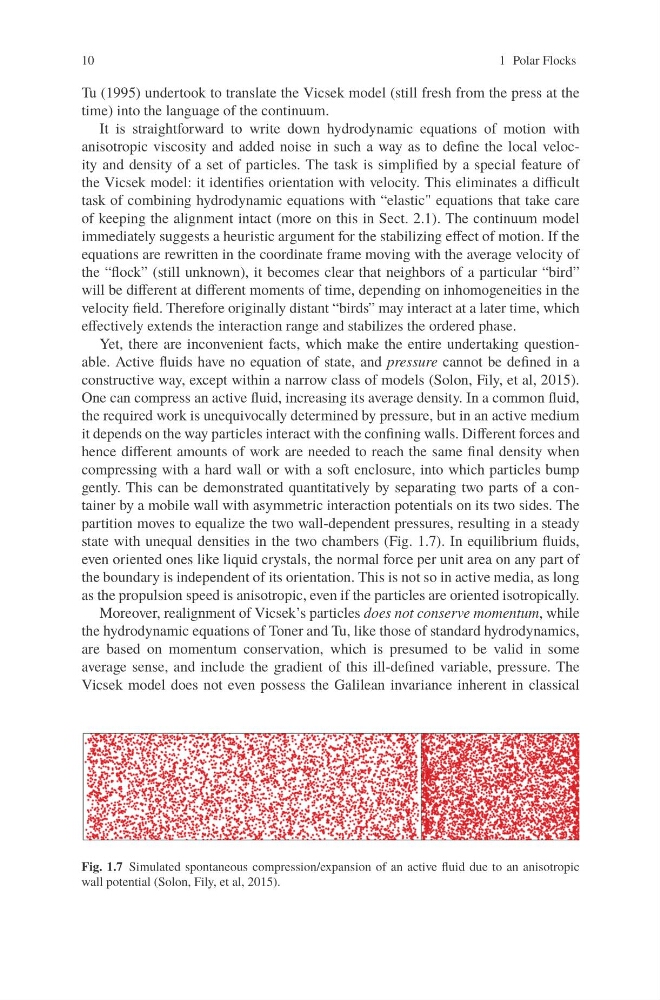
gently. This can be demonstrated quantitatively by separating two parts of a container by a mobile wall with asymmetric interaction potentials on its two sides. The
partition moves to equalize the two wall-dependent pressures, resulting in a steady
state with unequal densities in the two chambers (Fig. 1.7). In equilibrium fluids,
even oriented ones like liquid crystals, the normal force per unit area on any part of
the boundary is independent of its orientation. This is not so in active media, as long
as the propulsion speed is anisotropic, even if the particles are oriented isotropically.
Moreover, realignment of Vicsek’s particles does not conserve momentum, while
the hydrodynamic equations of Toner and Tu, like those of standard hydrodynamics,
are based on momentum conservation, which is presumed to be valid in some
average sense, and include the gradient of this ill-defined variable, pressure. The
Vicsek model does not even possess the Galilean invariance inherent in classical
Fig. 1.7 Simulated spontaneous compression/expansion of an active fluid due to an anisotropic
wall potential (Solon, Fily, et al, 2015).
1 Polar Flocks
Tu (1995) undertook to translate the Vicsek model (still fresh from the press at the
time) into the language of the continuum.
It is straightforward to write down hydrodynamic equations of motion with
anisotropic viscosity and added noise in such a way as to define the local velocity and density of a set of particles. The task is simplified by a special feature of
the Vicsek model: it identifies orientation with velocity. This eliminates a difficult
task of combining hydrodynamic equations with “elastic" equations that take care
of keeping the alignment intact (more on this in Sect. 2.1). The continuum model
immediately suggests a heuristic argument for the stabilizing effect of motion. If the
equations are rewritten in the coordinate frame moving with the average velocity of
the “flock” (still unknown), it becomes clear that neighbors of a particular “bird”
will be different at different moments of time, depending on inhomogeneities in the
velocity field. Therefore originally distant “birds” may interact at a later time, which
effectively extends the interaction range and stabilizes the ordered phase.
Yet, there are inconvenient facts, which make the entire undertaking questionable. Active fluids have no equation of state, and pressure cannot be defined in a
constructive way, except within a narrow class of models (Solon, Fily, et al, 2015).
One can compress an active fluid, increasing its average density. In a common fluid,
the required work is unequivocally determined by pressure, but in an active medium
it depends on the way particles interact with the confining walls. Different forces and
hence different amounts of work are needed to reach the same final density when
compressing with a hard wall or with a soft enclosure, into which particles bump
gently. This can be demonstrated quantitatively by separating two parts of a container by a mobile wall with asymmetric interaction potentials on its two sides. The
partition moves to equalize the two wall-dependent pressures, resulting in a steady
state with unequal densities in the two chambers (Fig. 1.7). In equilibrium fluids,
even oriented ones like liquid crystals, the normal force per unit area on any part of
the boundary is independent of its orientation. This is not so in active media, as long
as the propulsion speed is anisotropic, even if the particles are oriented isotropically.
Moreover, realignment of Vicsek’s particles does not conserve momentum, while
the hydrodynamic equations of Toner and Tu, like those of standard hydrodynamics,
are based on momentum conservation, which is presumed to be valid in some
average sense, and include the gradient of this ill-defined variable, pressure. The
Vicsek model does not even possess the Galilean invariance inherent in classical
Fig. 1.7 Simulated spontaneous compression/expansion of an active fluid due to an anisotropic
wall potential (Solon, Fily, et al, 2015).