

8
1 Polar Flocks
macroscopic scale. The number of bands increases with increasing density at constant noise (Solon, Chaté, and Tailleur, 2015).
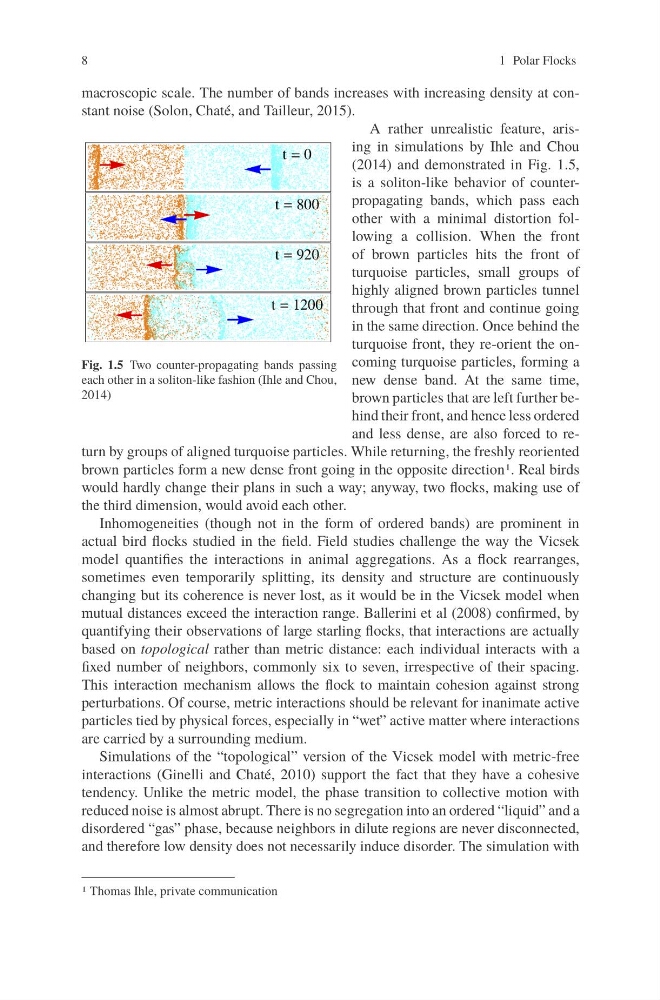
Fig. 1.5 Two counter-propagating bands passing
each other in a soliton-like fashion (Ihle and Chou,
2014)
A rather unrealistic feature, arising in simulations by Ihle and Chou
(2014) and demonstrated in Fig. 1.5,
is a soliton-like behavior of counterpropagating bands, which pass each
other with a minimal distortion following a collision. When the front
of brown particles hits the front of
turquoise particles, small groups of
highly aligned brown particles tunnel
through that front and continue going
in the same direction. Once behind the
turquoise front, they re-orient the oncoming turquoise particles, forming a
new dense band. At the same time,
brown particles that are left further behind their front, and hence less ordered
and less dense, are also forced to return by groups of aligned turquoise particles. While returning, the freshly reoriented
brown particles form a new dense front going in the opposite direction1. Real birds
would hardly change their plans in such a way; anyway, two flocks, making use of
the third dimension, would avoid each other.
Inhomogeneities (though not in the form of ordered bands) are prominent in
actual bird flocks studied in the field. Field studies challenge the way the Vicsek
model quantifies the interactions in animal aggregations. As a flock rearranges,
sometimes even temporarily splitting, its density and structure are continuously
changing but its coherence is never lost, as it would be in the Vicsek model when
mutual distances exceed the interaction range. Ballerini et al (2008) confirmed, by
quantifying their observations of large starling flocks, that interactions are actually
based on topological rather than metric distance: each individual interacts with a
fixed number of neighbors, commonly six to seven, irrespective of their spacing.
This interaction mechanism allows the flock to maintain cohesion against strong
perturbations. Of course, metric interactions should be relevant for inanimate active
particles tied by physical forces, especially in “wet” active matter where interactions
are carried by a surrounding medium.
Simulations of the “topological” version of the Vicsek model with metric-free
interactions (Ginelli and Chaté, 2010) support the fact that they have a cohesive
tendency. Unlike the metric model, the phase transition to collective motion with
reduced noise is almost abrupt. There is no segregation into an ordered “liquid” and a
disordered “gas” phase, because neighbors in dilute regions are never disconnected,
and therefore low density does not necessarily induce disorder. The simulation with
1 Thomas Ihle, private communication
1 Polar Flocks
macroscopic scale. The number of bands increases with increasing density at constant noise (Solon, Chaté, and Tailleur, 2015).
Fig. 1.5 Two counter-propagating bands passing
each other in a soliton-like fashion (Ihle and Chou,
2014)
A rather unrealistic feature, arising in simulations by Ihle and Chou
(2014) and demonstrated in Fig. 1.5,
is a soliton-like behavior of counterpropagating bands, which pass each
other with a minimal distortion following a collision. When the front
of brown particles hits the front of
turquoise particles, small groups of
highly aligned brown particles tunnel
through that front and continue going
in the same direction. Once behind the
turquoise front, they re-orient the oncoming turquoise particles, forming a
new dense band. At the same time,
brown particles that are left further behind their front, and hence less ordered
and less dense, are also forced to return by groups of aligned turquoise particles. While returning, the freshly reoriented
brown particles form a new dense front going in the opposite direction1. Real birds
would hardly change their plans in such a way; anyway, two flocks, making use of
the third dimension, would avoid each other.
Inhomogeneities (though not in the form of ordered bands) are prominent in
actual bird flocks studied in the field. Field studies challenge the way the Vicsek
model quantifies the interactions in animal aggregations. As a flock rearranges,
sometimes even temporarily splitting, its density and structure are continuously
changing but its coherence is never lost, as it would be in the Vicsek model when
mutual distances exceed the interaction range. Ballerini et al (2008) confirmed, by
quantifying their observations of large starling flocks, that interactions are actually
based on topological rather than metric distance: each individual interacts with a
fixed number of neighbors, commonly six to seven, irrespective of their spacing.
This interaction mechanism allows the flock to maintain cohesion against strong
perturbations. Of course, metric interactions should be relevant for inanimate active
particles tied by physical forces, especially in “wet” active matter where interactions
are carried by a surrounding medium.
Simulations of the “topological” version of the Vicsek model with metric-free
interactions (Ginelli and Chaté, 2010) support the fact that they have a cohesive
tendency. Unlike the metric model, the phase transition to collective motion with
reduced noise is almost abrupt. There is no segregation into an ordered “liquid” and a
disordered “gas” phase, because neighbors in dilute regions are never disconnected,
and therefore low density does not necessarily induce disorder. The simulation with
1 Thomas Ihle, private communication