

1.2 Phenomenology of Vicsek’s model
7
or ordered locally but disordered elsewhere (Fig. 1.3); the ordering can also be
intermittent when particles align for a while and then succumb to noise. Even when
the ordered state persists, the interaction network is permanently rearranged due to
the active motion of individuals, continuously changing their neighbors.
density
noise intensity
Fig. 1.3 Qualitative phase diagram showing the
dependence of ordering on the flock density and
the strength of noise (Ginelli, 2016)
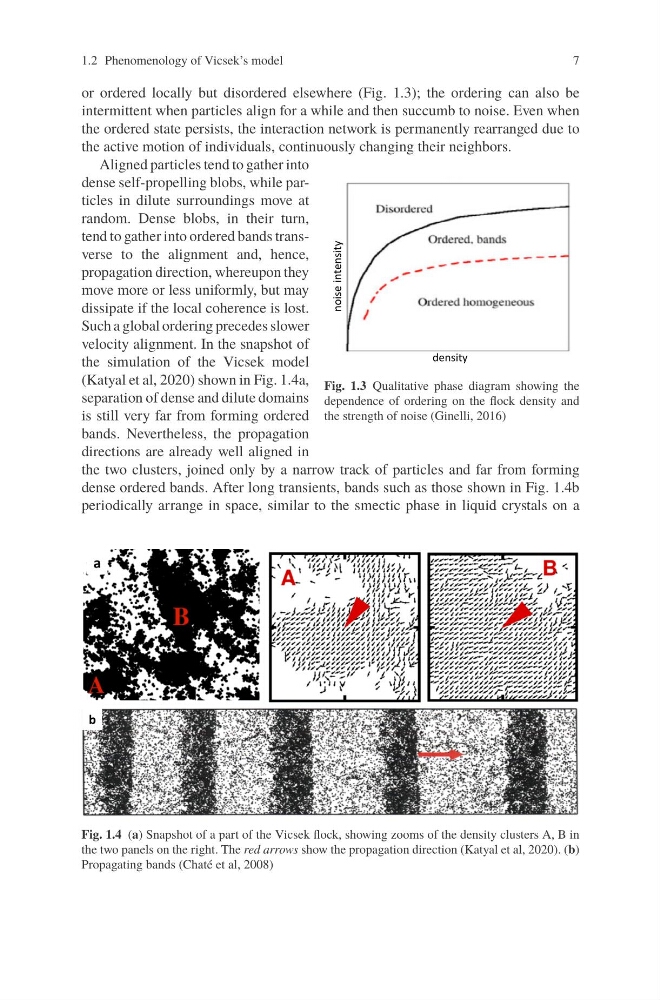
Aligned particles tend to gather into
dense self-propelling blobs, while particles in dilute surroundings move at
random. Dense blobs, in their turn,
tend to gather into ordered bands transverse to the alignment and, hence,
propagation direction, whereupon they
move more or less uniformly, but may
dissipate if the local coherence is lost.
Such a global ordering precedes slower
velocity alignment. In the snapshot of
the simulation of the Vicsek model
(Katyal et al, 2020) shown in Fig. 1.4a,
separation of dense and dilute domains
is still very far from forming ordered
bands. Nevertheless, the propagation
directions are already well aligned in
the two clusters, joined only by a narrow track of particles and far from forming
dense ordered bands. After long transients, bands such as those shown in Fig. 1.4b
periodically arrange in space, similar to the smectic phase in liquid crystals on a
Fig. 1.4 (a) Snapshot of a part of the Vicsek flock, showing zooms of the density clusters A, B in
the two panels on the right. The red arrows show the propagation direction (Katyal et al, 2020). (b)
Propagating bands (Chaté et al, 2008)
7
or ordered locally but disordered elsewhere (Fig. 1.3); the ordering can also be
intermittent when particles align for a while and then succumb to noise. Even when
the ordered state persists, the interaction network is permanently rearranged due to
the active motion of individuals, continuously changing their neighbors.
density
noise intensity
Fig. 1.3 Qualitative phase diagram showing the
dependence of ordering on the flock density and
the strength of noise (Ginelli, 2016)
Aligned particles tend to gather into
dense self-propelling blobs, while particles in dilute surroundings move at
random. Dense blobs, in their turn,
tend to gather into ordered bands transverse to the alignment and, hence,
propagation direction, whereupon they
move more or less uniformly, but may
dissipate if the local coherence is lost.
Such a global ordering precedes slower
velocity alignment. In the snapshot of
the simulation of the Vicsek model
(Katyal et al, 2020) shown in Fig. 1.4a,
separation of dense and dilute domains
is still very far from forming ordered
bands. Nevertheless, the propagation
directions are already well aligned in
the two clusters, joined only by a narrow track of particles and far from forming
dense ordered bands. After long transients, bands such as those shown in Fig. 1.4b
periodically arrange in space, similar to the smectic phase in liquid crystals on a
Fig. 1.4 (a) Snapshot of a part of the Vicsek flock, showing zooms of the density clusters A, B in
the two panels on the right. The red arrows show the propagation direction (Katyal et al, 2020). (b)
Propagating bands (Chaté et al, 2008)