

6
1 Polar Flocks
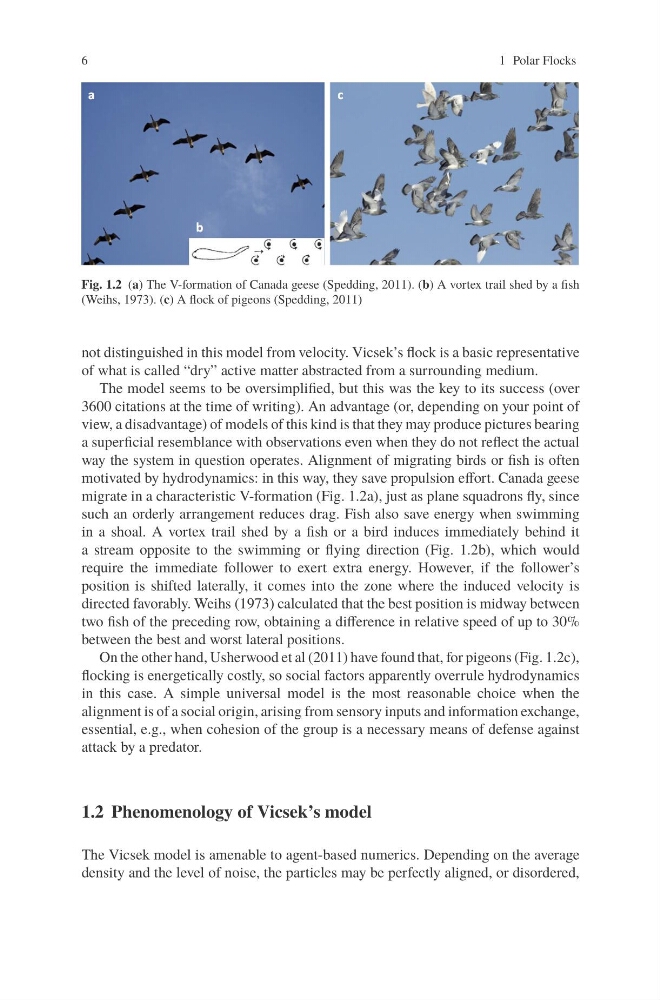
Fig. 1.2 (a) The V-formation of Canada geese (Spedding, 2011). (b) A vortex trail shed by a fish
(Weihs, 1973). (c) A flock of pigeons (Spedding, 2011)
not distinguished in this model from velocity. Vicsek’s flock is a basic representative
of what is called “dry” active matter abstracted from a surrounding medium.
The model seems to be oversimplified, but this was the key to its success (over
3600 citations at the time of writing). An advantage (or, depending on your point of
view, a disadvantage) of models of this kind is that they may produce pictures bearing
a superficial resemblance with observations even when they do not reflect the actual
way the system in question operates. Alignment of migrating birds or fish is often
motivated by hydrodynamics: in this way, they save propulsion effort. Canada geese
migrate in a characteristic V-formation (Fig. 1.2a), just as plane squadrons fly, since
such an orderly arrangement reduces drag. Fish also save energy when swimming
in a shoal. A vortex trail shed by a fish or a bird induces immediately behind it
a stream opposite to the swimming or flying direction (Fig. 1.2b), which would
require the immediate follower to exert extra energy. However, if the follower’s
position is shifted laterally, it comes into the zone where the induced velocity is
directed favorably. Weihs (1973) calculated that the best position is midway between
two fish of the preceding row, obtaining a difference in relative speed of up to 30%
between the best and worst lateral positions.
On the other hand, Usherwood et al (2011) have found that, for pigeons (Fig. 1.2c),
flocking is energetically costly, so social factors apparently overrule hydrodynamics
in this case. A simple universal model is the most reasonable choice when the
alignment is of a social origin, arising from sensory inputs and information exchange,
essential, e.g., when cohesion of the group is a necessary means of defense against
attack by a predator.
1.2 Phenomenology of Vicsek’s model
The Vicsek model is amenable to agent-based numerics. Depending on the average
density and the level of noise, the particles may be perfectly aligned, or disordered,
1 Polar Flocks
Fig. 1.2 (a) The V-formation of Canada geese (Spedding, 2011). (b) A vortex trail shed by a fish
(Weihs, 1973). (c) A flock of pigeons (Spedding, 2011)
not distinguished in this model from velocity. Vicsek’s flock is a basic representative
of what is called “dry” active matter abstracted from a surrounding medium.
The model seems to be oversimplified, but this was the key to its success (over
3600 citations at the time of writing). An advantage (or, depending on your point of
view, a disadvantage) of models of this kind is that they may produce pictures bearing
a superficial resemblance with observations even when they do not reflect the actual
way the system in question operates. Alignment of migrating birds or fish is often
motivated by hydrodynamics: in this way, they save propulsion effort. Canada geese
migrate in a characteristic V-formation (Fig. 1.2a), just as plane squadrons fly, since
such an orderly arrangement reduces drag. Fish also save energy when swimming
in a shoal. A vortex trail shed by a fish or a bird induces immediately behind it
a stream opposite to the swimming or flying direction (Fig. 1.2b), which would
require the immediate follower to exert extra energy. However, if the follower’s
position is shifted laterally, it comes into the zone where the induced velocity is
directed favorably. Weihs (1973) calculated that the best position is midway between
two fish of the preceding row, obtaining a difference in relative speed of up to 30%
between the best and worst lateral positions.
On the other hand, Usherwood et al (2011) have found that, for pigeons (Fig. 1.2c),
flocking is energetically costly, so social factors apparently overrule hydrodynamics
in this case. A simple universal model is the most reasonable choice when the
alignment is of a social origin, arising from sensory inputs and information exchange,
essential, e.g., when cohesion of the group is a necessary means of defense against
attack by a predator.
1.2 Phenomenology of Vicsek’s model
The Vicsek model is amenable to agent-based numerics. Depending on the average
density and the level of noise, the particles may be perfectly aligned, or disordered,