

Chapter 1
Polar Flocks
1.1 Birds of a Feather Fly Together
The most important feature of active “particles” (whatever their nature) is collective
motion. It may arise surprisingly easily, without any leader, or external field, or
geometrical constraints. The words “how birds fly together” appear in the title of a
paper written by physicists (Toner and Tu, 1995), not by ornithologists. But what
is a physicist’s bird? It is a vector moving in the direction shown by its arrow.
This is reasonable: animals move looking ahead, in the direction of their body axis.
Animals are social, and capable of comprehending their surroundings and adjusting
their behavior accordingly, thereby initiating collective motion.
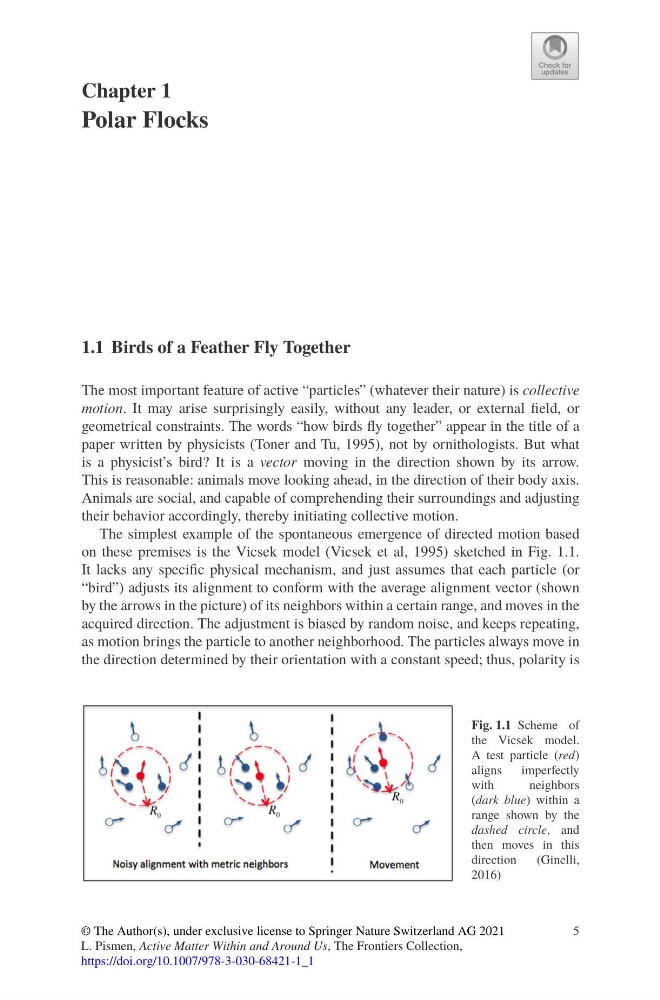
The simplest example of the spontaneous emergence of directed motion based
on these premises is the Vicsek model (Vicsek et al, 1995) sketched in Fig. 1.1.
It lacks any specific physical mechanism, and just assumes that each particle (or
“bird”) adjusts its alignment to conform with the average alignment vector (shown
by the arrows in the picture) of its neighbors within a certain range, and moves in the
acquired direction. The adjustment is biased by random noise, and keeps repeating,
as motion brings the particle to another neighborhood. The particles always move in
the direction determined by their orientation with a constant speed; thus, polarity is
Fig. 1.1 Scheme of
the Vicsek model.
A test particle (red)
aligns
imperfectly
with
neighbors
(dark blue) within a
range shown by the
dashed circle, and
then moves in this
direction
(Ginelli,
2016)
5
L. Pismen, Active Matter Within and Around Us, The Frontiers Collection,
https://doi.org/10.1007/978-3-030-68421-1_1
© The Author(s), under exclusive license to Springer Nature Switzerland AG 2021
Polar Flocks
1.1 Birds of a Feather Fly Together
The most important feature of active “particles” (whatever their nature) is collective
motion. It may arise surprisingly easily, without any leader, or external field, or
geometrical constraints. The words “how birds fly together” appear in the title of a
paper written by physicists (Toner and Tu, 1995), not by ornithologists. But what
is a physicist’s bird? It is a vector moving in the direction shown by its arrow.
This is reasonable: animals move looking ahead, in the direction of their body axis.
Animals are social, and capable of comprehending their surroundings and adjusting
their behavior accordingly, thereby initiating collective motion.
The simplest example of the spontaneous emergence of directed motion based
on these premises is the Vicsek model (Vicsek et al, 1995) sketched in Fig. 1.1.
It lacks any specific physical mechanism, and just assumes that each particle (or
“bird”) adjusts its alignment to conform with the average alignment vector (shown
by the arrows in the picture) of its neighbors within a certain range, and moves in the
acquired direction. The adjustment is biased by random noise, and keeps repeating,
as motion brings the particle to another neighborhood. The particles always move in
the direction determined by their orientation with a constant speed; thus, polarity is
Fig. 1.1 Scheme of
the Vicsek model.
A test particle (red)
aligns
imperfectly
with
neighbors
(dark blue) within a
range shown by the
dashed circle, and
then moves in this
direction
(Ginelli,
2016)
5
L. Pismen, Active Matter Within and Around Us, The Frontiers Collection,
https://doi.org/10.1007/978-3-030-68421-1_1
© The Author(s), under exclusive license to Springer Nature Switzerland AG 2021