

7.4 Mesenchymal Cell Migration
157
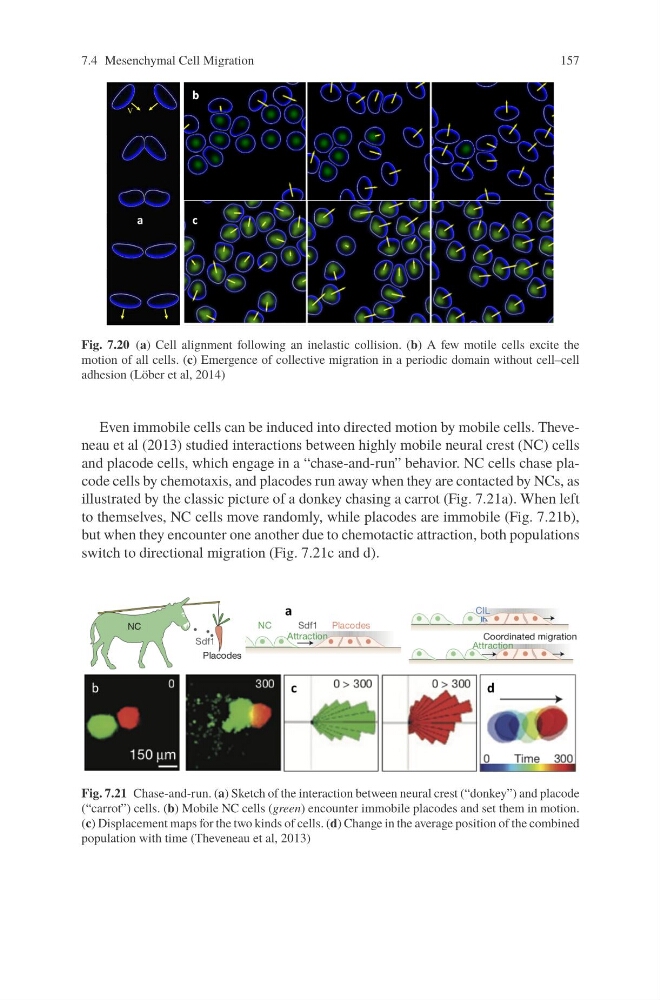
Fig. 7.20 (a) Cell alignment following an inelastic collision. (b) A few motile cells excite the
motion of all cells. (c) Emergence of collective migration in a periodic domain without cell–cell
adhesion (Löber et al, 2014)
Even immobile cells can be induced into directed motion by mobile cells. Theveneau et al (2013) studied interactions between highly mobile neural crest (NC) cells
and placode cells, which engage in a “chase-and-run” behavior. NC cells chase placode cells by chemotaxis, and placodes run away when they are contacted by NCs, as
illustrated by the classic picture of a donkey chasing a carrot (Fig. 7.21a). When left
to themselves, NC cells move randomly, while placodes are immobile (Fig. 7.21b),
but when they encounter one another due to chemotactic attraction, both populations
switch to directional migration (Fig. 7.21c and d).
Fig. 7.21 Chase-and-run. (a) Sketch of the interaction between neural crest (“donkey”) and placode
(“carrot”) cells. (b) Mobile NC cells (green) encounter immobile placodes and set them in motion.
(c) Displacement maps for the two kinds of cells. (d) Change in the average position of the combined
population with time (Theveneau et al, 2013)
157
Fig. 7.20 (a) Cell alignment following an inelastic collision. (b) A few motile cells excite the
motion of all cells. (c) Emergence of collective migration in a periodic domain without cell–cell
adhesion (Löber et al, 2014)
Even immobile cells can be induced into directed motion by mobile cells. Theveneau et al (2013) studied interactions between highly mobile neural crest (NC) cells
and placode cells, which engage in a “chase-and-run” behavior. NC cells chase placode cells by chemotaxis, and placodes run away when they are contacted by NCs, as
illustrated by the classic picture of a donkey chasing a carrot (Fig. 7.21a). When left
to themselves, NC cells move randomly, while placodes are immobile (Fig. 7.21b),
but when they encounter one another due to chemotactic attraction, both populations
switch to directional migration (Fig. 7.21c and d).
Fig. 7.21 Chase-and-run. (a) Sketch of the interaction between neural crest (“donkey”) and placode
(“carrot”) cells. (b) Mobile NC cells (green) encounter immobile placodes and set them in motion.
(c) Displacement maps for the two kinds of cells. (d) Change in the average position of the combined
population with time (Theveneau et al, 2013)