

156
7 Live Tissues
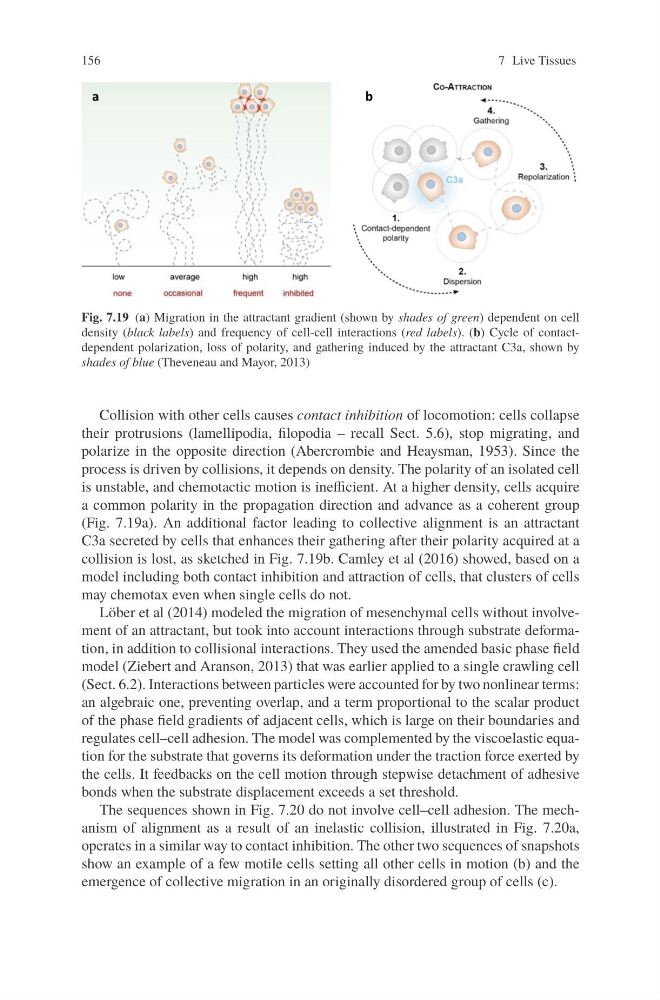
Fig. 7.19 (a) Migration in the attractant gradient (shown by shades of green) dependent on cell
density (black labels) and frequency of cell-cell interactions (red labels). (b) Cycle of contactdependent polarization, loss of polarity, and gathering induced by the attractant C3a, shown by
shades of blue (Theveneau and Mayor, 2013)
Collision with other cells causes contact inhibition of locomotion: cells collapse
their protrusions (lamellipodia, filopodia – recall Sect. 5.6), stop migrating, and
polarize in the opposite direction (Abercrombie and Heaysman, 1953). Since the
process is driven by collisions, it depends on density. The polarity of an isolated cell
is unstable, and chemotactic motion is inefficient. At a higher density, cells acquire
a common polarity in the propagation direction and advance as a coherent group
(Fig. 7.19a). An additional factor leading to collective alignment is an attractant
C3a secreted by cells that enhances their gathering after their polarity acquired at a
collision is lost, as sketched in Fig. 7.19b. Camley et al (2016) showed, based on a
model including both contact inhibition and attraction of cells, that clusters of cells
may chemotax even when single cells do not.
Löber et al (2014) modeled the migration of mesenchymal cells without involvement of an attractant, but took into account interactions through substrate deformation, in addition to collisional interactions. They used the amended basic phase field
model (Ziebert and Aranson, 2013) that was earlier applied to a single crawling cell
(Sect. 6.2). Interactions between particles were accounted for by two nonlinear terms:
an algebraic one, preventing overlap, and a term proportional to the scalar product
of the phase field gradients of adjacent cells, which is large on their boundaries and
regulates cell–cell adhesion. The model was complemented by the viscoelastic equation for the substrate that governs its deformation under the traction force exerted by
the cells. It feedbacks on the cell motion through stepwise detachment of adhesive
bonds when the substrate displacement exceeds a set threshold.
The sequences shown in Fig. 7.20 do not involve cell–cell adhesion. The mechanism of alignment as a result of an inelastic collision, illustrated in Fig. 7.20a,
operates in a similar way to contact inhibition. The other two sequences of snapshots
show an example of a few motile cells setting all other cells in motion (b) and the
emergence of collective migration in an originally disordered group of cells (c).
7 Live Tissues
Fig. 7.19 (a) Migration in the attractant gradient (shown by shades of green) dependent on cell
density (black labels) and frequency of cell-cell interactions (red labels). (b) Cycle of contactdependent polarization, loss of polarity, and gathering induced by the attractant C3a, shown by
shades of blue (Theveneau and Mayor, 2013)
Collision with other cells causes contact inhibition of locomotion: cells collapse
their protrusions (lamellipodia, filopodia – recall Sect. 5.6), stop migrating, and
polarize in the opposite direction (Abercrombie and Heaysman, 1953). Since the
process is driven by collisions, it depends on density. The polarity of an isolated cell
is unstable, and chemotactic motion is inefficient. At a higher density, cells acquire
a common polarity in the propagation direction and advance as a coherent group
(Fig. 7.19a). An additional factor leading to collective alignment is an attractant
C3a secreted by cells that enhances their gathering after their polarity acquired at a
collision is lost, as sketched in Fig. 7.19b. Camley et al (2016) showed, based on a
model including both contact inhibition and attraction of cells, that clusters of cells
may chemotax even when single cells do not.
Löber et al (2014) modeled the migration of mesenchymal cells without involvement of an attractant, but took into account interactions through substrate deformation, in addition to collisional interactions. They used the amended basic phase field
model (Ziebert and Aranson, 2013) that was earlier applied to a single crawling cell
(Sect. 6.2). Interactions between particles were accounted for by two nonlinear terms:
an algebraic one, preventing overlap, and a term proportional to the scalar product
of the phase field gradients of adjacent cells, which is large on their boundaries and
regulates cell–cell adhesion. The model was complemented by the viscoelastic equation for the substrate that governs its deformation under the traction force exerted by
the cells. It feedbacks on the cell motion through stepwise detachment of adhesive
bonds when the substrate displacement exceeds a set threshold.
The sequences shown in Fig. 7.20 do not involve cell–cell adhesion. The mechanism of alignment as a result of an inelastic collision, illustrated in Fig. 7.20a,
operates in a similar way to contact inhibition. The other two sequences of snapshots
show an example of a few motile cells setting all other cells in motion (b) and the
emergence of collective migration in an originally disordered group of cells (c).