

7.4 Mesenchymal Cell Migration
155
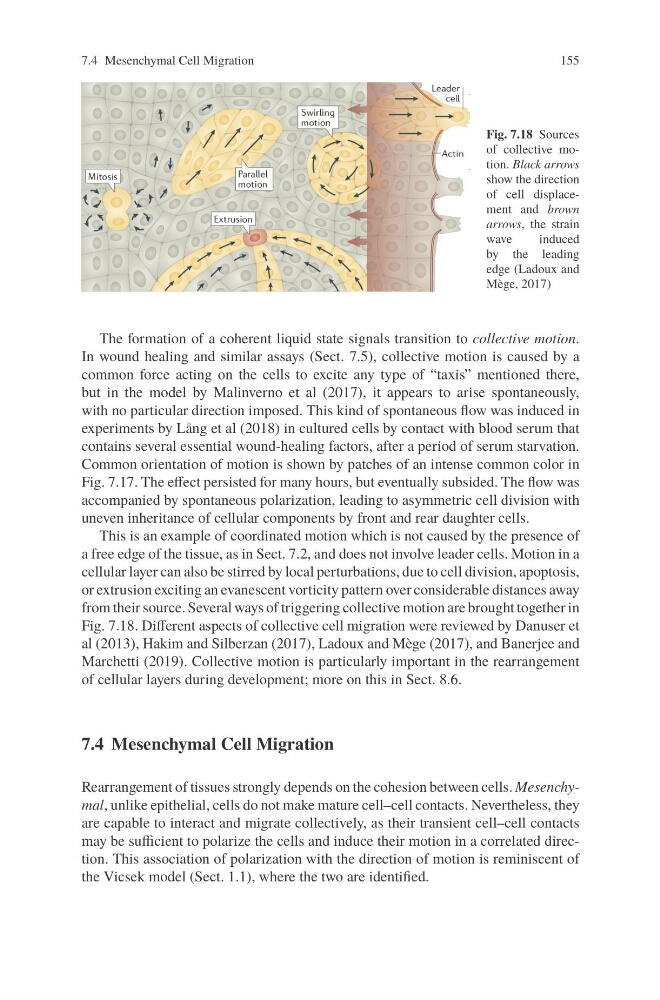
Fig. 7.18 Sources
of collective motion. Black arrows
show the direction
of cell displacement and brown
arrows, the strain
wave
induced
by the leading
edge (Ladoux and
Mège, 2017)
The formation of a coherent liquid state signals transition to collective motion.
In wound healing and similar assays (Sect. 7.5), collective motion is caused by a
common force acting on the cells to excite any type of “taxis” mentioned there,
but in the model by Malinverno et al (2017), it appears to arise spontaneously,
with no particular direction imposed. This kind of spontaneous flow was induced in
experiments by Lång et al (2018) in cultured cells by contact with blood serum that
contains several essential wound-healing factors, after a period of serum starvation.
Common orientation of motion is shown by patches of an intense common color in
Fig. 7.17. The effect persisted for many hours, but eventually subsided. The flow was
accompanied by spontaneous polarization, leading to asymmetric cell division with
uneven inheritance of cellular components by front and rear daughter cells.
This is an example of coordinated motion which is not caused by the presence of
a free edge of the tissue, as in Sect. 7.2, and does not involve leader cells. Motion in a
cellular layer can also be stirred by local perturbations, due to cell division, apoptosis,
or extrusion exciting an evanescent vorticity pattern over considerable distances away
from their source. Several ways of triggering collective motion are brought together in
Fig. 7.18. Different aspects of collective cell migration were reviewed by Danuser et
al (2013), Hakim and Silberzan (2017), Ladoux and Mège (2017), and Banerjee and
Marchetti (2019). Collective motion is particularly important in the rearrangement
of cellular layers during development; more on this in Sect. 8.6.
7.4 Mesenchymal Cell Migration
Rearrangement of tissues strongly depends on the cohesion between cells. Mesenchymal, unlike epithelial, cells do not make mature cell–cell contacts. Nevertheless, they
are capable to interact and migrate collectively, as their transient cell–cell contacts
may be sufficient to polarize the cells and induce their motion in a correlated direction. This association of polarization with the direction of motion is reminiscent of
the Vicsek model (Sect. 1.1), where the two are identified.
155
Fig. 7.18 Sources
of collective motion. Black arrows
show the direction
of cell displacement and brown
arrows, the strain
wave
induced
by the leading
edge (Ladoux and
Mège, 2017)
The formation of a coherent liquid state signals transition to collective motion.
In wound healing and similar assays (Sect. 7.5), collective motion is caused by a
common force acting on the cells to excite any type of “taxis” mentioned there,
but in the model by Malinverno et al (2017), it appears to arise spontaneously,
with no particular direction imposed. This kind of spontaneous flow was induced in
experiments by Lång et al (2018) in cultured cells by contact with blood serum that
contains several essential wound-healing factors, after a period of serum starvation.
Common orientation of motion is shown by patches of an intense common color in
Fig. 7.17. The effect persisted for many hours, but eventually subsided. The flow was
accompanied by spontaneous polarization, leading to asymmetric cell division with
uneven inheritance of cellular components by front and rear daughter cells.
This is an example of coordinated motion which is not caused by the presence of
a free edge of the tissue, as in Sect. 7.2, and does not involve leader cells. Motion in a
cellular layer can also be stirred by local perturbations, due to cell division, apoptosis,
or extrusion exciting an evanescent vorticity pattern over considerable distances away
from their source. Several ways of triggering collective motion are brought together in
Fig. 7.18. Different aspects of collective cell migration were reviewed by Danuser et
al (2013), Hakim and Silberzan (2017), Ladoux and Mège (2017), and Banerjee and
Marchetti (2019). Collective motion is particularly important in the rearrangement
of cellular layers during development; more on this in Sect. 8.6.
7.4 Mesenchymal Cell Migration
Rearrangement of tissues strongly depends on the cohesion between cells. Mesenchymal, unlike epithelial, cells do not make mature cell–cell contacts. Nevertheless, they
are capable to interact and migrate collectively, as their transient cell–cell contacts
may be sufficient to polarize the cells and induce their motion in a correlated direction. This association of polarization with the direction of motion is reminiscent of
the Vicsek model (Sect. 1.1), where the two are identified.