

7.3 Jamming and Liquefaction
151
7.3 Jamming and Liquefaction
We have seen in Sects. 1.6 and 1.7 that jamming is associated with crowding, but high
density does not totally freeze motion. Cates et al (1998), considering concentrated
colloidal suspension of hard particles or sandpiles, contended that these jammed
systems are fundamentally different from an ordinary solid and can be attributed to
a special class of materials: “fragile matter”, as they can rearrange even in response
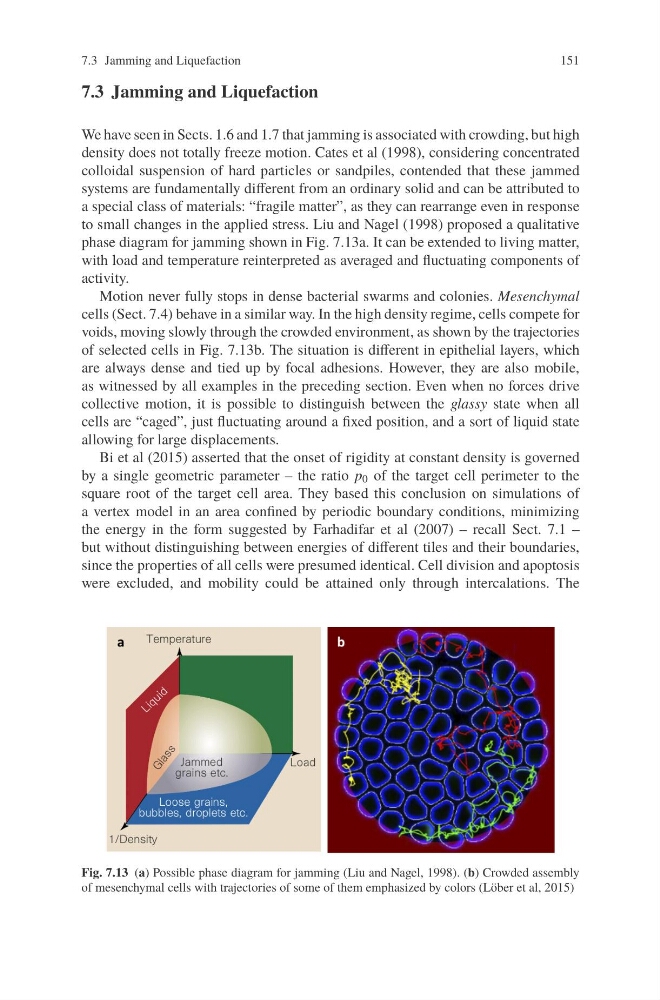
to small changes in the applied stress. Liu and Nagel (1998) proposed a qualitative
phase diagram for jamming shown in Fig. 7.13a. It can be extended to living matter,
with load and temperature reinterpreted as averaged and fluctuating components of
activity.
Motion never fully stops in dense bacterial swarms and colonies. Mesenchymal
cells (Sect. 7.4) behave in a similar way. In the high density regime, cells compete for
voids, moving slowly through the crowded environment, as shown by the trajectories
of selected cells in Fig. 7.13b. The situation is different in epithelial layers, which
are always dense and tied up by focal adhesions. However, they are also mobile,
as witnessed by all examples in the preceding section. Even when no forces drive
collective motion, it is possible to distinguish between the glassy state when all
cells are “caged”, just fluctuating around a fixed position, and a sort of liquid state
allowing for large displacements.
Bi et al (2015) asserted that the onset of rigidity at constant density is governed
by a single geometric parameter – the ratio p 0 of the target cell perimeter to the
square root of the target cell area. They based this conclusion on simulations of
a vertex model in an area confined by periodic boundary conditions, minimizing
the energy in the form suggested by Farhadifar et al (2007) – recall Sect. 7.1 –
but without distinguishing between energies of different tiles and their boundaries,
since the properties of all cells were presumed identical. Cell division and apoptosis
were excluded, and mobility could be attained only through intercalations. The
Fig. 7.13 (a) Possible phase diagram for jamming (Liu and Nagel, 1998). (b) Crowded assembly
of mesenchymal cells with trajectories of some of them emphasized by colors (Löber et al, 2015)
151
7.3 Jamming and Liquefaction
We have seen in Sects. 1.6 and 1.7 that jamming is associated with crowding, but high
density does not totally freeze motion. Cates et al (1998), considering concentrated
colloidal suspension of hard particles or sandpiles, contended that these jammed
systems are fundamentally different from an ordinary solid and can be attributed to
a special class of materials: “fragile matter”, as they can rearrange even in response
to small changes in the applied stress. Liu and Nagel (1998) proposed a qualitative
phase diagram for jamming shown in Fig. 7.13a. It can be extended to living matter,
with load and temperature reinterpreted as averaged and fluctuating components of
activity.
Motion never fully stops in dense bacterial swarms and colonies. Mesenchymal
cells (Sect. 7.4) behave in a similar way. In the high density regime, cells compete for
voids, moving slowly through the crowded environment, as shown by the trajectories
of selected cells in Fig. 7.13b. The situation is different in epithelial layers, which
are always dense and tied up by focal adhesions. However, they are also mobile,
as witnessed by all examples in the preceding section. Even when no forces drive
collective motion, it is possible to distinguish between the glassy state when all
cells are “caged”, just fluctuating around a fixed position, and a sort of liquid state
allowing for large displacements.
Bi et al (2015) asserted that the onset of rigidity at constant density is governed
by a single geometric parameter – the ratio p 0 of the target cell perimeter to the
square root of the target cell area. They based this conclusion on simulations of
a vertex model in an area confined by periodic boundary conditions, minimizing
the energy in the form suggested by Farhadifar et al (2007) – recall Sect. 7.1 –
but without distinguishing between energies of different tiles and their boundaries,
since the properties of all cells were presumed identical. Cell division and apoptosis
were excluded, and mobility could be attained only through intercalations. The
Fig. 7.13 (a) Possible phase diagram for jamming (Liu and Nagel, 1998). (b) Crowded assembly
of mesenchymal cells with trajectories of some of them emphasized by colors (Löber et al, 2015)