

150
7 Live Tissues
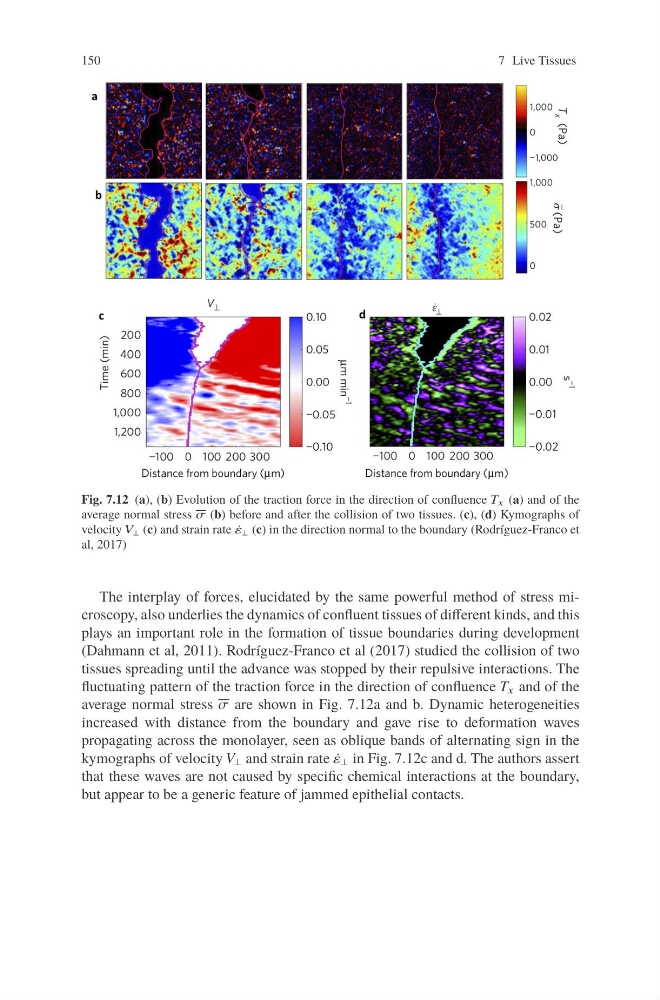
Fig. 7.12 (a), (b) Evolution of the traction force in the direction of confluence T x (a) and of the
average normal stress σ (b) before and after the collision of two tissues. (c), (d) Kymographs of
velocity V ⊥ (c) and strain rate
ε ⊥ (c) in the direction normal to the boundary (Rodríguez-Franco et
al, 2017)
The interplay of forces, elucidated by the same powerful method of stress microscopy, also underlies the dynamics of confluent tissues of different kinds, and this
plays an important role in the formation of tissue boundaries during development
(Dahmann et al, 2011). Rodríguez-Franco et al (2017) studied the collision of two
tissues spreading until the advance was stopped by their repulsive interactions. The
fluctuating pattern of the traction force in the direction of confluence T x and of the
average normal stress σ are shown in Fig. 7.12a and b. Dynamic heterogeneities
increased with distance from the boundary and gave rise to deformation waves
propagating across the monolayer, seen as oblique bands of alternating sign in the
kymographs of velocity V ⊥ and strain rate
ε ⊥ in Fig. 7.12c and d. The authors assert
that these waves are not caused by specific chemical interactions at the boundary,
but appear to be a generic feature of jammed epithelial contacts.
7 Live Tissues
Fig. 7.12 (a), (b) Evolution of the traction force in the direction of confluence T x (a) and of the
average normal stress σ (b) before and after the collision of two tissues. (c), (d) Kymographs of
velocity V ⊥ (c) and strain rate
ε ⊥ (c) in the direction normal to the boundary (Rodríguez-Franco et
al, 2017)
The interplay of forces, elucidated by the same powerful method of stress microscopy, also underlies the dynamics of confluent tissues of different kinds, and this
plays an important role in the formation of tissue boundaries during development
(Dahmann et al, 2011). Rodríguez-Franco et al (2017) studied the collision of two
tissues spreading until the advance was stopped by their repulsive interactions. The
fluctuating pattern of the traction force in the direction of confluence T x and of the
average normal stress σ are shown in Fig. 7.12a and b. Dynamic heterogeneities
increased with distance from the boundary and gave rise to deformation waves
propagating across the monolayer, seen as oblique bands of alternating sign in the
kymographs of velocity V ⊥ and strain rate
ε ⊥ in Fig. 7.12c and d. The authors assert
that these waves are not caused by specific chemical interactions at the boundary,
but appear to be a generic feature of jammed epithelial contacts.