

7.2 Forces in Migrating Layers
145
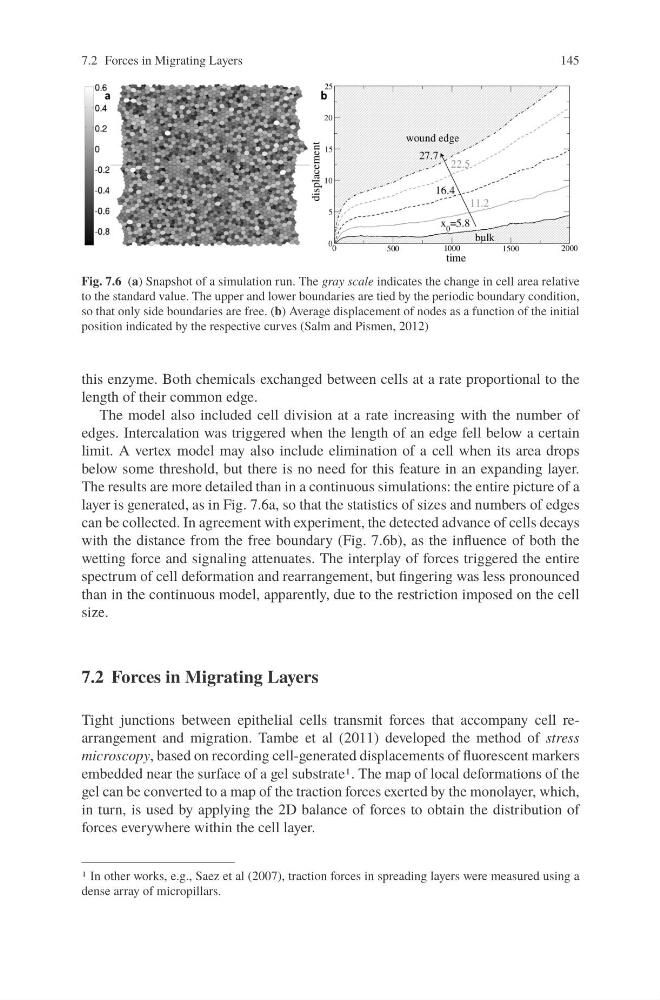
Fig. 7.6 (a) Snapshot of a simulation run. The gray scale indicates the change in cell area relative
to the standard value. The upper and lower boundaries are tied by the periodic boundary condition,
so that only side boundaries are free. (b) Average displacement of nodes as a function of the initial
position indicated by the respective curves (Salm and Pismen, 2012)
this enzyme. Both chemicals exchanged between cells at a rate proportional to the
length of their common edge.
The model also included cell division at a rate increasing with the number of
edges. Intercalation was triggered when the length of an edge fell below a certain
limit. A vertex model may also include elimination of a cell when its area drops
below some threshold, but there is no need for this feature in an expanding layer.
The results are more detailed than in a continuous simulations: the entire picture of a
layer is generated, as in Fig. 7.6a, so that the statistics of sizes and numbers of edges
can be collected. In agreement with experiment, the detected advance of cells decays
with the distance from the free boundary (Fig. 7.6b), as the influence of both the
wetting force and signaling attenuates. The interplay of forces triggered the entire
spectrum of cell deformation and rearrangement, but fingering was less pronounced
than in the continuous model, apparently, due to the restriction imposed on the cell
size.
7.2 Forces in Migrating Layers
Tight junctions between epithelial cells transmit forces that accompany cell rearrangement and migration. Tambe et al (2011) developed the method of stress
microscopy, based on recording cell-generated displacements of fluorescent markers
embedded near the surface of a gel substrate1. The map of local deformations of the
gel can be converted to a map of the traction forces exerted by the monolayer, which,
in turn, is used by applying the 2D balance of forces to obtain the distribution of
forces everywhere within the cell layer.
1 In other works, e.g., Saez et al (2007), traction forces in spreading layers were measured using a
dense array of micropillars.
145
Fig. 7.6 (a) Snapshot of a simulation run. The gray scale indicates the change in cell area relative
to the standard value. The upper and lower boundaries are tied by the periodic boundary condition,
so that only side boundaries are free. (b) Average displacement of nodes as a function of the initial
position indicated by the respective curves (Salm and Pismen, 2012)
this enzyme. Both chemicals exchanged between cells at a rate proportional to the
length of their common edge.
The model also included cell division at a rate increasing with the number of
edges. Intercalation was triggered when the length of an edge fell below a certain
limit. A vertex model may also include elimination of a cell when its area drops
below some threshold, but there is no need for this feature in an expanding layer.
The results are more detailed than in a continuous simulations: the entire picture of a
layer is generated, as in Fig. 7.6a, so that the statistics of sizes and numbers of edges
can be collected. In agreement with experiment, the detected advance of cells decays
with the distance from the free boundary (Fig. 7.6b), as the influence of both the
wetting force and signaling attenuates. The interplay of forces triggered the entire
spectrum of cell deformation and rearrangement, but fingering was less pronounced
than in the continuous model, apparently, due to the restriction imposed on the cell
size.
7.2 Forces in Migrating Layers
Tight junctions between epithelial cells transmit forces that accompany cell rearrangement and migration. Tambe et al (2011) developed the method of stress
microscopy, based on recording cell-generated displacements of fluorescent markers
embedded near the surface of a gel substrate1. The map of local deformations of the
gel can be converted to a map of the traction forces exerted by the monolayer, which,
in turn, is used by applying the 2D balance of forces to obtain the distribution of
forces everywhere within the cell layer.
1 In other works, e.g., Saez et al (2007), traction forces in spreading layers were measured using a
dense array of micropillars.