

144
7 Live Tissues
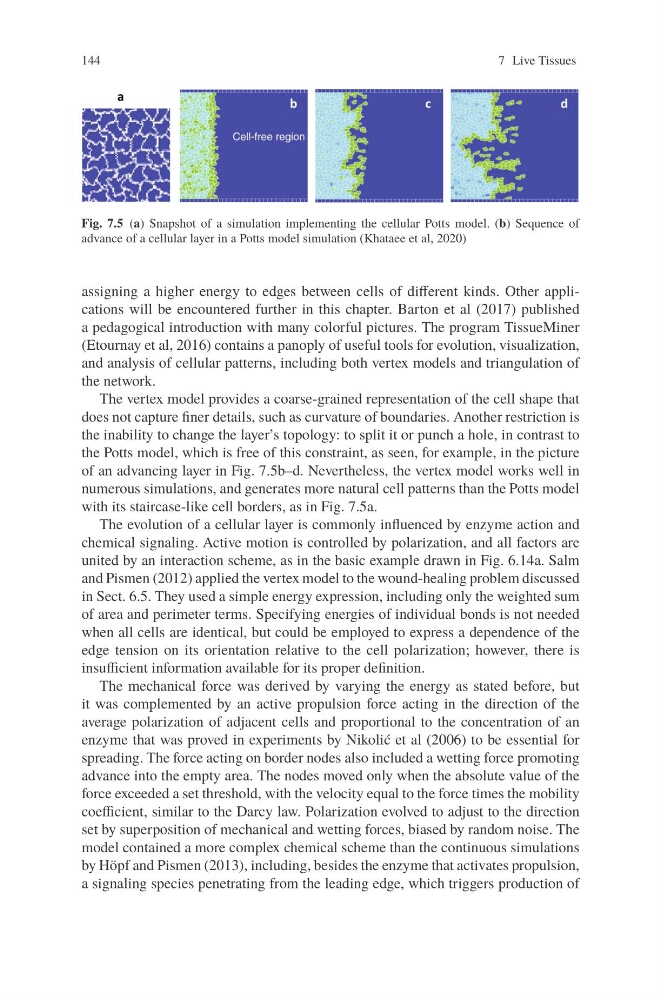
Fig. 7.5 (a) Snapshot of a simulation implementing the cellular Potts model. (b) Sequence of
advance of a cellular layer in a Potts model simulation (Khataee et al, 2020)
assigning a higher energy to edges between cells of different kinds. Other applications will be encountered further in this chapter. Barton et al (2017) published
a pedagogical introduction with many colorful pictures. The program TissueMiner
(Etournay et al, 2016) contains a panoply of useful tools for evolution, visualization,
and analysis of cellular patterns, including both vertex models and triangulation of
the network.
The vertex model provides a coarse-grained representation of the cell shape that
does not capture finer details, such as curvature of boundaries. Another restriction is
the inability to change the layer’s topology: to split it or punch a hole, in contrast to
the Potts model, which is free of this constraint, as seen, for example, in the picture
of an advancing layer in Fig. 7.5b–d. Nevertheless, the vertex model works well in
numerous simulations, and generates more natural cell patterns than the Potts model
with its staircase-like cell borders, as in Fig. 7.5a.
The evolution of a cellular layer is commonly influenced by enzyme action and
chemical signaling. Active motion is controlled by polarization, and all factors are
united by an interaction scheme, as in the basic example drawn in Fig. 6.14a. Salm
and Pismen (2012) applied the vertex model to the wound-healing problem discussed
in Sect. 6.5. They used a simple energy expression, including only the weighted sum
of area and perimeter terms. Specifying energies of individual bonds is not needed
when all cells are identical, but could be employed to express a dependence of the
edge tension on its orientation relative to the cell polarization; however, there is
insufficient information available for its proper definition.
The mechanical force was derived by varying the energy as stated before, but
it was complemented by an active propulsion force acting in the direction of the
average polarization of adjacent cells and proportional to the concentration of an
enzyme that was proved in experiments by Nikolić et al (2006) to be essential for
spreading. The force acting on border nodes also included a wetting force promoting
advance into the empty area. The nodes moved only when the absolute value of the
force exceeded a set threshold, with the velocity equal to the force times the mobility
coefficient, similar to the Darcy law. Polarization evolved to adjust to the direction
set by superposition of mechanical and wetting forces, biased by random noise. The
model contained a more complex chemical scheme than the continuous simulations
by Höpf and Pismen (2013), including, besides the enzyme that activates propulsion,
a signaling species penetrating from the leading edge, which triggers production of
7 Live Tissues
Fig. 7.5 (a) Snapshot of a simulation implementing the cellular Potts model. (b) Sequence of
advance of a cellular layer in a Potts model simulation (Khataee et al, 2020)
assigning a higher energy to edges between cells of different kinds. Other applications will be encountered further in this chapter. Barton et al (2017) published
a pedagogical introduction with many colorful pictures. The program TissueMiner
(Etournay et al, 2016) contains a panoply of useful tools for evolution, visualization,
and analysis of cellular patterns, including both vertex models and triangulation of
the network.
The vertex model provides a coarse-grained representation of the cell shape that
does not capture finer details, such as curvature of boundaries. Another restriction is
the inability to change the layer’s topology: to split it or punch a hole, in contrast to
the Potts model, which is free of this constraint, as seen, for example, in the picture
of an advancing layer in Fig. 7.5b–d. Nevertheless, the vertex model works well in
numerous simulations, and generates more natural cell patterns than the Potts model
with its staircase-like cell borders, as in Fig. 7.5a.
The evolution of a cellular layer is commonly influenced by enzyme action and
chemical signaling. Active motion is controlled by polarization, and all factors are
united by an interaction scheme, as in the basic example drawn in Fig. 6.14a. Salm
and Pismen (2012) applied the vertex model to the wound-healing problem discussed
in Sect. 6.5. They used a simple energy expression, including only the weighted sum
of area and perimeter terms. Specifying energies of individual bonds is not needed
when all cells are identical, but could be employed to express a dependence of the
edge tension on its orientation relative to the cell polarization; however, there is
insufficient information available for its proper definition.
The mechanical force was derived by varying the energy as stated before, but
it was complemented by an active propulsion force acting in the direction of the
average polarization of adjacent cells and proportional to the concentration of an
enzyme that was proved in experiments by Nikolić et al (2006) to be essential for
spreading. The force acting on border nodes also included a wetting force promoting
advance into the empty area. The nodes moved only when the absolute value of the
force exceeded a set threshold, with the velocity equal to the force times the mobility
coefficient, similar to the Darcy law. Polarization evolved to adjust to the direction
set by superposition of mechanical and wetting forces, biased by random noise. The
model contained a more complex chemical scheme than the continuous simulations
by Höpf and Pismen (2013), including, besides the enzyme that activates propulsion,
a signaling species penetrating from the leading edge, which triggers production of