

Chapter 7
Live Tissues
7.1 Cellular Models
Tissues consist of discrete entities, cells. Why then model them by continuous
equations, which are discretized anyway? A discretized description of cell shapes in
a 2D layer goes back to Graner and Glazier (1992), who applied an extended Potts
model, originally devised in a 1951 Ph.D. thesis to describe interacting spins on a
crystalline lattice. The addition or removal of a lattice site associated with a given cell
captures protrusion and retraction of the cell boundary. The standard Cartesian grid
used by Graner and Glazier is hardly compatible with living geometry, and a large
number of squares per cell is needed to approximate a natural shape. A triangular
grid, which can be readily subdivided when it is necessitated by large gradients, is
now generally preferred in all kinds of computations, and Potts models on a triangular
or hexagonal grid are also encountered, but not in biophysical applications.
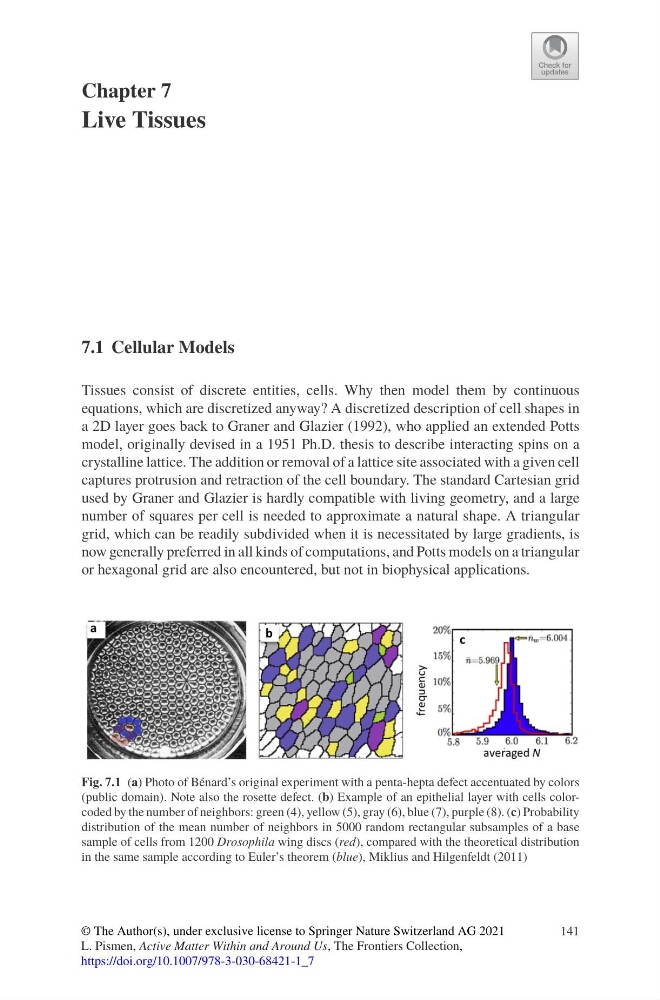
Fig. 7.1 (a) Photo of Bénard’s original experiment with a penta-hepta defect accentuated by colors
(public domain). Note also the rosette defect. (b) Example of an epithelial layer with cells colorcoded by the number of neighbors: green (4), yellow (5), gray (6), blue (7), purple (8). (c) Probability
distribution of the mean number of neighbors in 5000 random rectangular subsamples of a base
sample of cells from 1200 Drosophila wing discs (red), compared with the theoretical distribution
in the same sample according to Euler’s theorem (blue), Miklius and Hilgenfeldt (2011)
141
L. Pismen, Active Matter Within and Around Us, The Frontiers Collection,
https://doi.org/10.1007/978-3-030-68421-1_7
© The Author(s), under exclusive license to Springer Nature Switzerland AG 2021
Live Tissues
7.1 Cellular Models
Tissues consist of discrete entities, cells. Why then model them by continuous
equations, which are discretized anyway? A discretized description of cell shapes in
a 2D layer goes back to Graner and Glazier (1992), who applied an extended Potts
model, originally devised in a 1951 Ph.D. thesis to describe interacting spins on a
crystalline lattice. The addition or removal of a lattice site associated with a given cell
captures protrusion and retraction of the cell boundary. The standard Cartesian grid
used by Graner and Glazier is hardly compatible with living geometry, and a large
number of squares per cell is needed to approximate a natural shape. A triangular
grid, which can be readily subdivided when it is necessitated by large gradients, is
now generally preferred in all kinds of computations, and Potts models on a triangular
or hexagonal grid are also encountered, but not in biophysical applications.
Fig. 7.1 (a) Photo of Bénard’s original experiment with a penta-hepta defect accentuated by colors
(public domain). Note also the rosette defect. (b) Example of an epithelial layer with cells colorcoded by the number of neighbors: green (4), yellow (5), gray (6), blue (7), purple (8). (c) Probability
distribution of the mean number of neighbors in 5000 random rectangular subsamples of a base
sample of cells from 1200 Drosophila wing discs (red), compared with the theoretical distribution
in the same sample according to Euler’s theorem (blue), Miklius and Hilgenfeldt (2011)
141
L. Pismen, Active Matter Within and Around Us, The Frontiers Collection,
https://doi.org/10.1007/978-3-030-68421-1_7
© The Author(s), under exclusive license to Springer Nature Switzerland AG 2021