

140
6 Active Gels
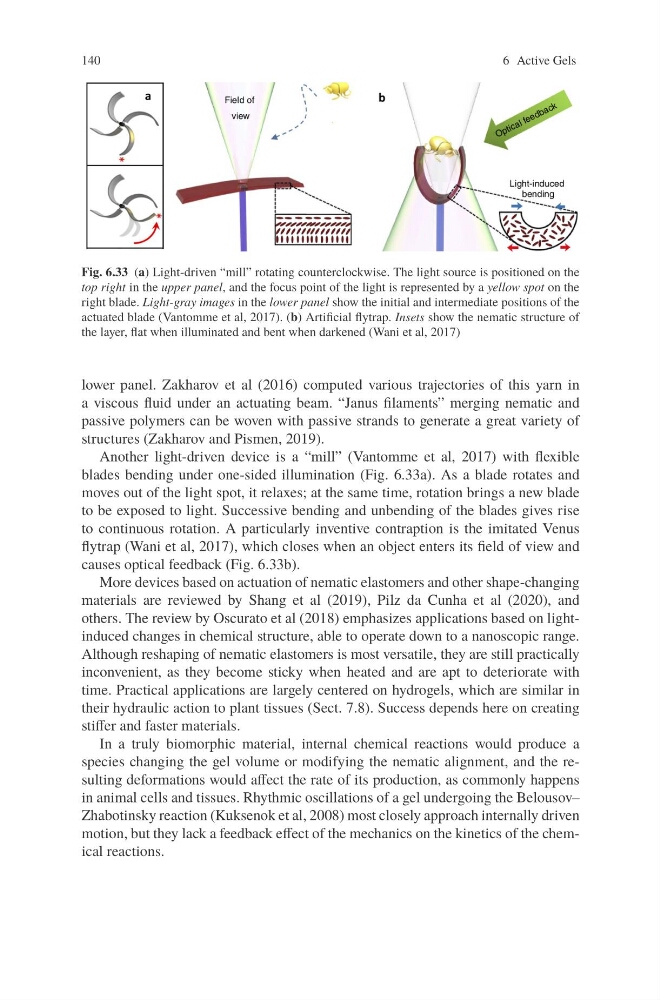
Fig. 6.33 (a) Light-driven “mill” rotating counterclockwise. The light source is positioned on the
top right in the upper panel, and the focus point of the light is represented by a yellow spot on the
right blade. Light-gray images in the lower panel show the initial and intermediate positions of the
actuated blade (Vantomme et al, 2017). (b) Artificial flytrap. Insets show the nematic structure of
the layer, flat when illuminated and bent when darkened (Wani et al, 2017)
lower panel. Zakharov et al (2016) computed various trajectories of this yarn in
a viscous fluid under an actuating beam. “Janus filaments” merging nematic and
passive polymers can be woven with passive strands to generate a great variety of
structures (Zakharov and Pismen, 2019).
Another light-driven device is a “mill” (Vantomme et al, 2017) with flexible
blades bending under one-sided illumination (Fig. 6.33a). As a blade rotates and
moves out of the light spot, it relaxes; at the same time, rotation brings a new blade
to be exposed to light. Successive bending and unbending of the blades gives rise
to continuous rotation. A particularly inventive contraption is the imitated Venus
flytrap (Wani et al, 2017), which closes when an object enters its field of view and
causes optical feedback (Fig. 6.33b).
More devices based on actuation of nematic elastomers and other shape-changing
materials are reviewed by Shang et al (2019), Pilz da Cunha et al (2020), and
others. The review by Oscurato et al (2018) emphasizes applications based on lightinduced changes in chemical structure, able to operate down to a nanoscopic range.
Although reshaping of nematic elastomers is most versatile, they are still practically
inconvenient, as they become sticky when heated and are apt to deteriorate with
time. Practical applications are largely centered on hydrogels, which are similar in
their hydraulic action to plant tissues (Sect. 7.8). Success depends here on creating
stiffer and faster materials.
In a truly biomorphic material, internal chemical reactions would produce a
species changing the gel volume or modifying the nematic alignment, and the resulting deformations would affect the rate of its production, as commonly happens
in animal cells and tissues. Rhythmic oscillations of a gel undergoing the Belousov–
Zhabotinsky reaction (Kuksenok et al, 2008) most closely approach internally driven
motion, but they lack a feedback effect of the mechanics on the kinetics of the chemical reactions.
6 Active Gels
Fig. 6.33 (a) Light-driven “mill” rotating counterclockwise. The light source is positioned on the
top right in the upper panel, and the focus point of the light is represented by a yellow spot on the
right blade. Light-gray images in the lower panel show the initial and intermediate positions of the
actuated blade (Vantomme et al, 2017). (b) Artificial flytrap. Insets show the nematic structure of
the layer, flat when illuminated and bent when darkened (Wani et al, 2017)
lower panel. Zakharov et al (2016) computed various trajectories of this yarn in
a viscous fluid under an actuating beam. “Janus filaments” merging nematic and
passive polymers can be woven with passive strands to generate a great variety of
structures (Zakharov and Pismen, 2019).
Another light-driven device is a “mill” (Vantomme et al, 2017) with flexible
blades bending under one-sided illumination (Fig. 6.33a). As a blade rotates and
moves out of the light spot, it relaxes; at the same time, rotation brings a new blade
to be exposed to light. Successive bending and unbending of the blades gives rise
to continuous rotation. A particularly inventive contraption is the imitated Venus
flytrap (Wani et al, 2017), which closes when an object enters its field of view and
causes optical feedback (Fig. 6.33b).
More devices based on actuation of nematic elastomers and other shape-changing
materials are reviewed by Shang et al (2019), Pilz da Cunha et al (2020), and
others. The review by Oscurato et al (2018) emphasizes applications based on lightinduced changes in chemical structure, able to operate down to a nanoscopic range.
Although reshaping of nematic elastomers is most versatile, they are still practically
inconvenient, as they become sticky when heated and are apt to deteriorate with
time. Practical applications are largely centered on hydrogels, which are similar in
their hydraulic action to plant tissues (Sect. 7.8). Success depends here on creating
stiffer and faster materials.
In a truly biomorphic material, internal chemical reactions would produce a
species changing the gel volume or modifying the nematic alignment, and the resulting deformations would affect the rate of its production, as commonly happens
in animal cells and tissues. Rhythmic oscillations of a gel undergoing the Belousov–
Zhabotinsky reaction (Kuksenok et al, 2008) most closely approach internally driven
motion, but they lack a feedback effect of the mechanics on the kinetics of the chemical reactions.