

6.7 Geometric Activity
135
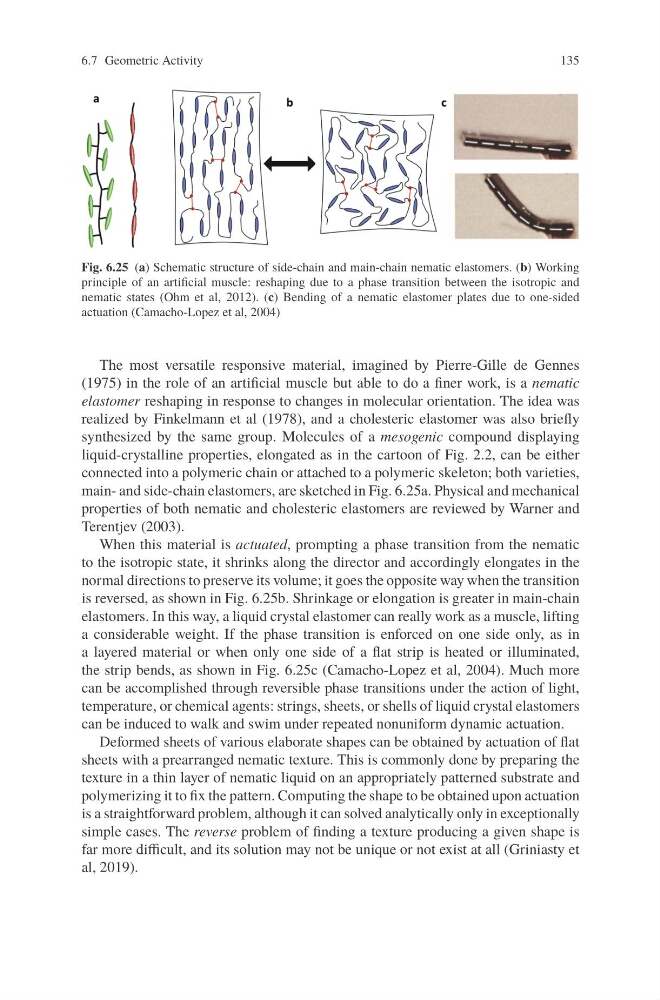
Fig. 6.25 (a) Schematic structure of side-chain and main-chain nematic elastomers. (b) Working
principle of an artificial muscle: reshaping due to a phase transition between the isotropic and
nematic states (Ohm et al, 2012). (c) Bending of a nematic elastomer plates due to one-sided
actuation (Camacho-Lopez et al, 2004)
The most versatile responsive material, imagined by Pierre-Gille de Gennes
(1975) in the role of an artificial muscle but able to do a finer work, is a nematic
elastomer reshaping in response to changes in molecular orientation. The idea was
realized by Finkelmann et al (1978), and a cholesteric elastomer was also briefly
synthesized by the same group. Molecules of a mesogenic compound displaying
liquid-crystalline properties, elongated as in the cartoon of Fig. 2.2, can be either
connected into a polymeric chain or attached to a polymeric skeleton; both varieties,
main- and side-chain elastomers, are sketched in Fig. 6.25a. Physical and mechanical
properties of both nematic and cholesteric elastomers are reviewed by Warner and
Terentjev (2003).
When this material is actuated, prompting a phase transition from the nematic
to the isotropic state, it shrinks along the director and accordingly elongates in the
normal directions to preserve its volume; it goes the opposite way when the transition
is reversed, as shown in Fig. 6.25b. Shrinkage or elongation is greater in main-chain
elastomers. In this way, a liquid crystal elastomer can really work as a muscle, lifting
a considerable weight. If the phase transition is enforced on one side only, as in
a layered material or when only one side of a flat strip is heated or illuminated,
the strip bends, as shown in Fig. 6.25c (Camacho-Lopez et al, 2004). Much more
can be accomplished through reversible phase transitions under the action of light,
temperature, or chemical agents: strings, sheets, or shells of liquid crystal elastomers
can be induced to walk and swim under repeated nonuniform dynamic actuation.
Deformed sheets of various elaborate shapes can be obtained by actuation of flat
sheets with a prearranged nematic texture. This is commonly done by preparing the
texture in a thin layer of nematic liquid on an appropriately patterned substrate and
polymerizing it to fix the pattern. Computing the shape to be obtained upon actuation
is a straightforward problem, although it can solved analytically only in exceptionally
simple cases. The reverse problem of finding a texture producing a given shape is
far more difficult, and its solution may not be unique or not exist at all (Griniasty et
al, 2019).
135
Fig. 6.25 (a) Schematic structure of side-chain and main-chain nematic elastomers. (b) Working
principle of an artificial muscle: reshaping due to a phase transition between the isotropic and
nematic states (Ohm et al, 2012). (c) Bending of a nematic elastomer plates due to one-sided
actuation (Camacho-Lopez et al, 2004)
The most versatile responsive material, imagined by Pierre-Gille de Gennes
(1975) in the role of an artificial muscle but able to do a finer work, is a nematic
elastomer reshaping in response to changes in molecular orientation. The idea was
realized by Finkelmann et al (1978), and a cholesteric elastomer was also briefly
synthesized by the same group. Molecules of a mesogenic compound displaying
liquid-crystalline properties, elongated as in the cartoon of Fig. 2.2, can be either
connected into a polymeric chain or attached to a polymeric skeleton; both varieties,
main- and side-chain elastomers, are sketched in Fig. 6.25a. Physical and mechanical
properties of both nematic and cholesteric elastomers are reviewed by Warner and
Terentjev (2003).
When this material is actuated, prompting a phase transition from the nematic
to the isotropic state, it shrinks along the director and accordingly elongates in the
normal directions to preserve its volume; it goes the opposite way when the transition
is reversed, as shown in Fig. 6.25b. Shrinkage or elongation is greater in main-chain
elastomers. In this way, a liquid crystal elastomer can really work as a muscle, lifting
a considerable weight. If the phase transition is enforced on one side only, as in
a layered material or when only one side of a flat strip is heated or illuminated,
the strip bends, as shown in Fig. 6.25c (Camacho-Lopez et al, 2004). Much more
can be accomplished through reversible phase transitions under the action of light,
temperature, or chemical agents: strings, sheets, or shells of liquid crystal elastomers
can be induced to walk and swim under repeated nonuniform dynamic actuation.
Deformed sheets of various elaborate shapes can be obtained by actuation of flat
sheets with a prearranged nematic texture. This is commonly done by preparing the
texture in a thin layer of nematic liquid on an appropriately patterned substrate and
polymerizing it to fix the pattern. Computing the shape to be obtained upon actuation
is a straightforward problem, although it can solved analytically only in exceptionally
simple cases. The reverse problem of finding a texture producing a given shape is
far more difficult, and its solution may not be unique or not exist at all (Griniasty et
al, 2019).