

134
6 Active Gels
6.7 Geometric Activity
Many (but not all) complications inherent in living tissues may be avoided in synthetic
active mater. A biomorphic material should be soft, compliant, and ductile; at the
same time, it has to possess its own intrinsic properties responsive to external signals.
Soft materials may reshape in various ways following plastic deformations due to
volume change or anisotropic expansion/contraction. This sort of response, not
driven by internal energy sources of the kind molecular motors would supply, can be
characterized as geometric activity. This behavior is neither exotic nor sophisticated.
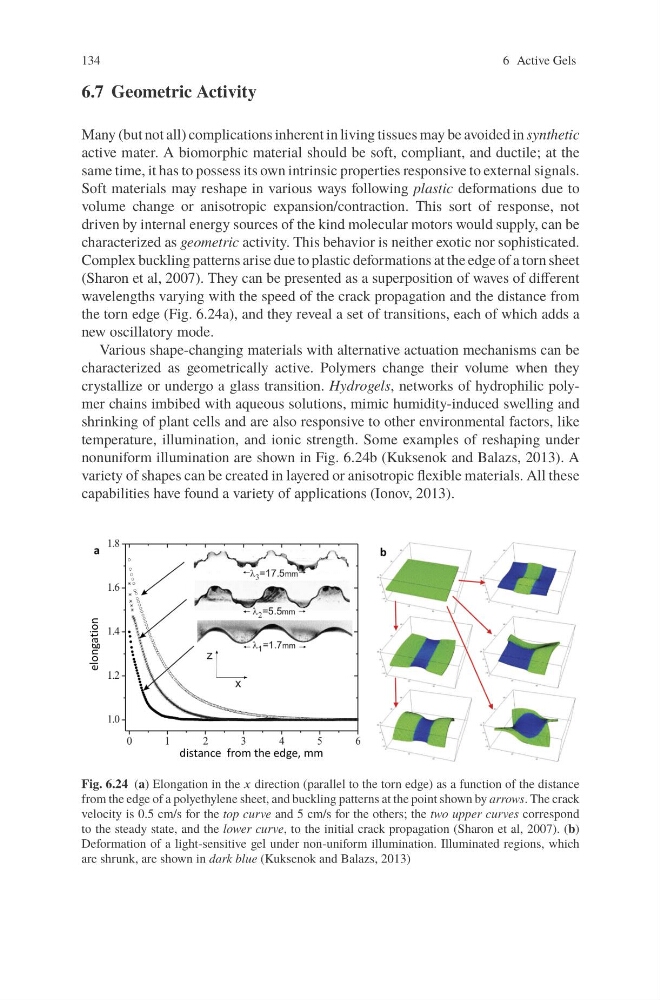
Complex buckling patterns arise due to plastic deformations at the edge of a torn sheet
(Sharon et al, 2007). They can be presented as a superposition of waves of different
wavelengths varying with the speed of the crack propagation and the distance from
the torn edge (Fig. 6.24a), and they reveal a set of transitions, each of which adds a
new oscillatory mode.
Various shape-changing materials with alternative actuation mechanisms can be
characterized as geometrically active. Polymers change their volume when they
crystallize or undergo a glass transition. Hydrogels, networks of hydrophilic polymer chains imbibed with aqueous solutions, mimic humidity-induced swelling and
shrinking of plant cells and are also responsive to other environmental factors, like
temperature, illumination, and ionic strength. Some examples of reshaping under
nonuniform illumination are shown in Fig. 6.24b (Kuksenok and Balazs, 2013). A
variety of shapes can be created in layered or anisotropic flexible materials. All these
capabilities have found a variety of applications (Ionov, 2013).
Fig. 6.24 (a) Elongation in the x direction (parallel to the torn edge) as a function of the distance
from the edge of a polyethylene sheet, and buckling patterns at the point shown by arrows. The crack
velocity is 0.5 cm/s for the top curve and 5 cm/s for the others; the two upper curves correspond
to the steady state, and the lower curve, to the initial crack propagation (Sharon et al, 2007). (b)
Deformation of a light-sensitive gel under non-uniform illumination. Illuminated regions, which
are shrunk, are shown in dark blue (Kuksenok and Balazs, 2013)
6 Active Gels
6.7 Geometric Activity
Many (but not all) complications inherent in living tissues may be avoided in synthetic
active mater. A biomorphic material should be soft, compliant, and ductile; at the
same time, it has to possess its own intrinsic properties responsive to external signals.
Soft materials may reshape in various ways following plastic deformations due to
volume change or anisotropic expansion/contraction. This sort of response, not
driven by internal energy sources of the kind molecular motors would supply, can be
characterized as geometric activity. This behavior is neither exotic nor sophisticated.
Complex buckling patterns arise due to plastic deformations at the edge of a torn sheet
(Sharon et al, 2007). They can be presented as a superposition of waves of different
wavelengths varying with the speed of the crack propagation and the distance from
the torn edge (Fig. 6.24a), and they reveal a set of transitions, each of which adds a
new oscillatory mode.
Various shape-changing materials with alternative actuation mechanisms can be
characterized as geometrically active. Polymers change their volume when they
crystallize or undergo a glass transition. Hydrogels, networks of hydrophilic polymer chains imbibed with aqueous solutions, mimic humidity-induced swelling and
shrinking of plant cells and are also responsive to other environmental factors, like
temperature, illumination, and ionic strength. Some examples of reshaping under
nonuniform illumination are shown in Fig. 6.24b (Kuksenok and Balazs, 2013). A
variety of shapes can be created in layered or anisotropic flexible materials. All these
capabilities have found a variety of applications (Ionov, 2013).
Fig. 6.24 (a) Elongation in the x direction (parallel to the torn edge) as a function of the distance
from the edge of a polyethylene sheet, and buckling patterns at the point shown by arrows. The crack
velocity is 0.5 cm/s for the top curve and 5 cm/s for the others; the two upper curves correspond
to the steady state, and the lower curve, to the initial crack propagation (Sharon et al, 2007). (b)
Deformation of a light-sensitive gel under non-uniform illumination. Illuminated regions, which
are shrunk, are shown in dark blue (Kuksenok and Balazs, 2013)