

6.6 Network Restructuring
131
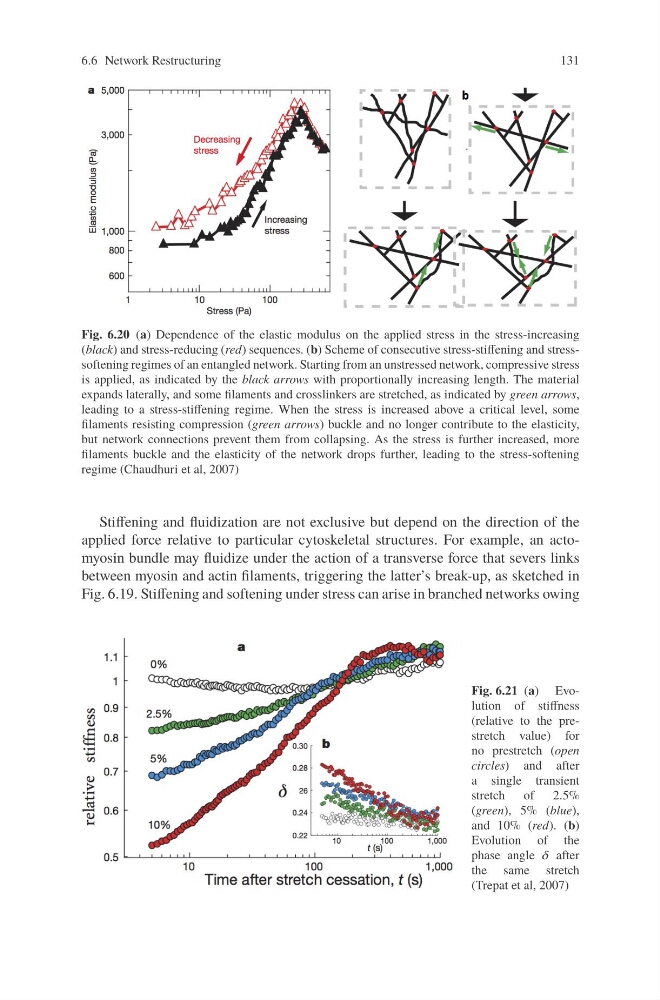
Fig. 6.20 (a) Dependence of the elastic modulus on the applied stress in the stress-increasing
(black) and stress-reducing (red) sequences. (b) Scheme of consecutive stress-stiffening and stresssoftening regimes of an entangled network. Starting from an unstressed network, compressive stress
is applied, as indicated by the black arrows with proportionally increasing length. The material
expands laterally, and some filaments and crosslinkers are stretched, as indicated by green arrows,
leading to a stress-stiffening regime. When the stress is increased above a critical level, some
filaments resisting compression (green arrows) buckle and no longer contribute to the elasticity,
but network connections prevent them from collapsing. As the stress is further increased, more
filaments buckle and the elasticity of the network drops further, leading to the stress-softening
regime (Chaudhuri et al, 2007)
Stiffening and fluidization are not exclusive but depend on the direction of the
applied force relative to particular cytoskeletal structures. For example, an actomyosin bundle may fluidize under the action of a transverse force that severs links
between myosin and actin filaments, triggering the latter’s break-up, as sketched in
Fig. 6.19. Stiffening and softening under stress can arise in branched networks owing
Fig. 6.21 (a) Evolution of stiffness
(relative to the prestretch value) for
no prestretch (open
circles) and after
a single transient
stretch of 2.5%
(green), 5% (blue),
and 10% (red). (b)
Evolution of the
phase angle δ after
the same stretch
(Trepat et al, 2007)
131
Fig. 6.20 (a) Dependence of the elastic modulus on the applied stress in the stress-increasing
(black) and stress-reducing (red) sequences. (b) Scheme of consecutive stress-stiffening and stresssoftening regimes of an entangled network. Starting from an unstressed network, compressive stress
is applied, as indicated by the black arrows with proportionally increasing length. The material
expands laterally, and some filaments and crosslinkers are stretched, as indicated by green arrows,
leading to a stress-stiffening regime. When the stress is increased above a critical level, some
filaments resisting compression (green arrows) buckle and no longer contribute to the elasticity,
but network connections prevent them from collapsing. As the stress is further increased, more
filaments buckle and the elasticity of the network drops further, leading to the stress-softening
regime (Chaudhuri et al, 2007)
Stiffening and fluidization are not exclusive but depend on the direction of the
applied force relative to particular cytoskeletal structures. For example, an actomyosin bundle may fluidize under the action of a transverse force that severs links
between myosin and actin filaments, triggering the latter’s break-up, as sketched in
Fig. 6.19. Stiffening and softening under stress can arise in branched networks owing
Fig. 6.21 (a) Evolution of stiffness
(relative to the prestretch value) for
no prestretch (open
circles) and after
a single transient
stretch of 2.5%
(green), 5% (blue),
and 10% (red). (b)
Evolution of the
phase angle δ after
the same stretch
(Trepat et al, 2007)