

130
6 Active Gels
6.6 Network Restructuring
The ultimate challenge to the active gel theory is a dynamic nonlinear dependence
of its parameters on applied or emergent forces. Cytoskeleton is a live permanently
restructuring material. Therefore, it reacts to applied force not just by extending or
contracting as an iron rod would do, and not just in a more sophisticated fashion as
a rubber string or jelly would react, but by adjusting its structure in a way dependent
on the strength of the force and its temporal changes. In a supplement to their paper,
Trepat et al (2007) briefly review the early appreciation of uncommon mechanical
properties of living matter:
The hallmarks of “soft glassy matter” including shear fluidization (thixotropy), crowding,
and trapping of particles by their neighbors, had already been identified in the living cell –
although not without substantial controversy – as long ago as the late part of the 19th and early
part of the 20th centuries. But with the subsequent discovery of the polymeric cytoskeleton,
the emergence of polymer physics, and modern theories of semiflexible networks that stiffen
with strain instead of being fluidized, these early seminal observations were all but forgotten.
Stiffening mechanisms were emphasized in the late 20th century. The guiding
principle was mechanotransduction (Ingber, 1997), whereby mechanical signals
modify intracellular biochemistry, e.g., through influx of signaling molecules through
stretch-sensitive ion channels, and promoting synthesis of molecular enhancers of
filament polarization and branching. In this way, stretching a tissue sample leads
to the assembly of cytoskeletal filaments, and relaxation of tension promotes their
disassembly. There is also a purely mechanical reason for the stiffening of a wormlike
polymer chain before it breaks at a critical tension. This is entropic elasticity due to a
decreasing number of possible configurations of a stretched chain. The theory based
on this principle was extended to networks of semi-flexible filaments (MacKintosh
et al, 1995), explaining significant strain hardening at modest strains, as well as a
stiff power-law dependence of the elastic modulus on actin density due to increased
entanglement. A stress-stiffening material offers little resistance to small deformations, allowing it to be easily remodeled locally, but strengthens at larger strains to
ensure cell and tissue integrity.
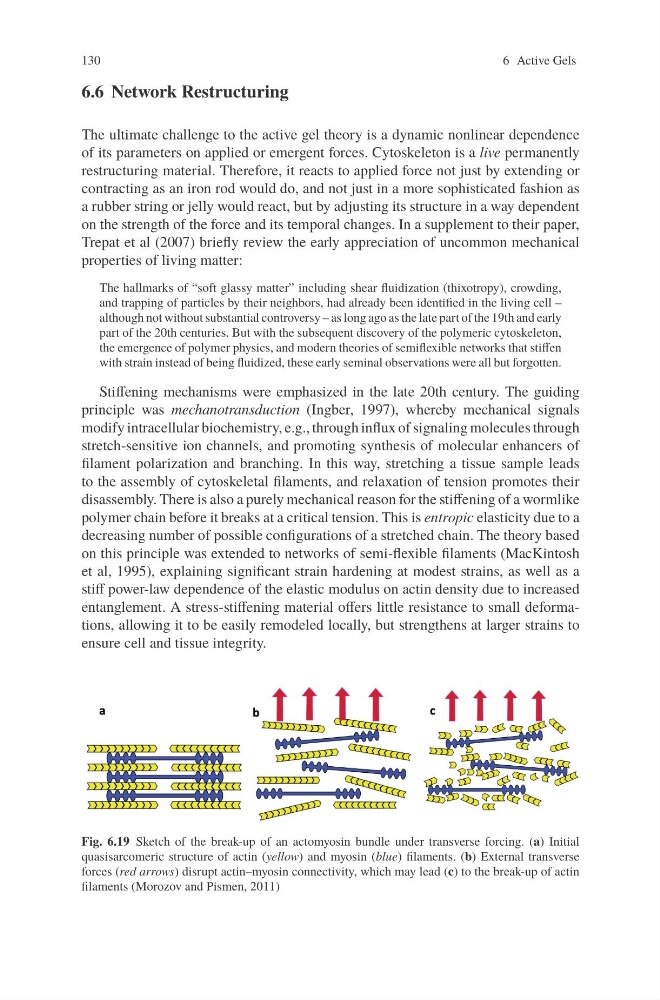
Fig. 6.19 Sketch of the break-up of an actomyosin bundle under transverse forcing. (a) Initial
quasisarcomeric structure of actin (yellow) and myosin (blue) filaments. (b) External transverse
forces (red arrows) disrupt actin–myosin connectivity, which may lead (c) to the break-up of actin
filaments (Morozov and Pismen, 2011)
6 Active Gels
6.6 Network Restructuring
The ultimate challenge to the active gel theory is a dynamic nonlinear dependence
of its parameters on applied or emergent forces. Cytoskeleton is a live permanently
restructuring material. Therefore, it reacts to applied force not just by extending or
contracting as an iron rod would do, and not just in a more sophisticated fashion as
a rubber string or jelly would react, but by adjusting its structure in a way dependent
on the strength of the force and its temporal changes. In a supplement to their paper,
Trepat et al (2007) briefly review the early appreciation of uncommon mechanical
properties of living matter:
The hallmarks of “soft glassy matter” including shear fluidization (thixotropy), crowding,
and trapping of particles by their neighbors, had already been identified in the living cell –
although not without substantial controversy – as long ago as the late part of the 19th and early
part of the 20th centuries. But with the subsequent discovery of the polymeric cytoskeleton,
the emergence of polymer physics, and modern theories of semiflexible networks that stiffen
with strain instead of being fluidized, these early seminal observations were all but forgotten.
Stiffening mechanisms were emphasized in the late 20th century. The guiding
principle was mechanotransduction (Ingber, 1997), whereby mechanical signals
modify intracellular biochemistry, e.g., through influx of signaling molecules through
stretch-sensitive ion channels, and promoting synthesis of molecular enhancers of
filament polarization and branching. In this way, stretching a tissue sample leads
to the assembly of cytoskeletal filaments, and relaxation of tension promotes their
disassembly. There is also a purely mechanical reason for the stiffening of a wormlike
polymer chain before it breaks at a critical tension. This is entropic elasticity due to a
decreasing number of possible configurations of a stretched chain. The theory based
on this principle was extended to networks of semi-flexible filaments (MacKintosh
et al, 1995), explaining significant strain hardening at modest strains, as well as a
stiff power-law dependence of the elastic modulus on actin density due to increased
entanglement. A stress-stiffening material offers little resistance to small deformations, allowing it to be easily remodeled locally, but strengthens at larger strains to
ensure cell and tissue integrity.
Fig. 6.19 Sketch of the break-up of an actomyosin bundle under transverse forcing. (a) Initial
quasisarcomeric structure of actin (yellow) and myosin (blue) filaments. (b) External transverse
forces (red arrows) disrupt actin–myosin connectivity, which may lead (c) to the break-up of actin
filaments (Morozov and Pismen, 2011)