

128
6 Active Gels
phase field when the motion of a single crawling cell was considered in Sect. 6.2.
Here, as in the crawling cell problem, different approaches were attempted, reflecting
physical reality with variable veracity and tinkering efforts. The phase field is no
longer needed because, unlike volume-conserving cells, the layers grow due to
cell division, and therefore tend to advance into available space, in what is called
kenotaxis, from the Greek κκ νóς, meaning “void”. The tendency to advance may be
strengthened by the force deriving from the tendency of cells to form focal adhesions.
This kind of motion is called haptotaxis, from the Greek ´
απτω, meaning “touch”.
It is similar to wetting by common fluids, which is likewise driven by molecular
fluid–substrate interactions.
Arciero et al (2011) managed to fit their observations of the closing gap in a
tissue with the help of a model based on the Darcy law, which itself originated in the
theory of flow in porous media, wherein the velocity is proportional to a pressure
gradient. The pressure was connected to the cell density by the ideal gas law (!), and
the layer was referred to as “a compressible inviscid fluid”, although, of course, the
Darcy law is based on viscous motion. Neither polarity nor activity nor cell division
were included, but the layer nevertheless moved under the action of a force applied
to the free boundary, and the model had enough parameters to produce convincing
pictures and acquire a fair number of citations.
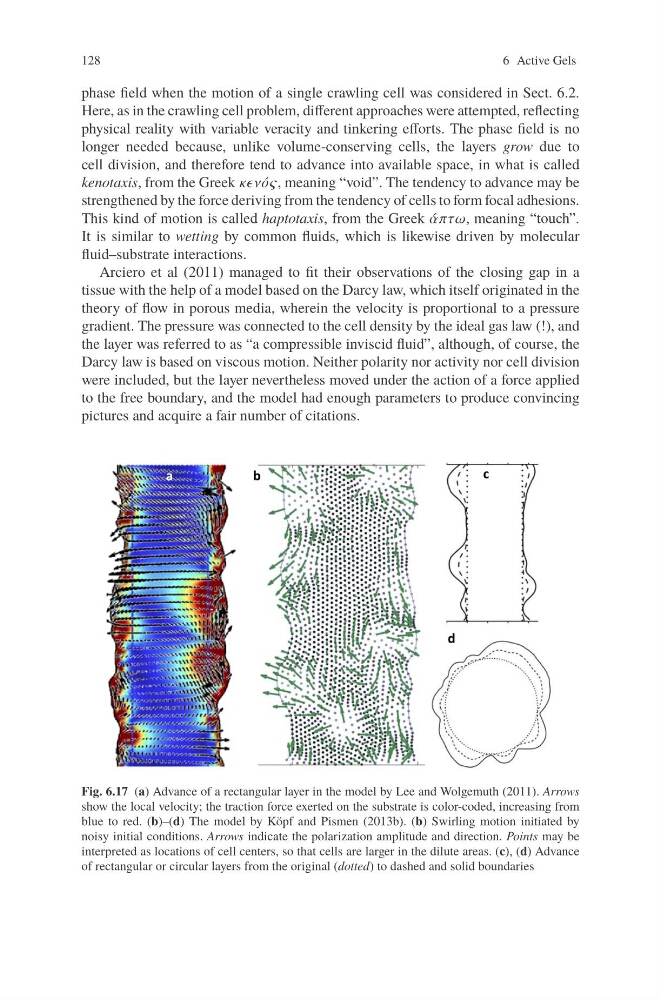
Fig. 6.17 (a) Advance of a rectangular layer in the model by Lee and Wolgemuth (2011). Arrows
show the local velocity; the traction force exerted on the substrate is color-coded, increasing from
blue to red. (b)–(d) The model by Köpf and Pismen (2013b). (b) Swirling motion initiated by
noisy initial conditions. Arrows indicate the polarization amplitude and direction. Points may be
interpreted as locations of cell centers, so that cells are larger in the dilute areas. (c), (d) Advance
of rectangular or circular layers from the original (dotted) to dashed and solid boundaries
6 Active Gels
phase field when the motion of a single crawling cell was considered in Sect. 6.2.
Here, as in the crawling cell problem, different approaches were attempted, reflecting
physical reality with variable veracity and tinkering efforts. The phase field is no
longer needed because, unlike volume-conserving cells, the layers grow due to
cell division, and therefore tend to advance into available space, in what is called
kenotaxis, from the Greek κκ νóς, meaning “void”. The tendency to advance may be
strengthened by the force deriving from the tendency of cells to form focal adhesions.
This kind of motion is called haptotaxis, from the Greek ´
απτω, meaning “touch”.
It is similar to wetting by common fluids, which is likewise driven by molecular
fluid–substrate interactions.
Arciero et al (2011) managed to fit their observations of the closing gap in a
tissue with the help of a model based on the Darcy law, which itself originated in the
theory of flow in porous media, wherein the velocity is proportional to a pressure
gradient. The pressure was connected to the cell density by the ideal gas law (!), and
the layer was referred to as “a compressible inviscid fluid”, although, of course, the
Darcy law is based on viscous motion. Neither polarity nor activity nor cell division
were included, but the layer nevertheless moved under the action of a force applied
to the free boundary, and the model had enough parameters to produce convincing
pictures and acquire a fair number of citations.
Fig. 6.17 (a) Advance of a rectangular layer in the model by Lee and Wolgemuth (2011). Arrows
show the local velocity; the traction force exerted on the substrate is color-coded, increasing from
blue to red. (b)–(d) The model by Köpf and Pismen (2013b). (b) Swirling motion initiated by
noisy initial conditions. Arrows indicate the polarization amplitude and direction. Points may be
interpreted as locations of cell centers, so that cells are larger in the dilute areas. (c), (d) Advance
of rectangular or circular layers from the original (dotted) to dashed and solid boundaries