

5.8 Cytoplasmic Flow
109
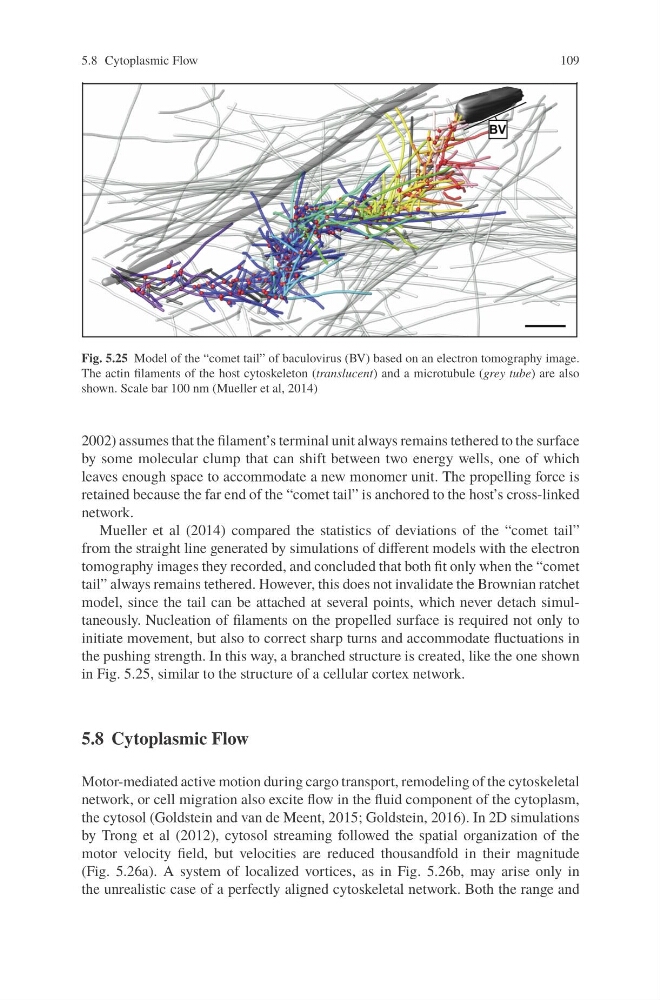
Fig. 5.25 Model of the “comet tail” of baculovirus (BV) based on an electron tomography image.
The actin filaments of the host cytoskeleton (translucent) and a microtubule (grey tube) are also
shown. Scale bar 100 nm (Mueller et al, 2014)
2002) assumes that the filament’s terminal unit always remains tethered to the surface
by some molecular clump that can shift between two energy wells, one of which
leaves enough space to accommodate a new monomer unit. The propelling force is
retained because the far end of the “comet tail” is anchored to the host’s cross-linked
network.
Mueller et al (2014) compared the statistics of deviations of the “comet tail”
from the straight line generated by simulations of different models with the electron
tomography images they recorded, and concluded that both fit only when the “comet
tail” always remains tethered. However, this does not invalidate the Brownian ratchet
model, since the tail can be attached at several points, which never detach simultaneously. Nucleation of filaments on the propelled surface is required not only to
initiate movement, but also to correct sharp turns and accommodate fluctuations in
the pushing strength. In this way, a branched structure is created, like the one shown
in Fig. 5.25, similar to the structure of a cellular cortex network.
5.8 Cytoplasmic Flow
Motor-mediated active motion during cargo transport, remodeling of the cytoskeletal
network, or cell migration also excite flow in the fluid component of the cytoplasm,
the cytosol (Goldstein and van de Meent, 2015; Goldstein, 2016). In 2D simulations
by Trong et al (2012), cytosol streaming followed the spatial organization of the
motor velocity field, but velocities are reduced thousandfold in their magnitude
(Fig. 5.26a). A system of localized vortices, as in Fig. 5.26b, may arise only in
the unrealistic case of a perfectly aligned cytoskeletal network. Both the range and
109
Fig. 5.25 Model of the “comet tail” of baculovirus (BV) based on an electron tomography image.
The actin filaments of the host cytoskeleton (translucent) and a microtubule (grey tube) are also
shown. Scale bar 100 nm (Mueller et al, 2014)
2002) assumes that the filament’s terminal unit always remains tethered to the surface
by some molecular clump that can shift between two energy wells, one of which
leaves enough space to accommodate a new monomer unit. The propelling force is
retained because the far end of the “comet tail” is anchored to the host’s cross-linked
network.
Mueller et al (2014) compared the statistics of deviations of the “comet tail”
from the straight line generated by simulations of different models with the electron
tomography images they recorded, and concluded that both fit only when the “comet
tail” always remains tethered. However, this does not invalidate the Brownian ratchet
model, since the tail can be attached at several points, which never detach simultaneously. Nucleation of filaments on the propelled surface is required not only to
initiate movement, but also to correct sharp turns and accommodate fluctuations in
the pushing strength. In this way, a branched structure is created, like the one shown
in Fig. 5.25, similar to the structure of a cellular cortex network.
5.8 Cytoplasmic Flow
Motor-mediated active motion during cargo transport, remodeling of the cytoskeletal
network, or cell migration also excite flow in the fluid component of the cytoplasm,
the cytosol (Goldstein and van de Meent, 2015; Goldstein, 2016). In 2D simulations
by Trong et al (2012), cytosol streaming followed the spatial organization of the
motor velocity field, but velocities are reduced thousandfold in their magnitude
(Fig. 5.26a). A system of localized vortices, as in Fig. 5.26b, may arise only in
the unrealistic case of a perfectly aligned cytoskeletal network. Both the range and