

108
5 Eukaryotic Cells
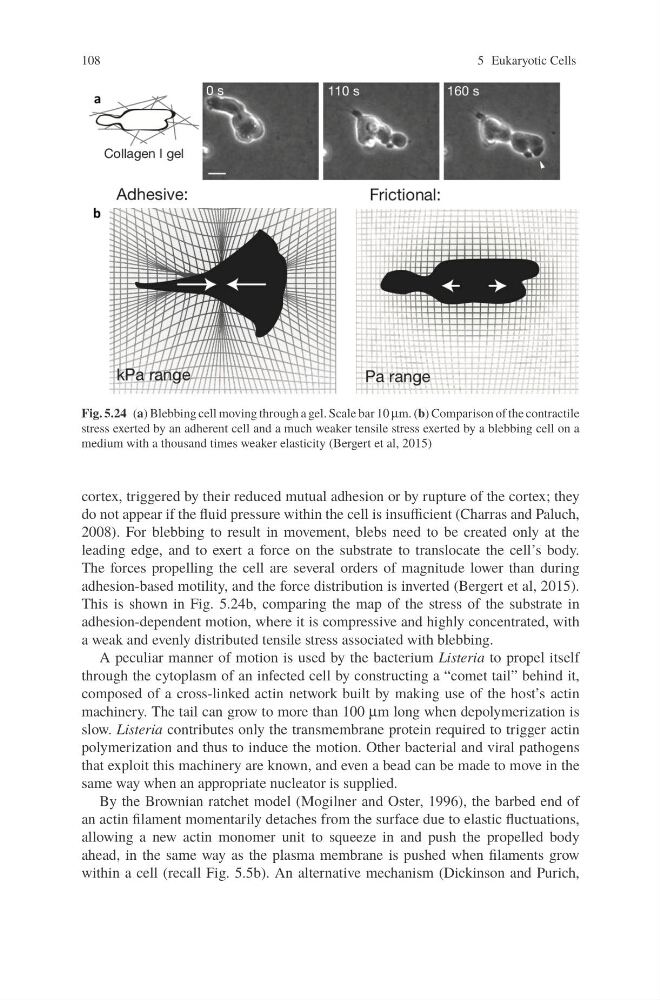
Fig. 5.24 (a) Blebbing cell moving through a gel. Scale bar 10 μm. (b) Comparison of the contractile
stress exerted by an adherent cell and a much weaker tensile stress exerted by a blebbing cell on a
medium with a thousand times weaker elasticity (Bergert et al, 2015)
cortex, triggered by their reduced mutual adhesion or by rupture of the cortex; they
do not appear if the fluid pressure within the cell is insufficient (Charras and Paluch,
2008). For blebbing to result in movement, blebs need to be created only at the
leading edge, and to exert a force on the substrate to translocate the cell’s body.
The forces propelling the cell are several orders of magnitude lower than during
adhesion-based motility, and the force distribution is inverted (Bergert et al, 2015).
This is shown in Fig. 5.24b, comparing the map of the stress of the substrate in
adhesion-dependent motion, where it is compressive and highly concentrated, with
a weak and evenly distributed tensile stress associated with blebbing.
A peculiar manner of motion is used by the bacterium Listeria to propel itself
through the cytoplasm of an infected cell by constructing a “comet tail” behind it,
composed of a cross-linked actin network built by making use of the host’s actin
machinery. The tail can grow to more than 100 μm long when depolymerization is
slow. Listeria contributes only the transmembrane protein required to trigger actin
polymerization and thus to induce the motion. Other bacterial and viral pathogens
that exploit this machinery are known, and even a bead can be made to move in the
same way when an appropriate nucleator is supplied.
By the Brownian ratchet model (Mogilner and Oster, 1996), the barbed end of
an actin filament momentarily detaches from the surface due to elastic fluctuations,
allowing a new actin monomer unit to squeeze in and push the propelled body
ahead, in the same way as the plasma membrane is pushed when filaments grow
within a cell (recall Fig. 5.5b). An alternative mechanism (Dickinson and Purich,
5 Eukaryotic Cells
Fig. 5.24 (a) Blebbing cell moving through a gel. Scale bar 10 μm. (b) Comparison of the contractile
stress exerted by an adherent cell and a much weaker tensile stress exerted by a blebbing cell on a
medium with a thousand times weaker elasticity (Bergert et al, 2015)
cortex, triggered by their reduced mutual adhesion or by rupture of the cortex; they
do not appear if the fluid pressure within the cell is insufficient (Charras and Paluch,
2008). For blebbing to result in movement, blebs need to be created only at the
leading edge, and to exert a force on the substrate to translocate the cell’s body.
The forces propelling the cell are several orders of magnitude lower than during
adhesion-based motility, and the force distribution is inverted (Bergert et al, 2015).
This is shown in Fig. 5.24b, comparing the map of the stress of the substrate in
adhesion-dependent motion, where it is compressive and highly concentrated, with
a weak and evenly distributed tensile stress associated with blebbing.
A peculiar manner of motion is used by the bacterium Listeria to propel itself
through the cytoplasm of an infected cell by constructing a “comet tail” behind it,
composed of a cross-linked actin network built by making use of the host’s actin
machinery. The tail can grow to more than 100 μm long when depolymerization is
slow. Listeria contributes only the transmembrane protein required to trigger actin
polymerization and thus to induce the motion. Other bacterial and viral pathogens
that exploit this machinery are known, and even a bead can be made to move in the
same way when an appropriate nucleator is supplied.
By the Brownian ratchet model (Mogilner and Oster, 1996), the barbed end of
an actin filament momentarily detaches from the surface due to elastic fluctuations,
allowing a new actin monomer unit to squeeze in and push the propelled body
ahead, in the same way as the plasma membrane is pushed when filaments grow
within a cell (recall Fig. 5.5b). An alternative mechanism (Dickinson and Purich,