

100
5 Eukaryotic Cells
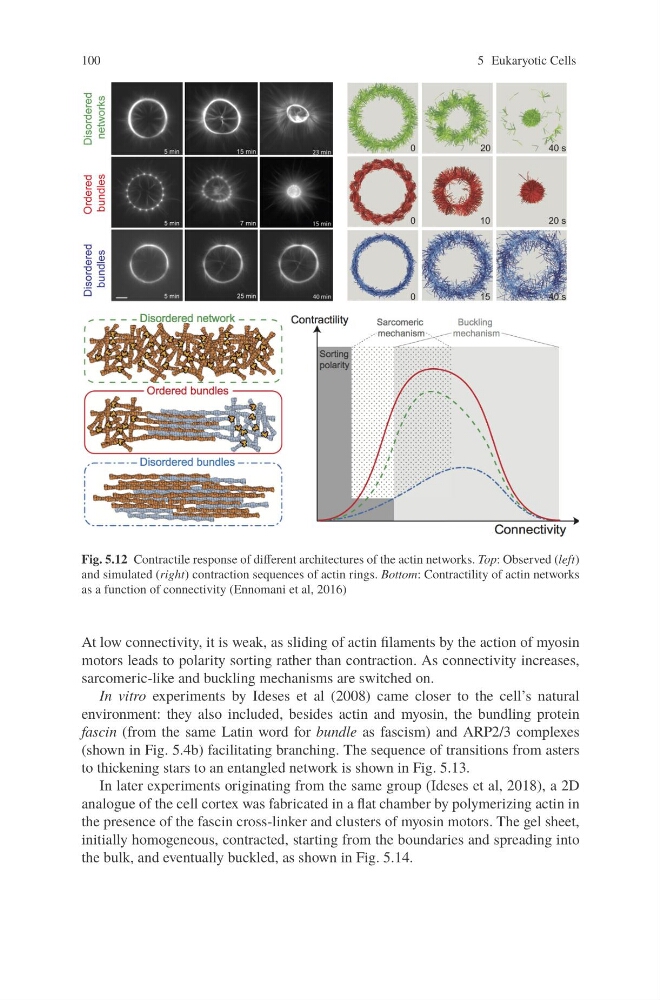
Fig. 5.12 Contractile response of different architectures of the actin networks. Top: Observed (left)
and simulated (right) contraction sequences of actin rings. Bottom: Contractility of actin networks
as a function of connectivity (Ennomani et al, 2016)
At low connectivity, it is weak, as sliding of actin filaments by the action of myosin
motors leads to polarity sorting rather than contraction. As connectivity increases,
sarcomeric-like and buckling mechanisms are switched on.
In vitro experiments by Ideses et al (2008) came closer to the cell’s natural
environment: they also included, besides actin and myosin, the bundling protein
fascin (from the same Latin word for bundle as fascism) and ARP2/3 complexes
(shown in Fig. 5.4b) facilitating branching. The sequence of transitions from asters
to thickening stars to an entangled network is shown in Fig. 5.13.
In later experiments originating from the same group (Ideses et al, 2018), a 2D
analogue of the cell cortex was fabricated in a flat chamber by polymerizing actin in
the presence of the fascin cross-linker and clusters of myosin motors. The gel sheet,
initially homogeneous, contracted, starting from the boundaries and spreading into
the bulk, and eventually buckled, as shown in Fig. 5.14.
5 Eukaryotic Cells
Fig. 5.12 Contractile response of different architectures of the actin networks. Top: Observed (left)
and simulated (right) contraction sequences of actin rings. Bottom: Contractility of actin networks
as a function of connectivity (Ennomani et al, 2016)
At low connectivity, it is weak, as sliding of actin filaments by the action of myosin
motors leads to polarity sorting rather than contraction. As connectivity increases,
sarcomeric-like and buckling mechanisms are switched on.
In vitro experiments by Ideses et al (2008) came closer to the cell’s natural
environment: they also included, besides actin and myosin, the bundling protein
fascin (from the same Latin word for bundle as fascism) and ARP2/3 complexes
(shown in Fig. 5.4b) facilitating branching. The sequence of transitions from asters
to thickening stars to an entangled network is shown in Fig. 5.13.
In later experiments originating from the same group (Ideses et al, 2018), a 2D
analogue of the cell cortex was fabricated in a flat chamber by polymerizing actin in
the presence of the fascin cross-linker and clusters of myosin motors. The gel sheet,
initially homogeneous, contracted, starting from the boundaries and spreading into
the bulk, and eventually buckled, as shown in Fig. 5.14.