

5.2 Filaments and Motors
93
actin monomers (Fig. 5.1b). They are about 6 nm in diameter, and more flexible than
microtubules, but they still bend only slightly over their length. The least prominent
kind are intermediate filaments, about 10 nm thick and far more flexible.
Both microtubules and actin filaments, but not intermediate ones, are polar. The
polarity defines both their direction of growth and the direction of motion of the
associated molecular motors. The latter’s functions are different. Kinesin motors
(Fig. 5.1c) carry protein cargo along microtubules. They have a dimer structure,
with each unit having a globular head; the attached long strands are intertwined in a
stalk. The dimer is structured in such a way that it literally walks upright on its track,
moving its two heads alternately, as we move our feet (Fig. 5.1d).
The required energy comes from the common cellular currency – ATP. The
energy is released when one of its three phosphorous groups is hydrolyzed, ATP
→ ADP (ATriP to ADiP, P standing for phosphate and A for adenosine, the name
of the carrying nucleotide), and is recharged when the missing phosphorus group
is joined back in the mitochondrion. Each step involves a change of conformation,
and requires one ATP molecule to be released. The track is unidirectional: as a rule,
kinesin motors walk towards the “positive” end of polarized microtubules, although
some are able to switch directionality. Actin filaments are associated with myosin
motors, structured, walking, and powered in a similar way, but their main function is
to tie up and stress the filaments, as they are integrated into the cytoskeletal network.
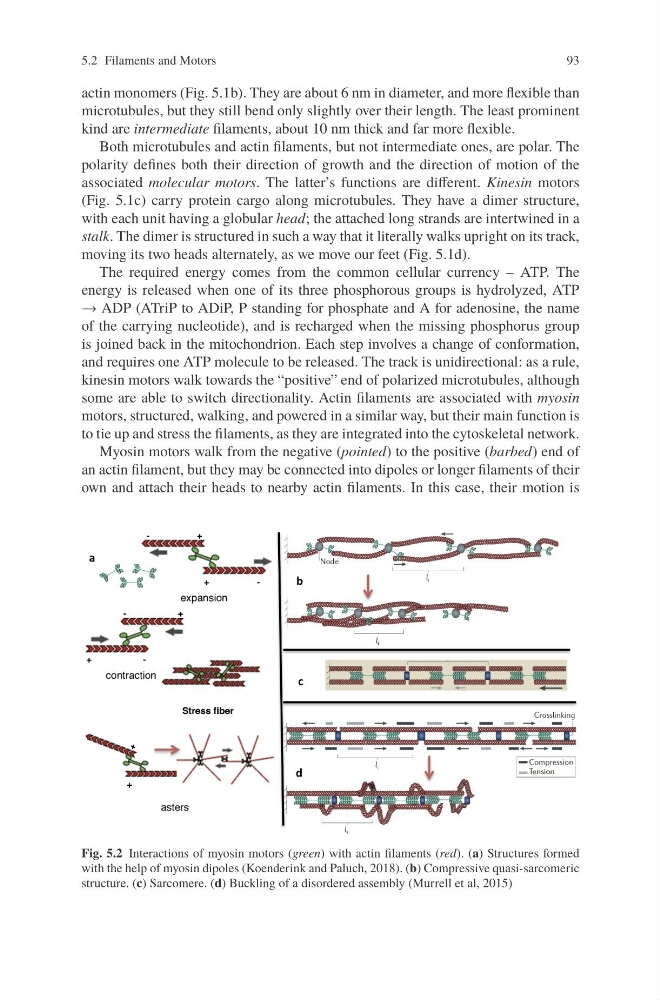
Myosin motors walk from the negative (pointed) to the positive (barbed) end of
an actin filament, but they may be connected into dipoles or longer filaments of their
own and attach their heads to nearby actin filaments. In this case, their motion is
Fig. 5.2 Interactions of myosin motors (green) with actin filaments (red). (a) Structures formed
with the help of myosin dipoles (Koenderink and Paluch, 2018). (b) Compressive quasi-sarcomeric
structure. (c) Sarcomere. (d) Buckling of a disordered assembly (Murrell et al, 2015)
93
actin monomers (Fig. 5.1b). They are about 6 nm in diameter, and more flexible than
microtubules, but they still bend only slightly over their length. The least prominent
kind are intermediate filaments, about 10 nm thick and far more flexible.
Both microtubules and actin filaments, but not intermediate ones, are polar. The
polarity defines both their direction of growth and the direction of motion of the
associated molecular motors. The latter’s functions are different. Kinesin motors
(Fig. 5.1c) carry protein cargo along microtubules. They have a dimer structure,
with each unit having a globular head; the attached long strands are intertwined in a
stalk. The dimer is structured in such a way that it literally walks upright on its track,
moving its two heads alternately, as we move our feet (Fig. 5.1d).
The required energy comes from the common cellular currency – ATP. The
energy is released when one of its three phosphorous groups is hydrolyzed, ATP
→ ADP (ATriP to ADiP, P standing for phosphate and A for adenosine, the name
of the carrying nucleotide), and is recharged when the missing phosphorus group
is joined back in the mitochondrion. Each step involves a change of conformation,
and requires one ATP molecule to be released. The track is unidirectional: as a rule,
kinesin motors walk towards the “positive” end of polarized microtubules, although
some are able to switch directionality. Actin filaments are associated with myosin
motors, structured, walking, and powered in a similar way, but their main function is
to tie up and stress the filaments, as they are integrated into the cytoskeletal network.
Myosin motors walk from the negative (pointed) to the positive (barbed) end of
an actin filament, but they may be connected into dipoles or longer filaments of their
own and attach their heads to nearby actin filaments. In this case, their motion is
Fig. 5.2 Interactions of myosin motors (green) with actin filaments (red). (a) Structures formed
with the help of myosin dipoles (Koenderink and Paluch, 2018). (b) Compressive quasi-sarcomeric
structure. (c) Sarcomere. (d) Buckling of a disordered assembly (Murrell et al, 2015)