

H z
ð Þ ¼ H 0 þ
H 0
2
3Ω M 1 þ z 0
ð
Þ
2 þ 3 1 þ w
ð
ÞΩ DE 1 þ z 0
ð
Þ
3 1þw
ð
ÞÀ1
Ω M 1 þ z 0
ð
Þ
3 þ Ω DE 1 þ z 0
ð
Þ
3 1þw
ð
Þ
h
i 1
2
z À z 0
ð
Þ ð8:2Þ
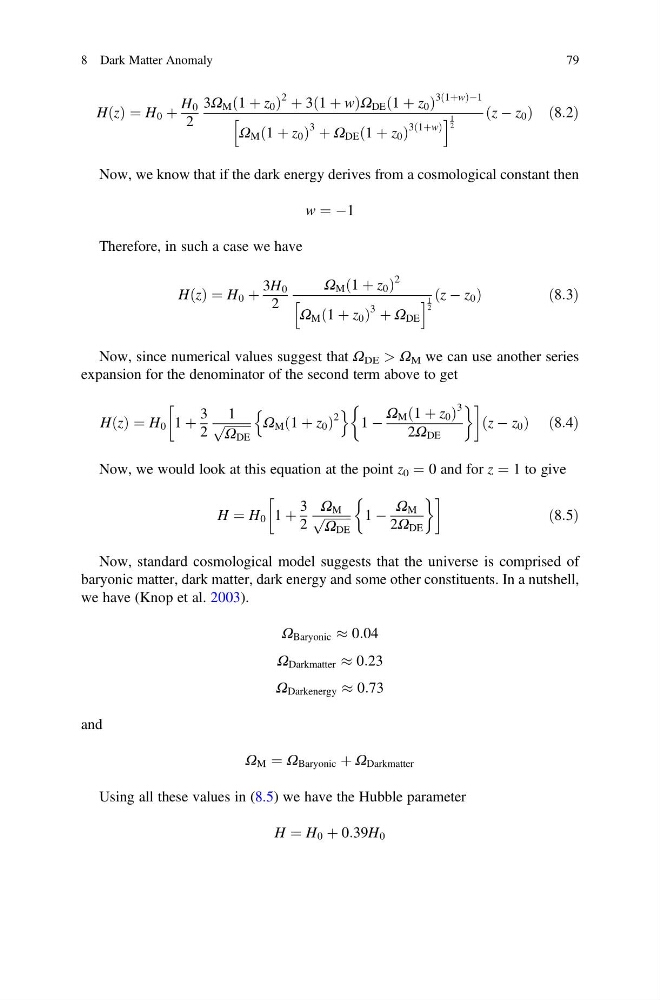
Now, we know that if the dark energy derives from a cosmological constant then
w ¼ À1
Therefore, in such a case we have
H z
ð Þ ¼ H 0 þ
3H 0
2
Ω M 1 þ z 0
ð
Þ
2
Ω M 1 þ z 0
ð
Þ
3 þ Ω DE
h
i 1
2
z À z 0
ð
Þ
ð8:3Þ
Now, since numerical values suggest that Ω DE > Ω M we can use another series
expansion for the denominator of the second term above to get
H z
ð Þ ¼ H 0 1 þ
3
2
1
ffiffiffiffiffiffiffiffi ffi
Ω DE
p
Ω M 1 þ z 0
ð
Þ
2
n
o
1 À
Ω M 1 þ z 0
ð
Þ
3
2Ω DE
z À z 0
ð
Þ ð8:4Þ
Now, we would look at this equation at the point z 0 ¼ 0 and for z ¼ 1 to give
H ¼ H 0 1 þ
3
2
Ω M
ffiffiffiffiffiffiffiffi ffi
Ω DE
p
1 À
Ω M
2Ω DE
ð8:5Þ
Now, standard cosmological model suggests that the universe is comprised of
baryonic matter, dark matter, dark energy and some other constituents. In a nutshell,
we have (Knop et al. 2003).
Ω Baryonic % 0:04
Ω Darkmatter % 0:23
Ω Darkenergy % 0:73
and
Ω M ¼ Ω Baryonic þ Ω Darkmatter
Using all these values in (8.5) we have the Hubble parameter
H ¼ H 0 þ 0:39H 0
8 Dark Matter Anomaly
79
ð Þ ¼ H 0 þ
H 0
2
3Ω M 1 þ z 0
ð
Þ
2 þ 3 1 þ w
ð
ÞΩ DE 1 þ z 0
ð
Þ
3 1þw
ð
ÞÀ1
Ω M 1 þ z 0
ð
Þ
3 þ Ω DE 1 þ z 0
ð
Þ
3 1þw
ð
Þ
h
i 1
2
z À z 0
ð
Þ ð8:2Þ
Now, we know that if the dark energy derives from a cosmological constant then
w ¼ À1
Therefore, in such a case we have
H z
ð Þ ¼ H 0 þ
3H 0
2
Ω M 1 þ z 0
ð
Þ
2
Ω M 1 þ z 0
ð
Þ
3 þ Ω DE
h
i 1
2
z À z 0
ð
Þ
ð8:3Þ
Now, since numerical values suggest that Ω DE > Ω M we can use another series
expansion for the denominator of the second term above to get
H z
ð Þ ¼ H 0 1 þ
3
2
1
ffiffiffiffiffiffiffiffi ffi
Ω DE
p
Ω M 1 þ z 0
ð
Þ
2
n
o
1 À
Ω M 1 þ z 0
ð
Þ
3
2Ω DE
z À z 0
ð
Þ ð8:4Þ
Now, we would look at this equation at the point z 0 ¼ 0 and for z ¼ 1 to give
H ¼ H 0 1 þ
3
2
Ω M
ffiffiffiffiffiffiffiffi ffi
Ω DE
p
1 À
Ω M
2Ω DE
ð8:5Þ
Now, standard cosmological model suggests that the universe is comprised of
baryonic matter, dark matter, dark energy and some other constituents. In a nutshell,
we have (Knop et al. 2003).
Ω Baryonic % 0:04
Ω Darkmatter % 0:23
Ω Darkenergy % 0:73
and
Ω M ¼ Ω Baryonic þ Ω Darkmatter
Using all these values in (8.5) we have the Hubble parameter
H ¼ H 0 þ 0:39H 0
8 Dark Matter Anomaly
79