

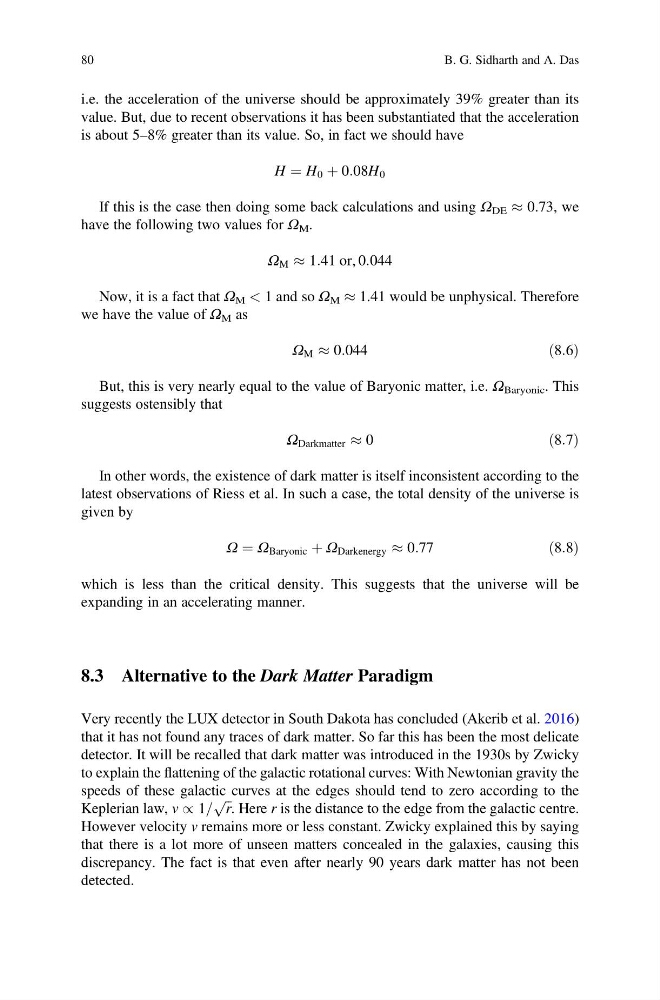
i.e. the acceleration of the universe should be approximately 39% greater than its
value. But, due to recent observations it has been substantiated that the acceleration
is about 5–8% greater than its value. So, in fact we should have
H ¼ H 0 þ 0:08H 0
If this is the case then doing some back calculations and using Ω DE % 0.73, we
have the following two values for Ω M .
Ω M % 1:41 or, 0:044
Now, it is a fact that Ω M < 1 and so Ω M % 1.41 would be unphysical. Therefore
we have the value of Ω M as
Ω M % 0:044
ð8:6Þ
But, this is very nearly equal to the value of Baryonic matter, i.e. Ω Baryonic . This
suggests ostensibly that
Ω Darkmatter % 0
ð8:7Þ
In other words, the existence of dark matter is itself inconsistent according to the
latest observations of Riess et al. In such a case, the total density of the universe is
given by
Ω ¼ Ω Baryonic þ Ω Darkenergy % 0:77
ð8:8Þ
which is less than the critical density. This suggests that the universe will be
expanding in an accelerating manner.
8.3 Alternative to the Dark Matter Paradigm
Very recently the LUX detector in South Dakota has concluded (Akerib et al. 2016)
that it has not found any traces of dark matter. So far this has been the most delicate
detector. It will be recalled that dark matter was introduced in the 1930s by Zwicky
to explain the flattening of the galactic rotational curves: With Newtonian gravity the
speeds of these galactic curves at the edges should tend to zero according to the
Keplerian law, v / 1=
ffiffi
r
p
. Here r is the distance to the edge from the galactic centre.
However velocity v remains more or less constant. Zwicky explained this by saying
that there is a lot more of unseen matters concealed in the galaxies, causing this
discrepancy. The fact is that even after nearly 90 years dark matter has not been
detected.
80
B. G. Sidharth and A. Das
value. But, due to recent observations it has been substantiated that the acceleration
is about 5–8% greater than its value. So, in fact we should have
H ¼ H 0 þ 0:08H 0
If this is the case then doing some back calculations and using Ω DE % 0.73, we
have the following two values for Ω M .
Ω M % 1:41 or, 0:044
Now, it is a fact that Ω M < 1 and so Ω M % 1.41 would be unphysical. Therefore
we have the value of Ω M as
Ω M % 0:044
ð8:6Þ
But, this is very nearly equal to the value of Baryonic matter, i.e. Ω Baryonic . This
suggests ostensibly that
Ω Darkmatter % 0
ð8:7Þ
In other words, the existence of dark matter is itself inconsistent according to the
latest observations of Riess et al. In such a case, the total density of the universe is
given by
Ω ¼ Ω Baryonic þ Ω Darkenergy % 0:77
ð8:8Þ
which is less than the critical density. This suggests that the universe will be
expanding in an accelerating manner.
8.3 Alternative to the Dark Matter Paradigm
Very recently the LUX detector in South Dakota has concluded (Akerib et al. 2016)
that it has not found any traces of dark matter. So far this has been the most delicate
detector. It will be recalled that dark matter was introduced in the 1930s by Zwicky
to explain the flattening of the galactic rotational curves: With Newtonian gravity the
speeds of these galactic curves at the edges should tend to zero according to the
Keplerian law, v / 1=
ffiffi
r
p
. Here r is the distance to the edge from the galactic centre.
However velocity v remains more or less constant. Zwicky explained this by saying
that there is a lot more of unseen matters concealed in the galaxies, causing this
discrepancy. The fact is that even after nearly 90 years dark matter has not been
detected.
80
B. G. Sidharth and A. Das