

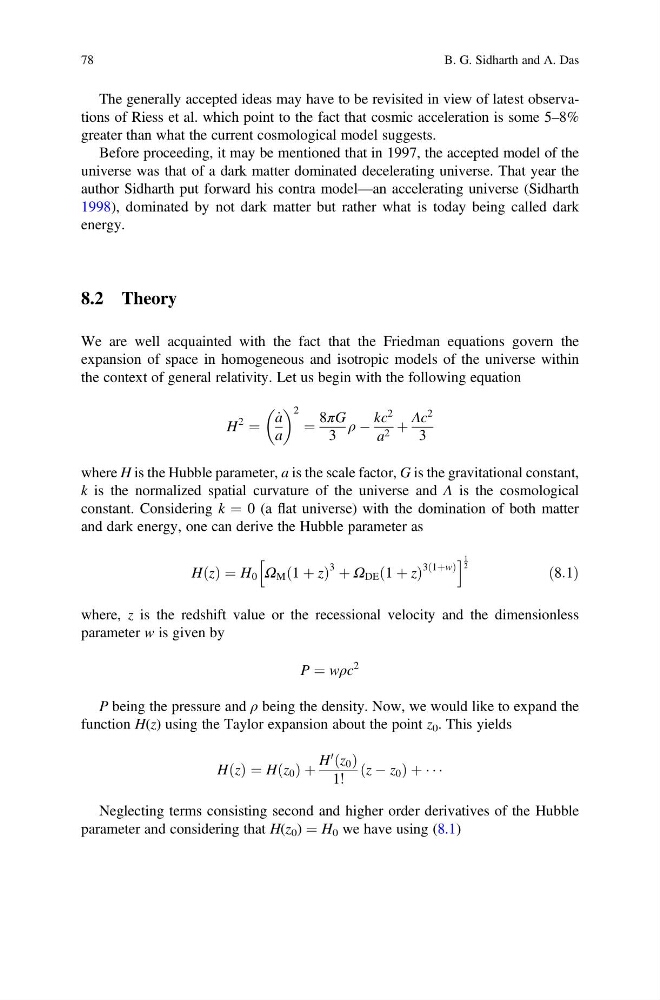
The generally accepted ideas may have to be revisited in view of latest observations of Riess et al. which point to the fact that cosmic acceleration is some 5–8%
greater than what the current cosmological model suggests.
Before proceeding, it may be mentioned that in 1997, the accepted model of the
universe was that of a dark matter dominated decelerating universe. That year the
author Sidharth put forward his contra model—an accelerating universe (Sidharth
1998), dominated by not dark matter but rather what is today being called dark
energy.
8.2 Theory
We are well acquainted with the fact that the Friedman equations govern the
expansion of space in homogeneous and isotropic models of the universe within
the context of general relativity. Let us begin with the following equation
H
2
¼
_
a
a
2
¼
8πG
3
ρ À
kc
2
a 2 þ
Λc
2
3
where H is the Hubble parameter, a is the scale factor, G is the gravitational constant,
k is the normalized spatial curvature of the universe and Λ is the cosmological
constant. Considering k ¼ 0 (a flat universe) with the domination of both matter
and dark energy, one can derive the Hubble parameter as
H z
ð Þ ¼ H 0 Ω M 1 þ z
ð
Þ
3 þ Ω DE 1 þ z
ð
Þ
3 1þw
ð
Þ
h
i 1
2
ð8:1Þ
where, z is the redshift value or the recessional velocity and the dimensionless
parameter w is given by
P ¼ wρc
2
P being the pressure and ρ being the density. Now, we would like to expand the
function H(z) using the Taylor expansion about the point z 0 . This yields
H z
ð Þ ¼ H z 0
ð Þ þ
H
0 z 0
ð Þ
1!
z À z 0
ð
Þ þ Á Á Á
Neglecting terms consisting second and higher order derivatives of the Hubble
parameter and considering that H(z 0 ) ¼ H 0 we have using (8.1)
78
B. G. Sidharth and A. Das
greater than what the current cosmological model suggests.
Before proceeding, it may be mentioned that in 1997, the accepted model of the
universe was that of a dark matter dominated decelerating universe. That year the
author Sidharth put forward his contra model—an accelerating universe (Sidharth
1998), dominated by not dark matter but rather what is today being called dark
energy.
8.2 Theory
We are well acquainted with the fact that the Friedman equations govern the
expansion of space in homogeneous and isotropic models of the universe within
the context of general relativity. Let us begin with the following equation
H
2
¼
_
a
a
2
¼
8πG
3
ρ À
kc
2
a 2 þ
Λc
2
3
where H is the Hubble parameter, a is the scale factor, G is the gravitational constant,
k is the normalized spatial curvature of the universe and Λ is the cosmological
constant. Considering k ¼ 0 (a flat universe) with the domination of both matter
and dark energy, one can derive the Hubble parameter as
H z
ð Þ ¼ H 0 Ω M 1 þ z
ð
Þ
3 þ Ω DE 1 þ z
ð
Þ
3 1þw
ð
Þ
h
i 1
2
ð8:1Þ
where, z is the redshift value or the recessional velocity and the dimensionless
parameter w is given by
P ¼ wρc
2
P being the pressure and ρ being the density. Now, we would like to expand the
function H(z) using the Taylor expansion about the point z 0 . This yields
H z
ð Þ ¼ H z 0
ð Þ þ
H
0 z 0
ð Þ
1!
z À z 0
ð
Þ þ Á Á Á
Neglecting terms consisting second and higher order derivatives of the Hubble
parameter and considering that H(z 0 ) ¼ H 0 we have using (8.1)
78
B. G. Sidharth and A. Das