

where H(cosmol) is a value of the Friedman equation, and if we use the idea that the
potential energy, V, of initial inflation is initially over shadowed by the contributions
of the Friedman equation, H, at the onset of inflation. Then
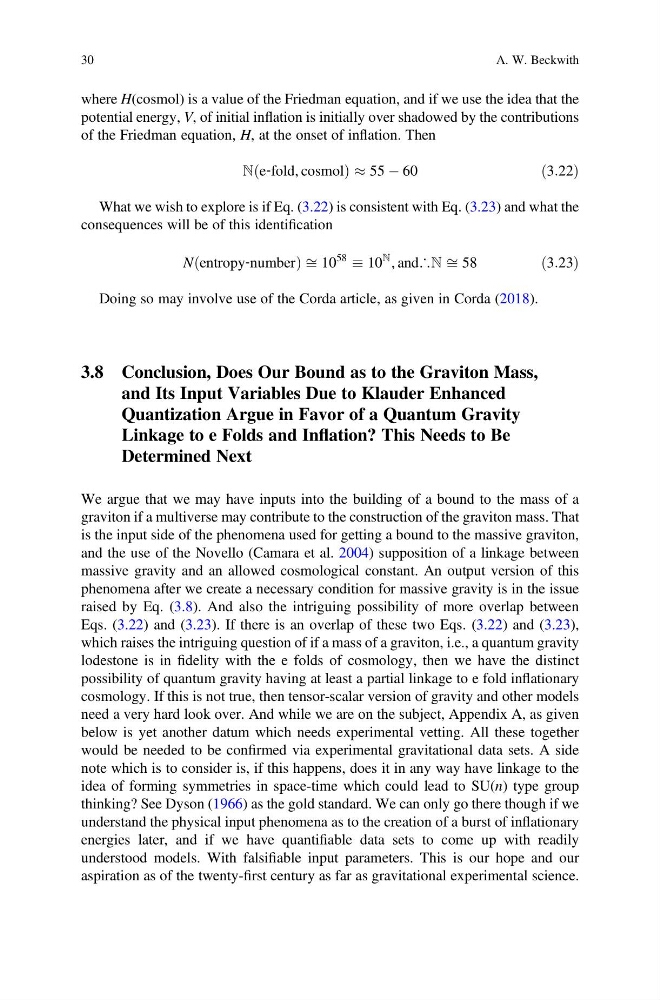
ℕ e‐fold, cosmol
ð
Þ%55 À 60
ð3:22Þ
What we wish to explore is if Eq. (3.22) is consistent with Eq. (3.23) and what the
consequences will be of this identification
N entropy‐number
ð
Þ ffi 10
58
10
ℕ , and∴ℕ ffi 58
ð3:23Þ
Doing so may involve use of the Corda article, as given in Corda (2018).
3.8 Conclusion, Does Our Bound as to the Graviton Mass,
and Its Input Variables Due to Klauder Enhanced
Quantization Argue in Favor of a Quantum Gravity
Linkage to e Folds and Inflation? This Needs to Be
Determined Next
We argue that we may have inputs into the building of a bound to the mass of a
graviton if a multiverse may contribute to the construction of the graviton mass. That
is the input side of the phenomena used for getting a bound to the massive graviton,
and the use of the Novello (Camara et al. 2004) supposition of a linkage between
massive gravity and an allowed cosmological constant. An output version of this
phenomena after we create a necessary condition for massive gravity is in the issue
raised by Eq. (3.8). And also the intriguing possibility of more overlap between
Eqs. (3.22) and (3.23). If there is an overlap of these two Eqs. (3.22) and (3.23),
which raises the intriguing question of if a mass of a graviton, i.e., a quantum gravity
lodestone is in fidelity with the e folds of cosmology, then we have the distinct
possibility of quantum gravity having at least a partial linkage to e fold inflationary
cosmology. If this is not true, then tensor-scalar version of gravity and other models
need a very hard look over. And while we are on the subject, Appendix A, as given
below is yet another datum which needs experimental vetting. All these together
would be needed to be confirmed via experimental gravitational data sets. A side
note which is to consider is, if this happens, does it in any way have linkage to the
idea of forming symmetries in space-time which could lead to SU(n) type group
thinking? See Dyson (1966) as the gold standard. We can only go there though if we
understand the physical input phenomena as to the creation of a burst of inflationary
energies later, and if we have quantifiable data sets to come up with readily
understood models. With falsifiable input parameters. This is our hope and our
aspiration as of the twenty-first century as far as gravitational experimental science.
30
A. W. Beckwith
potential energy, V, of initial inflation is initially over shadowed by the contributions
of the Friedman equation, H, at the onset of inflation. Then
ℕ e‐fold, cosmol
ð
Þ%55 À 60
ð3:22Þ
What we wish to explore is if Eq. (3.22) is consistent with Eq. (3.23) and what the
consequences will be of this identification
N entropy‐number
ð
Þ ffi 10
58
10
ℕ , and∴ℕ ffi 58
ð3:23Þ
Doing so may involve use of the Corda article, as given in Corda (2018).
3.8 Conclusion, Does Our Bound as to the Graviton Mass,
and Its Input Variables Due to Klauder Enhanced
Quantization Argue in Favor of a Quantum Gravity
Linkage to e Folds and Inflation? This Needs to Be
Determined Next
We argue that we may have inputs into the building of a bound to the mass of a
graviton if a multiverse may contribute to the construction of the graviton mass. That
is the input side of the phenomena used for getting a bound to the massive graviton,
and the use of the Novello (Camara et al. 2004) supposition of a linkage between
massive gravity and an allowed cosmological constant. An output version of this
phenomena after we create a necessary condition for massive gravity is in the issue
raised by Eq. (3.8). And also the intriguing possibility of more overlap between
Eqs. (3.22) and (3.23). If there is an overlap of these two Eqs. (3.22) and (3.23),
which raises the intriguing question of if a mass of a graviton, i.e., a quantum gravity
lodestone is in fidelity with the e folds of cosmology, then we have the distinct
possibility of quantum gravity having at least a partial linkage to e fold inflationary
cosmology. If this is not true, then tensor-scalar version of gravity and other models
need a very hard look over. And while we are on the subject, Appendix A, as given
below is yet another datum which needs experimental vetting. All these together
would be needed to be confirmed via experimental gravitational data sets. A side
note which is to consider is, if this happens, does it in any way have linkage to the
idea of forming symmetries in space-time which could lead to SU(n) type group
thinking? See Dyson (1966) as the gold standard. We can only go there though if we
understand the physical input phenomena as to the creation of a burst of inflationary
energies later, and if we have quantifiable data sets to come up with readily
understood models. With falsifiable input parameters. This is our hope and our
aspiration as of the twenty-first century as far as gravitational experimental science.
30
A. W. Beckwith