

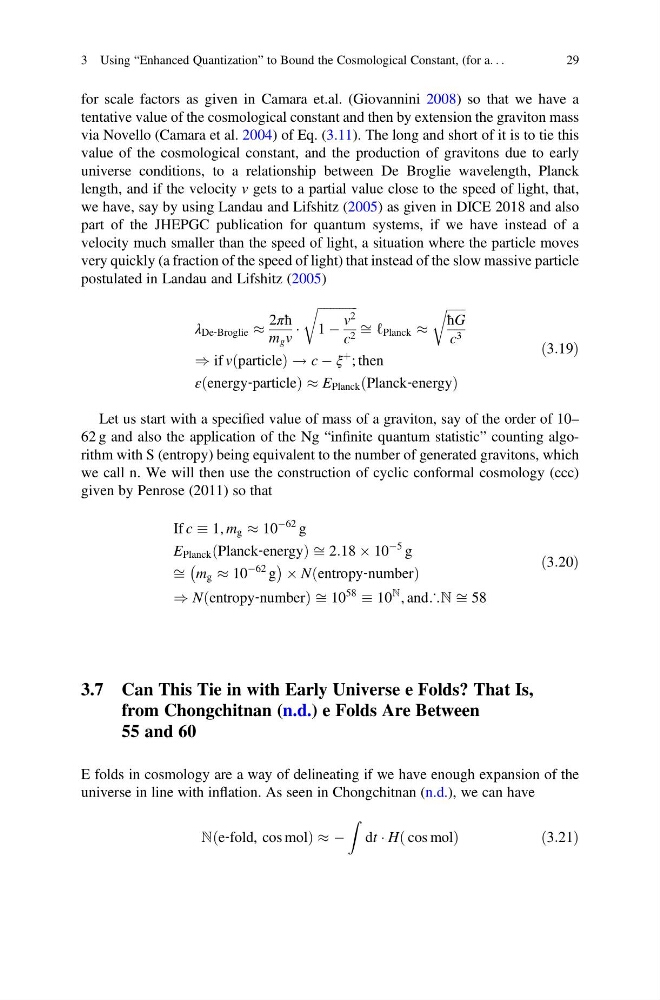
for scale factors as given in Camara et.al. (Giovannini 2008) so that we have a
tentative value of the cosmological constant and then by extension the graviton mass
via Novello (Camara et al. 2004) of Eq. (3.11). The long and short of it is to tie this
value of the cosmological constant, and the production of gravitons due to early
universe conditions, to a relationship between De Broglie wavelength, Planck
length, and if the velocity v gets to a partial value close to the speed of light, that,
we have, say by using Landau and Lifshitz (2005) as given in DICE 2018 and also
part of the JHEPGC publication for quantum systems, if we have instead of a
velocity much smaller than the speed of light, a situation where the particle moves
very quickly (a fraction of the speed of light) that instead of the slow massive particle
postulated in Landau and Lifshitz (2005)
λ De‐Broglie %
2πħ
m g v
Á
ffiffiffiffiffiffiffiffiffiffiffiffi ffi
1 À
v
2
c 2
r
ffi ℓ Planck %
ffiffiffiffiffiffi
ħG
c 3
r
) if v particle
ð
Þ!c À ξ
þ ; then
ε energy‐particle
ð
Þ % E Planck Planck‐energy
ð
Þ
ð3:19Þ
Let us start with a specified value of mass of a graviton, say of the order of 10–
62 g and also the application of the Ng “infinite quantum statistic” counting algorithm with S (entropy) being equivalent to the number of generated gravitons, which
we call n. We will then use the construction of cyclic conformal cosmology (ccc)
given by Penrose (2011) so that
If c 1, m g % 10
À62 g
E Planck Planck‐energy
ð
Þffi2:18 Â 10
À5 g
ffi m g % 10
À62 g
À
Á Â N entropy‐number
ð
Þ
) N entropy‐number
ð
Þ ffi 10
58
10
ℕ , and∴ℕ ffi 58
ð3:20Þ
3.7 Can This Tie in with Early Universe e Folds? That Is,
from Chongchitnan (n.d.) e Folds Are Between
55 and 60
E folds in cosmology are a way of delineating if we have enough expansion of the
universe in line with inflation. As seen in Chongchitnan (n.d.), we can have
ℕ e‐fold, cos mol
ð
Þ % À
Z
dt Á H cos mol
ð
Þ
ð 3:21Þ
3 Using “Enhanced Quantization” to Bound the Cosmological Constant, (for a. . .
29
tentative value of the cosmological constant and then by extension the graviton mass
via Novello (Camara et al. 2004) of Eq. (3.11). The long and short of it is to tie this
value of the cosmological constant, and the production of gravitons due to early
universe conditions, to a relationship between De Broglie wavelength, Planck
length, and if the velocity v gets to a partial value close to the speed of light, that,
we have, say by using Landau and Lifshitz (2005) as given in DICE 2018 and also
part of the JHEPGC publication for quantum systems, if we have instead of a
velocity much smaller than the speed of light, a situation where the particle moves
very quickly (a fraction of the speed of light) that instead of the slow massive particle
postulated in Landau and Lifshitz (2005)
λ De‐Broglie %
2πħ
m g v
Á
ffiffiffiffiffiffiffiffiffiffiffiffi ffi
1 À
v
2
c 2
r
ffi ℓ Planck %
ffiffiffiffiffiffi
ħG
c 3
r
) if v particle
ð
Þ!c À ξ
þ ; then
ε energy‐particle
ð
Þ % E Planck Planck‐energy
ð
Þ
ð3:19Þ
Let us start with a specified value of mass of a graviton, say of the order of 10–
62 g and also the application of the Ng “infinite quantum statistic” counting algorithm with S (entropy) being equivalent to the number of generated gravitons, which
we call n. We will then use the construction of cyclic conformal cosmology (ccc)
given by Penrose (2011) so that
If c 1, m g % 10
À62 g
E Planck Planck‐energy
ð
Þffi2:18 Â 10
À5 g
ffi m g % 10
À62 g
À
Á Â N entropy‐number
ð
Þ
) N entropy‐number
ð
Þ ffi 10
58
10
ℕ , and∴ℕ ffi 58
ð3:20Þ
3.7 Can This Tie in with Early Universe e Folds? That Is,
from Chongchitnan (n.d.) e Folds Are Between
55 and 60
E folds in cosmology are a way of delineating if we have enough expansion of the
universe in line with inflation. As seen in Chongchitnan (n.d.), we can have
ℕ e‐fold, cos mol
ð
Þ % À
Z
dt Á H cos mol
ð
Þ
ð 3:21Þ
3 Using “Enhanced Quantization” to Bound the Cosmological Constant, (for a. . .
29