

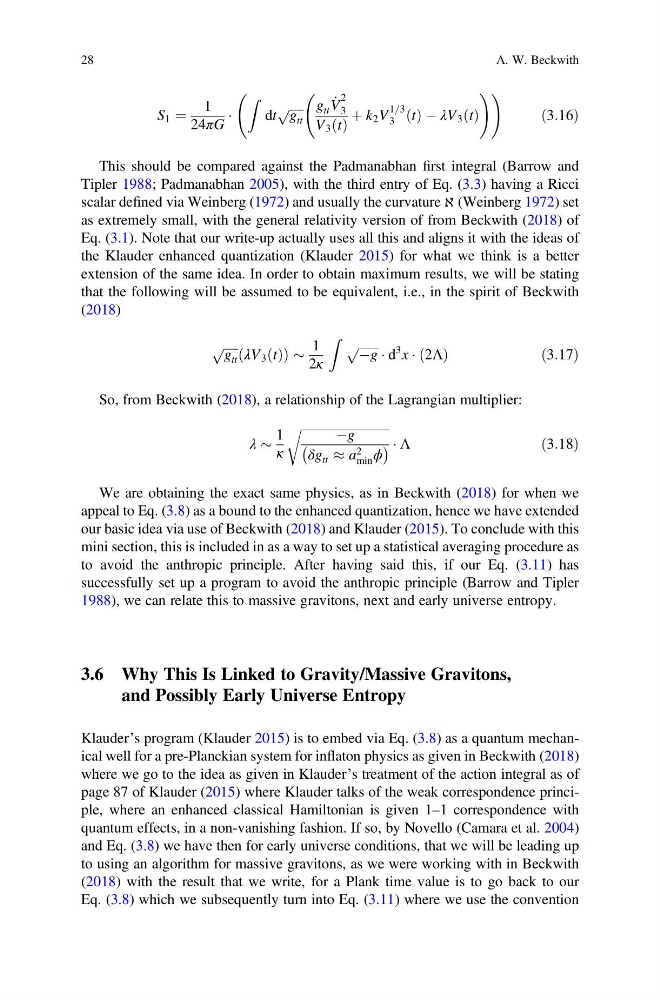
S 1 ¼
1
24πG
Á
Z
dt
ffiffiffiffiffi
g tt
p
g tt _
V
2
3
V 3 t
ð Þ
þ k 2 V
1=3
3
t
ð Þ À λV 3 t
ð Þ
! !
ð3:16Þ
This should be compared against the Padmanabhan first integral (Barrow and
Tipler 1988; Padmanabhan 2005), with the third entry of Eq. (3.3) having a Ricci
scalar defined via Weinberg (1972) and usually the curvature ℵ (Weinberg 1972) set
as extremely small, with the general relativity version of from Beckwith (2018) of
Eq. (3.1). Note that our write-up actually uses all this and aligns it with the ideas of
the Klauder enhanced quantization (Klauder 2015) for what we think is a better
extension of the same idea. In order to obtain maximum results, we will be stating
that the following will be assumed to be equivalent, i.e., in the spirit of Beckwith
(2018)
ffiffiffiffiffi
g tt
p λV 3 t
ð Þ
ð
Þ$
1
2κ
Z ffiffiffiffiffiffi ffi
Àg
p Á d
3 x Á 2Λ
ð Þ
ð3:17Þ
So, from Beckwith (2018), a relationship of the Lagrangian multiplier:
λ $
1
κ
ffiffiffiffiffiffiffiffiffiffiffiffiffiffiffiffiffiffiffiffiffiffiffiffiffiffiffiffi ffi
Àg
δg tt % a 2
min ϕ
À
Á
r
Á Λ
ð3:18Þ
We are obtaining the exact same physics, as in Beckwith (2018) for when we
appeal to Eq. (3.8) as a bound to the enhanced quantization, hence we have extended
our basic idea via use of Beckwith (2018) and Klauder (2015). To conclude with this
mini section, this is included in as a way to set up a statistical averaging procedure as
to avoid the anthropic principle. After having said this, if our Eq. (3.11) has
successfully set up a program to avoid the anthropic principle (Barrow and Tipler
1988), we can relate this to massive gravitons, next and early universe entropy.
3.6 Why This Is Linked to Gravity/Massive Gravitons,
and Possibly Early Universe Entropy
Klauder’s program (Klauder 2015) is to embed via Eq. (3.8) as a quantum mechanical well for a pre-Planckian system for inflaton physics as given in Beckwith (2018)
where we go to the idea as given in Klauder’s treatment of the action integral as of
page 87 of Klauder (2015) where Klauder talks of the weak correspondence principle, where an enhanced classical Hamiltonian is given 1–1 correspondence with
quantum effects, in a non-vanishing fashion. If so, by Novello (Camara et al. 2004)
and Eq. (3.8) we have then for early universe conditions, that we will be leading up
to using an algorithm for massive gravitons, as we were working with in Beckwith
(2018) with the result that we write, for a Plank time value is to go back to our
Eq. (3.8) which we subsequently turn into Eq. (3.11) where we use the convention
28
A. W. Beckwith
1
24πG
Á
Z
dt
ffiffiffiffiffi
g tt
p
g tt _
V
2
3
V 3 t
ð Þ
þ k 2 V
1=3
3
t
ð Þ À λV 3 t
ð Þ
! !
ð3:16Þ
This should be compared against the Padmanabhan first integral (Barrow and
Tipler 1988; Padmanabhan 2005), with the third entry of Eq. (3.3) having a Ricci
scalar defined via Weinberg (1972) and usually the curvature ℵ (Weinberg 1972) set
as extremely small, with the general relativity version of from Beckwith (2018) of
Eq. (3.1). Note that our write-up actually uses all this and aligns it with the ideas of
the Klauder enhanced quantization (Klauder 2015) for what we think is a better
extension of the same idea. In order to obtain maximum results, we will be stating
that the following will be assumed to be equivalent, i.e., in the spirit of Beckwith
(2018)
ffiffiffiffiffi
g tt
p λV 3 t
ð Þ
ð
Þ$
1
2κ
Z ffiffiffiffiffiffi ffi
Àg
p Á d
3 x Á 2Λ
ð Þ
ð3:17Þ
So, from Beckwith (2018), a relationship of the Lagrangian multiplier:
λ $
1
κ
ffiffiffiffiffiffiffiffiffiffiffiffiffiffiffiffiffiffiffiffiffiffiffiffiffiffiffiffi ffi
Àg
δg tt % a 2
min ϕ
À
Á
r
Á Λ
ð3:18Þ
We are obtaining the exact same physics, as in Beckwith (2018) for when we
appeal to Eq. (3.8) as a bound to the enhanced quantization, hence we have extended
our basic idea via use of Beckwith (2018) and Klauder (2015). To conclude with this
mini section, this is included in as a way to set up a statistical averaging procedure as
to avoid the anthropic principle. After having said this, if our Eq. (3.11) has
successfully set up a program to avoid the anthropic principle (Barrow and Tipler
1988), we can relate this to massive gravitons, next and early universe entropy.
3.6 Why This Is Linked to Gravity/Massive Gravitons,
and Possibly Early Universe Entropy
Klauder’s program (Klauder 2015) is to embed via Eq. (3.8) as a quantum mechanical well for a pre-Planckian system for inflaton physics as given in Beckwith (2018)
where we go to the idea as given in Klauder’s treatment of the action integral as of
page 87 of Klauder (2015) where Klauder talks of the weak correspondence principle, where an enhanced classical Hamiltonian is given 1–1 correspondence with
quantum effects, in a non-vanishing fashion. If so, by Novello (Camara et al. 2004)
and Eq. (3.8) we have then for early universe conditions, that we will be leading up
to using an algorithm for massive gravitons, as we were working with in Beckwith
(2018) with the result that we write, for a Plank time value is to go back to our
Eq. (3.8) which we subsequently turn into Eq. (3.11) where we use the convention
28
A. W. Beckwith