

Note that the main methodology in the Penrose proposal (Beckwith 2014, 2018;
Penrose 2011) has been evaluating a change in the metric g ab by a conformal
mapping b
Ω to
b g ab ¼ b
Ω
2
g ab
ð3:12Þ
Penrose’s suggestion has been to utilize the following (Beckwith 2014, 2018;
Penrose 2011)
b
Ω!
ccc
b
Ω
À1
ð3:13Þ
In fall into cosmic black hopes has been the main mechanism which will be useful
for the recycling apparent in Eq. (3.14) above with ħ kept constant from cycle to
cycle as represented by Beckwith (2014, 2018)
ħ old‐cosmology‐cycle ¼ ħ present‐cosmology‐cycle
ð3:14Þ
We claim that Eq. (3.14) with Eq. (3.8) and Eq. (3.10) above gives a uniform
mass to a graviton, per cycle, if Equation (3.14) holds we have the ability to make
gravitons keep a constant non zero mass from cycle to cycle of the CCC paradigm.
The idea is to keep consistency in physical law during each cycle of CCC dynamics.
If the laws of laws of physics remain invariant , then graviton mass will not be
altered. This also involves the physics of Ng (2008), Poplawski (2011), and
Hawkings (n.d.). In doing so, from Beckwith (2018) consider the dynamics of the
scale factor a(t), which is nearly zero, in the pre-Planckian regime of space-time. i.e.,
as to how a(t) changes and evolves, we look at the treatment given in Roos (2003) as
well as Dye (1965). In addition by Beckwith (2018) and Hamber (2009).
Z
dt
ffiffiffiffiffi
g tt
p V 3 t
ð Þ ¼ V 4 t
ð Þ $ 8π
2 r
4
=3
&V 3 t
ð Þ ¼ 2π
2 a t
ð Þ
3 =3
&k 2 ¼ 9 2π
2
À Á 2=3
ð3:15Þ
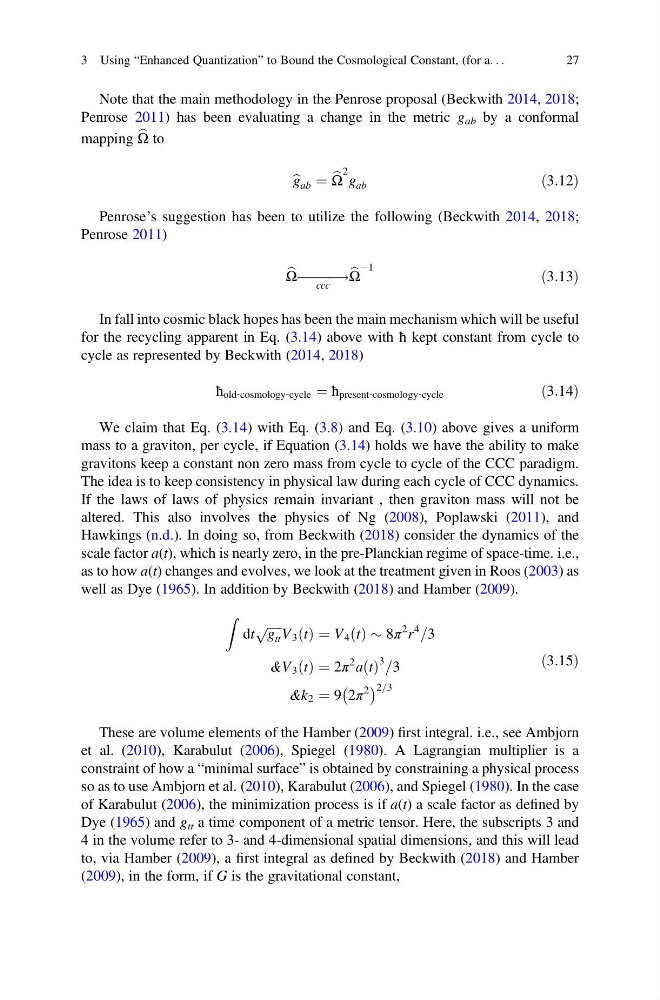
These are volume elements of the Hamber (2009) first integral. i.e., see Ambjorn
et al. (2010), Karabulut (2006), Spiegel (1980). A Lagrangian multiplier is a
constraint of how a “minimal surface” is obtained by constraining a physical process
so as to use Ambjorn et al. (2010), Karabulut (2006), and Spiegel (1980). In the case
of Karabulut (2006), the minimization process is if a(t) a scale factor as defined by
Dye (1965) and g tt a time component of a metric tensor. Here, the subscripts 3 and
4 in the volume refer to 3- and 4-dimensional spatial dimensions, and this will lead
to, via Hamber (2009), a first integral as defined by Beckwith (2018) and Hamber
(2009), in the form, if G is the gravitational constant,
3 Using “Enhanced Quantization” to Bound the Cosmological Constant, (for a. . .
27
Penrose 2011) has been evaluating a change in the metric g ab by a conformal
mapping b
Ω to
b g ab ¼ b
Ω
2
g ab
ð3:12Þ
Penrose’s suggestion has been to utilize the following (Beckwith 2014, 2018;
Penrose 2011)
b
Ω!
ccc
b
Ω
À1
ð3:13Þ
In fall into cosmic black hopes has been the main mechanism which will be useful
for the recycling apparent in Eq. (3.14) above with ħ kept constant from cycle to
cycle as represented by Beckwith (2014, 2018)
ħ old‐cosmology‐cycle ¼ ħ present‐cosmology‐cycle
ð3:14Þ
We claim that Eq. (3.14) with Eq. (3.8) and Eq. (3.10) above gives a uniform
mass to a graviton, per cycle, if Equation (3.14) holds we have the ability to make
gravitons keep a constant non zero mass from cycle to cycle of the CCC paradigm.
The idea is to keep consistency in physical law during each cycle of CCC dynamics.
If the laws of laws of physics remain invariant , then graviton mass will not be
altered. This also involves the physics of Ng (2008), Poplawski (2011), and
Hawkings (n.d.). In doing so, from Beckwith (2018) consider the dynamics of the
scale factor a(t), which is nearly zero, in the pre-Planckian regime of space-time. i.e.,
as to how a(t) changes and evolves, we look at the treatment given in Roos (2003) as
well as Dye (1965). In addition by Beckwith (2018) and Hamber (2009).
Z
dt
ffiffiffiffiffi
g tt
p V 3 t
ð Þ ¼ V 4 t
ð Þ $ 8π
2 r
4
=3
&V 3 t
ð Þ ¼ 2π
2 a t
ð Þ
3 =3
&k 2 ¼ 9 2π
2
À Á 2=3
ð3:15Þ
These are volume elements of the Hamber (2009) first integral. i.e., see Ambjorn
et al. (2010), Karabulut (2006), Spiegel (1980). A Lagrangian multiplier is a
constraint of how a “minimal surface” is obtained by constraining a physical process
so as to use Ambjorn et al. (2010), Karabulut (2006), and Spiegel (1980). In the case
of Karabulut (2006), the minimization process is if a(t) a scale factor as defined by
Dye (1965) and g tt a time component of a metric tensor. Here, the subscripts 3 and
4 in the volume refer to 3- and 4-dimensional spatial dimensions, and this will lead
to, via Hamber (2009), a first integral as defined by Beckwith (2018) and Hamber
(2009), in the form, if G is the gravitational constant,
3 Using “Enhanced Quantization” to Bound the Cosmological Constant, (for a. . .
27