

Claim 3.1
1
N
Á
X N
j¼1
Ξ j
j‐before‐nucleation‐regime
!
vacuum‐nucleation‐tranfer
Ξ i j i‐fixed‐after‐nucleation‐regime
ð3:10Þ
And
Ξ j
j‐before‐nucleation‐regime
%
X Max
k¼1
e
Ξ k
black‐holes‐jth‐universe
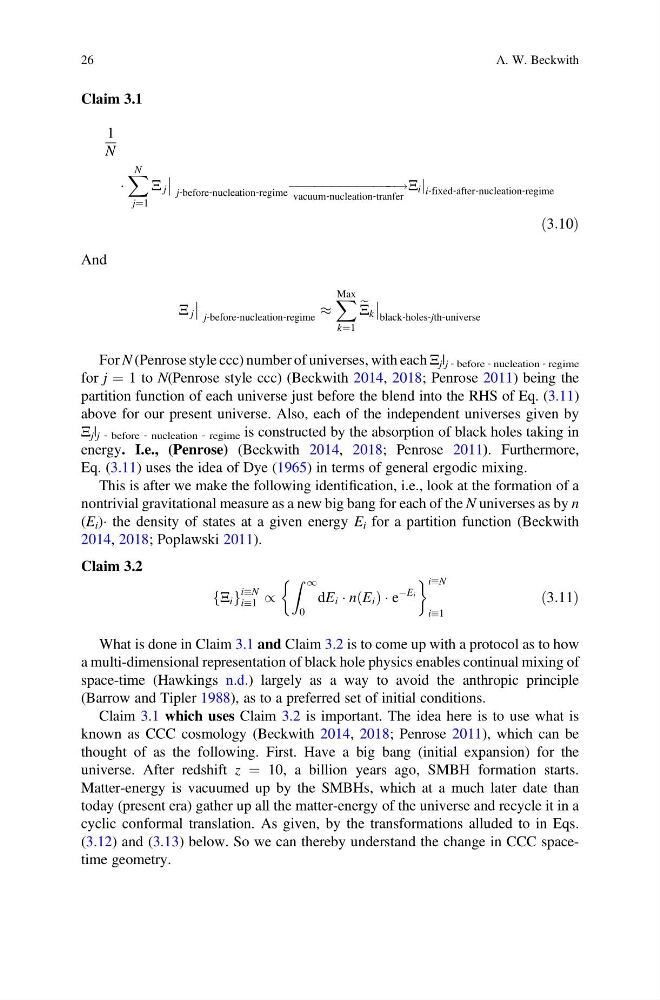
For N (Penrose style ccc) number of universes, with each Ξ j | j ‐ before ‐ nucleation ‐ regime
for j ¼ 1 to N(Penrose style ccc) (Beckwith 2014, 2018; Penrose 2011) being the
partition function of each universe just before the blend into the RHS of Eq. (3.11)
above for our present universe. Also, each of the independent universes given by
Ξ j | j ‐ before ‐ nucleation ‐ regime is constructed by the absorption of black holes taking in
energy. I.e., (Penrose) (Beckwith 2014, 2018; Penrose 2011). Furthermore,
Eq. (3.11) uses the idea of Dye (1965) in terms of general ergodic mixing.
This is after we make the following identification, i.e., look at the formation of a
nontrivial gravitational measure as a new big bang for each of the N universes as by n
(E i )Á the density of states at a given energy E i for a partition function (Beckwith
2014, 2018; Poplawski 2011).
Claim 3.2
Ξ i
f g
iN
i1 /
Z 1
0
dE i Á n E i
ð Þ Á e
ÀE i
&
' iN
i1
ð3:11Þ
What is done in Claim 3.1 and Claim 3.2 is to come up with a protocol as to how
a multi-dimensional representation of black hole physics enables continual mixing of
space-time (Hawkings n.d.) largely as a way to avoid the anthropic principle
(Barrow and Tipler 1988), as to a preferred set of initial conditions.
Claim 3.1 which uses Claim 3.2 is important. The idea here is to use what is
known as CCC cosmology (Beckwith 2014, 2018; Penrose 2011), which can be
thought of as the following. First. Have a big bang (initial expansion) for the
universe. After redshift z ¼ 10, a billion years ago, SMBH formation starts.
Matter-energy is vacuumed up by the SMBHs, which at a much later date than
today (present era) gather up all the matter-energy of the universe and recycle it in a
cyclic conformal translation. As given, by the transformations alluded to in Eqs.
(3.12) and (3.13) below. So we can thereby understand the change in CCC spacetime geometry.
26
A. W. Beckwith
1
N
Á
X N
j¼1
Ξ j
j‐before‐nucleation‐regime
!
vacuum‐nucleation‐tranfer
Ξ i j i‐fixed‐after‐nucleation‐regime
ð3:10Þ
And
Ξ j
j‐before‐nucleation‐regime
%
X Max
k¼1
e
Ξ k
black‐holes‐jth‐universe
For N (Penrose style ccc) number of universes, with each Ξ j | j ‐ before ‐ nucleation ‐ regime
for j ¼ 1 to N(Penrose style ccc) (Beckwith 2014, 2018; Penrose 2011) being the
partition function of each universe just before the blend into the RHS of Eq. (3.11)
above for our present universe. Also, each of the independent universes given by
Ξ j | j ‐ before ‐ nucleation ‐ regime is constructed by the absorption of black holes taking in
energy. I.e., (Penrose) (Beckwith 2014, 2018; Penrose 2011). Furthermore,
Eq. (3.11) uses the idea of Dye (1965) in terms of general ergodic mixing.
This is after we make the following identification, i.e., look at the formation of a
nontrivial gravitational measure as a new big bang for each of the N universes as by n
(E i )Á the density of states at a given energy E i for a partition function (Beckwith
2014, 2018; Poplawski 2011).
Claim 3.2
Ξ i
f g
iN
i1 /
Z 1
0
dE i Á n E i
ð Þ Á e
ÀE i
&
' iN
i1
ð3:11Þ
What is done in Claim 3.1 and Claim 3.2 is to come up with a protocol as to how
a multi-dimensional representation of black hole physics enables continual mixing of
space-time (Hawkings n.d.) largely as a way to avoid the anthropic principle
(Barrow and Tipler 1988), as to a preferred set of initial conditions.
Claim 3.1 which uses Claim 3.2 is important. The idea here is to use what is
known as CCC cosmology (Beckwith 2014, 2018; Penrose 2011), which can be
thought of as the following. First. Have a big bang (initial expansion) for the
universe. After redshift z ¼ 10, a billion years ago, SMBH formation starts.
Matter-energy is vacuumed up by the SMBHs, which at a much later date than
today (present era) gather up all the matter-energy of the universe and recycle it in a
cyclic conformal translation. As given, by the transformations alluded to in Eqs.
(3.12) and (3.13) below. So we can thereby understand the change in CCC spacetime geometry.
26
A. W. Beckwith