

Finally what if there are many micro black holes created almost at the start of the
Universe? What would this do in terms of GW generation? See Appendix B, as a
future works project which may add more context as far as the varying mechanisms
as far as GW, and our project is so delineated. This is in terms of entropy, itself and is
a much smaller contribution of entropy than what is already delineated. But if we
develop GW physics as an experimental science, this too may be something not to
ignore and will involve the physics of Chongchitnan (n.d.), Corda (2018), and
Dyson (1966) fully.
Appendix A: Infinite Quantum Statistics as Given by Jack Ng
Jack Ng changes conventional statistics: he outlines how to get S % N, which with
additional arguments we refine to be S % < n> (where is graviton density).
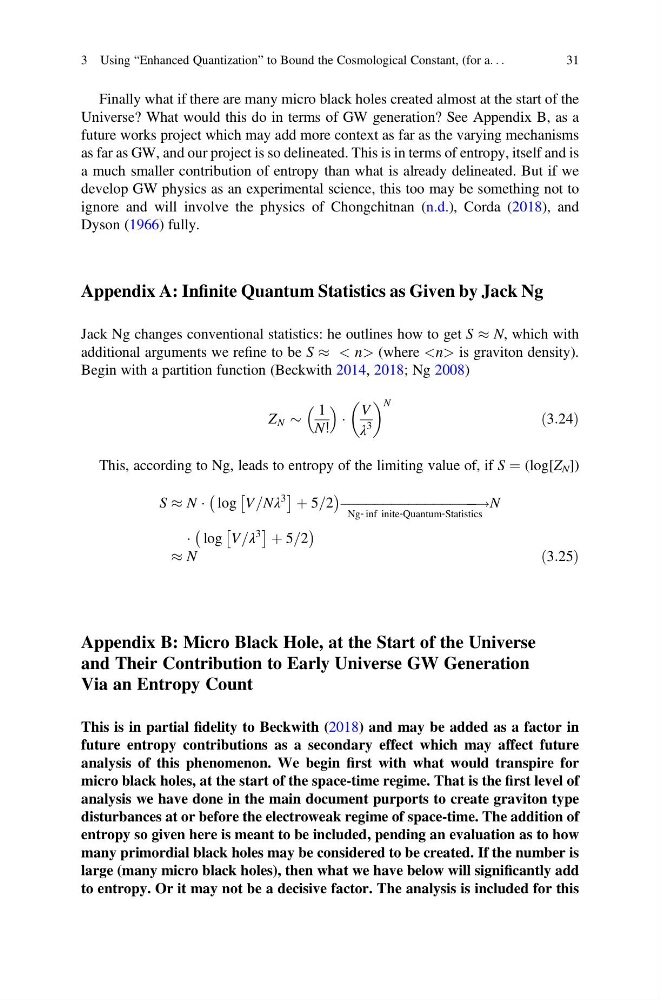
Begin with a partition function (Beckwith 2014, 2018; Ng 2008)
Z N $
1
N!
Á
V
λ
3
N
ð3:24Þ
This, according to Ng, leads to entropy of the limiting value of, if S ¼ (log[Z N ])
S % N Á log V=Nλ
3
Â
à þ 5=2
À
Á !
Ng‐ inf inite‐Quantum‐Statistics
N
Á log V=λ
3
Â
à þ 5=2
À
Á
% N
ð3:25Þ
Appendix B: Micro Black Hole, at the Start of the Universe
and Their Contribution to Early Universe GW Generation
Via an Entropy Count
This is in partial fidelity to Beckwith (2018) and may be added as a factor in
future entropy contributions as a secondary effect which may affect future
analysis of this phenomenon. We begin first with what would transpire for
micro black holes, at the start of the space-time regime. That is the first level of
analysis we have done in the main document purports to create graviton type
disturbances at or before the electroweak regime of space-time. The addition of
entropy so given here is meant to be included, pending an evaluation as to how
many primordial black holes may be considered to be created. If the number is
large (many micro black holes), then what we have below will significantly add
to entropy. Or it may not be a decisive factor. The analysis is included for this
3 Using “Enhanced Quantization” to Bound the Cosmological Constant, (for a. . .
31
Universe? What would this do in terms of GW generation? See Appendix B, as a
future works project which may add more context as far as the varying mechanisms
as far as GW, and our project is so delineated. This is in terms of entropy, itself and is
a much smaller contribution of entropy than what is already delineated. But if we
develop GW physics as an experimental science, this too may be something not to
ignore and will involve the physics of Chongchitnan (n.d.), Corda (2018), and
Dyson (1966) fully.
Appendix A: Infinite Quantum Statistics as Given by Jack Ng
Jack Ng changes conventional statistics: he outlines how to get S % N, which with
additional arguments we refine to be S % < n> (where
Begin with a partition function (Beckwith 2014, 2018; Ng 2008)
Z N $
1
N!
Á
V
λ
3
N
ð3:24Þ
This, according to Ng, leads to entropy of the limiting value of, if S ¼ (log[Z N ])
S % N Á log V=Nλ
3
Â
à þ 5=2
À
Á !
Ng‐ inf inite‐Quantum‐Statistics
N
Á log V=λ
3
Â
à þ 5=2
À
Á
% N
ð3:25Þ
Appendix B: Micro Black Hole, at the Start of the Universe
and Their Contribution to Early Universe GW Generation
Via an Entropy Count
This is in partial fidelity to Beckwith (2018) and may be added as a factor in
future entropy contributions as a secondary effect which may affect future
analysis of this phenomenon. We begin first with what would transpire for
micro black holes, at the start of the space-time regime. That is the first level of
analysis we have done in the main document purports to create graviton type
disturbances at or before the electroweak regime of space-time. The addition of
entropy so given here is meant to be included, pending an evaluation as to how
many primordial black holes may be considered to be created. If the number is
large (many micro black holes), then what we have below will significantly add
to entropy. Or it may not be a decisive factor. The analysis is included for this
3 Using “Enhanced Quantization” to Bound the Cosmological Constant, (for a. . .
31