

in terms of line energy, corresponding to energy differences between atomic levels,
requires consolidation exercises, in particular the design of energy levels and related
emissions (Ph12.1) or vice versa with the reconstruction of a structure of energy
levels starting from a discrete spectrum (Ph11.2). Knowingly, the Bohr model is
avoided in order to avoid the idea that a single energy level correspond to a specific
orbit (valid only for the hydrogen atom), and discussing, in more general terms, an
atom as a system having access to only specific energetic values.
Beyond the lab exploration of diffraction phenomena described above, two
experimental activities have been implemented in the path for enriching the educational proposals: thanks to them, students observe different kinds of spectra, the
discrete one emitted by a gas-discharge lamp and a non-complete continuous one
with an emission peak typical of LEDs. The two experiments described in the
following, despite widely used in spectroscopy lessons, assumed an original role
since they have been coupled with targeted questions to inquiry students’ reasoning.
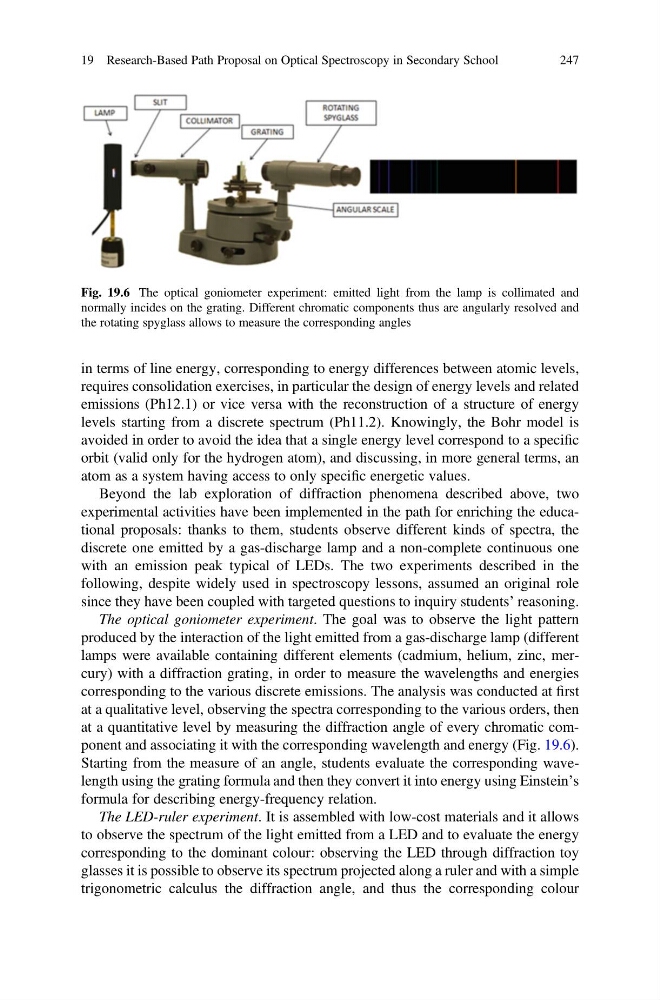
The optical goniometer experiment. The goal was to observe the light pattern
produced by the interaction of the light emitted from a gas-discharge lamp (different
lamps were available containing different elements (cadmium, helium, zinc, mercury) with a diffraction grating, in order to measure the wavelengths and energies
corresponding to the various discrete emissions. The analysis was conducted at first
at a qualitative level, observing the spectra corresponding to the various orders, then
at a quantitative level by measuring the diffraction angle of every chromatic component and associating it with the corresponding wavelength and energy (Fig. 19.6).
Starting from the measure of an angle, students evaluate the corresponding wavelength using the grating formula and then they convert it into energy using Einstein’s
formula for describing energy-frequency relation.
The LED-ruler experiment. It is assembled with low-cost materials and it allows
to observe the spectrum of the light emitted from a LED and to evaluate the energy
corresponding to the dominant colour: observing the LED through diffraction toy
glasses it is possible to observe its spectrum projected along a ruler and with a simple
trigonometric calculus the diffraction angle, and thus the corresponding colour
Fig. 19.6 The optical goniometer experiment: emitted light from the lamp is collimated and
normally incides on the grating. Different chromatic components thus are angularly resolved and
the rotating spyglass allows to measure the corresponding angles
19 Research-Based Path Proposal on Optical Spectroscopy in Secondary School
247
requires consolidation exercises, in particular the design of energy levels and related
emissions (Ph12.1) or vice versa with the reconstruction of a structure of energy
levels starting from a discrete spectrum (Ph11.2). Knowingly, the Bohr model is
avoided in order to avoid the idea that a single energy level correspond to a specific
orbit (valid only for the hydrogen atom), and discussing, in more general terms, an
atom as a system having access to only specific energetic values.
Beyond the lab exploration of diffraction phenomena described above, two
experimental activities have been implemented in the path for enriching the educational proposals: thanks to them, students observe different kinds of spectra, the
discrete one emitted by a gas-discharge lamp and a non-complete continuous one
with an emission peak typical of LEDs. The two experiments described in the
following, despite widely used in spectroscopy lessons, assumed an original role
since they have been coupled with targeted questions to inquiry students’ reasoning.
The optical goniometer experiment. The goal was to observe the light pattern
produced by the interaction of the light emitted from a gas-discharge lamp (different
lamps were available containing different elements (cadmium, helium, zinc, mercury) with a diffraction grating, in order to measure the wavelengths and energies
corresponding to the various discrete emissions. The analysis was conducted at first
at a qualitative level, observing the spectra corresponding to the various orders, then
at a quantitative level by measuring the diffraction angle of every chromatic component and associating it with the corresponding wavelength and energy (Fig. 19.6).
Starting from the measure of an angle, students evaluate the corresponding wavelength using the grating formula and then they convert it into energy using Einstein’s
formula for describing energy-frequency relation.
The LED-ruler experiment. It is assembled with low-cost materials and it allows
to observe the spectrum of the light emitted from a LED and to evaluate the energy
corresponding to the dominant colour: observing the LED through diffraction toy
glasses it is possible to observe its spectrum projected along a ruler and with a simple
trigonometric calculus the diffraction angle, and thus the corresponding colour
Fig. 19.6 The optical goniometer experiment: emitted light from the lamp is collimated and
normally incides on the grating. Different chromatic components thus are angularly resolved and
the rotating spyglass allows to measure the corresponding angles
19 Research-Based Path Proposal on Optical Spectroscopy in Secondary School
247