

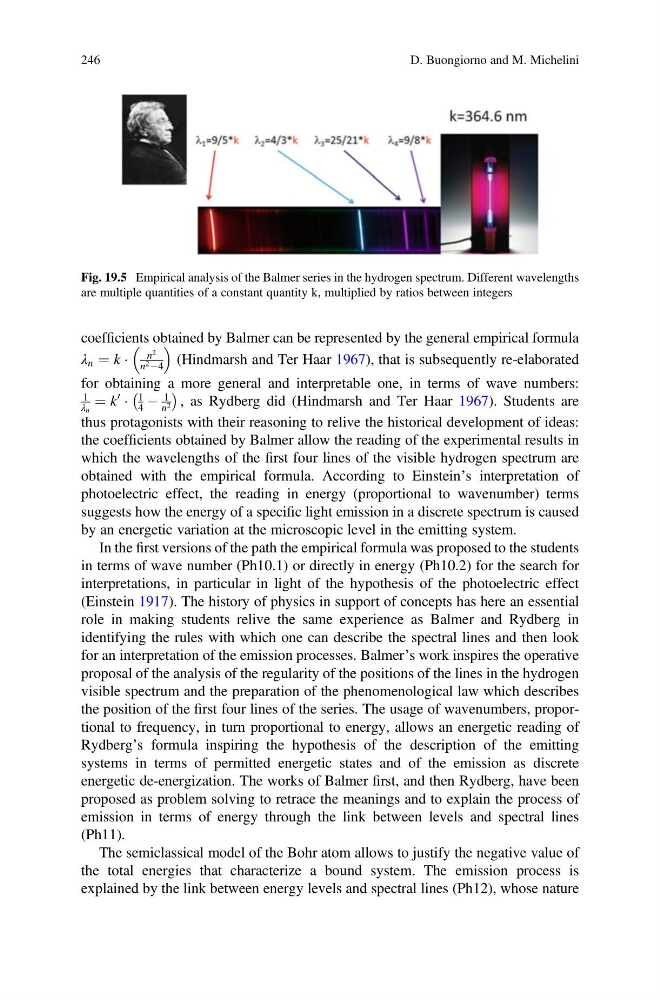
coefficients obtained by Balmer can be represented by the general empirical formula
λ n ¼ k Á
n
2
n 2 À4
(Hindmarsh and Ter Haar 1967), that is subsequently re-elaborated
for obtaining a more general and interpretable one, in terms of wave numbers:
1
λ n
¼ k
0
Á
1
4 À
1
n 2
À
Á
, as Rydberg did (Hindmarsh and Ter Haar 1967). Students are
thus protagonists with their reasoning to relive the historical development of ideas:
the coefficients obtained by Balmer allow the reading of the experimental results in
which the wavelengths of the first four lines of the visible hydrogen spectrum are
obtained with the empirical formula. According to Einstein’s interpretation of
photoelectric effect, the reading in energy (proportional to wavenumber) terms
suggests how the energy of a specific light emission in a discrete spectrum is caused
by an energetic variation at the microscopic level in the emitting system.
In the first versions of the path the empirical formula was proposed to the students
in terms of wave number (Ph10.1) or directly in energy (Ph10.2) for the search for
interpretations, in particular in light of the hypothesis of the photoelectric effect
(Einstein 1917). The history of physics in support of concepts has here an essential
role in making students relive the same experience as Balmer and Rydberg in
identifying the rules with which one can describe the spectral lines and then look
for an interpretation of the emission processes. Balmer’s work inspires the operative
proposal of the analysis of the regularity of the positions of the lines in the hydrogen
visible spectrum and the preparation of the phenomenological law which describes
the position of the first four lines of the series. The usage of wavenumbers, proportional to frequency, in turn proportional to energy, allows an energetic reading of
Rydberg’s formula inspiring the hypothesis of the description of the emitting
systems in terms of permitted energetic states and of the emission as discrete
energetic de-energization. The works of Balmer first, and then Rydberg, have been
proposed as problem solving to retrace the meanings and to explain the process of
emission in terms of energy through the link between levels and spectral lines
(Ph11).
The semiclassical model of the Bohr atom allows to justify the negative value of
the total energies that characterize a bound system. The emission process is
explained by the link between energy levels and spectral lines (Ph12), whose nature
Fig. 19.5 Empirical analysis of the Balmer series in the hydrogen spectrum. Different wavelengths
are multiple quantities of a constant quantity k, multiplied by ratios between integers
246
D. Buongiorno and M. Michelini
λ n ¼ k Á
n
2
n 2 À4
(Hindmarsh and Ter Haar 1967), that is subsequently re-elaborated
for obtaining a more general and interpretable one, in terms of wave numbers:
1
λ n
¼ k
0
Á
1
4 À
1
n 2
À
Á
, as Rydberg did (Hindmarsh and Ter Haar 1967). Students are
thus protagonists with their reasoning to relive the historical development of ideas:
the coefficients obtained by Balmer allow the reading of the experimental results in
which the wavelengths of the first four lines of the visible hydrogen spectrum are
obtained with the empirical formula. According to Einstein’s interpretation of
photoelectric effect, the reading in energy (proportional to wavenumber) terms
suggests how the energy of a specific light emission in a discrete spectrum is caused
by an energetic variation at the microscopic level in the emitting system.
In the first versions of the path the empirical formula was proposed to the students
in terms of wave number (Ph10.1) or directly in energy (Ph10.2) for the search for
interpretations, in particular in light of the hypothesis of the photoelectric effect
(Einstein 1917). The history of physics in support of concepts has here an essential
role in making students relive the same experience as Balmer and Rydberg in
identifying the rules with which one can describe the spectral lines and then look
for an interpretation of the emission processes. Balmer’s work inspires the operative
proposal of the analysis of the regularity of the positions of the lines in the hydrogen
visible spectrum and the preparation of the phenomenological law which describes
the position of the first four lines of the series. The usage of wavenumbers, proportional to frequency, in turn proportional to energy, allows an energetic reading of
Rydberg’s formula inspiring the hypothesis of the description of the emitting
systems in terms of permitted energetic states and of the emission as discrete
energetic de-energization. The works of Balmer first, and then Rydberg, have been
proposed as problem solving to retrace the meanings and to explain the process of
emission in terms of energy through the link between levels and spectral lines
(Ph11).
The semiclassical model of the Bohr atom allows to justify the negative value of
the total energies that characterize a bound system. The emission process is
explained by the link between energy levels and spectral lines (Ph12), whose nature
Fig. 19.5 Empirical analysis of the Balmer series in the hydrogen spectrum. Different wavelengths
are multiple quantities of a constant quantity k, multiplied by ratios between integers
246
D. Buongiorno and M. Michelini