

took place with IBL strategy (Michelini and Stefanel 2015) in which students
themselves (Ph8.1) design an experiment in order to obtain the laws describing the
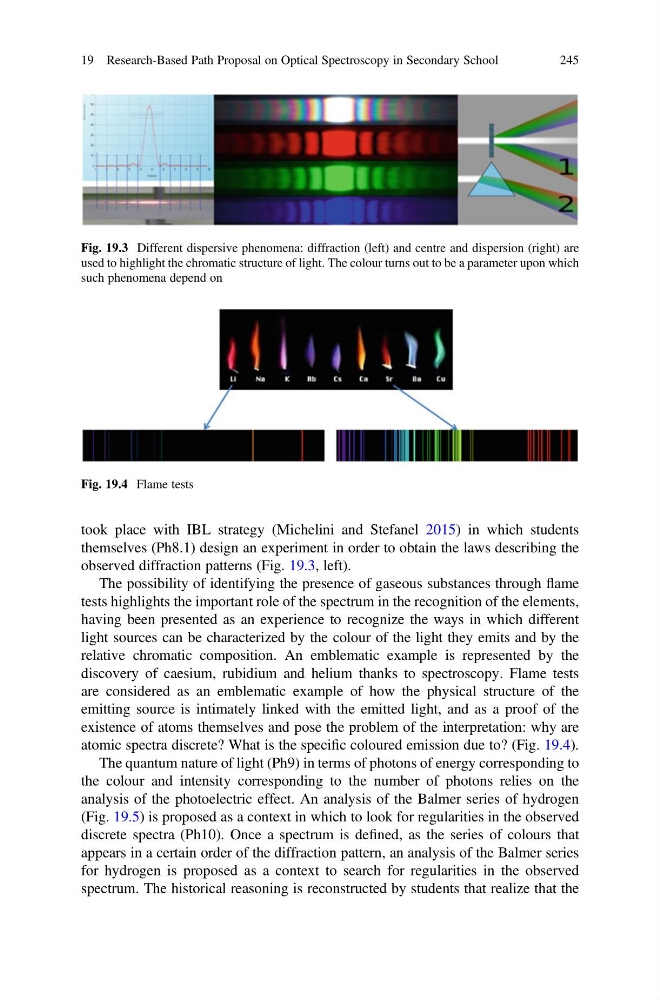
observed diffraction patterns (Fig. 19.3, left).
The possibility of identifying the presence of gaseous substances through flame
tests highlights the important role of the spectrum in the recognition of the elements,
having been presented as an experience to recognize the ways in which different
light sources can be characterized by the colour of the light they emits and by the
relative chromatic composition. An emblematic example is represented by the
discovery of caesium, rubidium and helium thanks to spectroscopy. Flame tests
are considered as an emblematic example of how the physical structure of the
emitting source is intimately linked with the emitted light, and as a proof of the
existence of atoms themselves and pose the problem of the interpretation: why are
atomic spectra discrete? What is the specific coloured emission due to? (Fig. 19.4).
The quantum nature of light (Ph9) in terms of photons of energy corresponding to
the colour and intensity corresponding to the number of photons relies on the
analysis of the photoelectric effect. An analysis of the Balmer series of hydrogen
(Fig. 19.5) is proposed as a context in which to look for regularities in the observed
discrete spectra (Ph10). Once a spectrum is defined, as the series of colours that
appears in a certain order of the diffraction pattern, an analysis of the Balmer series
for hydrogen is proposed as a context to search for regularities in the observed
spectrum. The historical reasoning is reconstructed by students that realize that the
Fig. 19.3 Different dispersive phenomena: diffraction (left) and centre and dispersion (right) are
used to highlight the chromatic structure of light. The colour turns out to be a parameter upon which
such phenomena depend on
Fig. 19.4 Flame tests
19 Research-Based Path Proposal on Optical Spectroscopy in Secondary School
245
themselves (Ph8.1) design an experiment in order to obtain the laws describing the
observed diffraction patterns (Fig. 19.3, left).
The possibility of identifying the presence of gaseous substances through flame
tests highlights the important role of the spectrum in the recognition of the elements,
having been presented as an experience to recognize the ways in which different
light sources can be characterized by the colour of the light they emits and by the
relative chromatic composition. An emblematic example is represented by the
discovery of caesium, rubidium and helium thanks to spectroscopy. Flame tests
are considered as an emblematic example of how the physical structure of the
emitting source is intimately linked with the emitted light, and as a proof of the
existence of atoms themselves and pose the problem of the interpretation: why are
atomic spectra discrete? What is the specific coloured emission due to? (Fig. 19.4).
The quantum nature of light (Ph9) in terms of photons of energy corresponding to
the colour and intensity corresponding to the number of photons relies on the
analysis of the photoelectric effect. An analysis of the Balmer series of hydrogen
(Fig. 19.5) is proposed as a context in which to look for regularities in the observed
discrete spectra (Ph10). Once a spectrum is defined, as the series of colours that
appears in a certain order of the diffraction pattern, an analysis of the Balmer series
for hydrogen is proposed as a context to search for regularities in the observed
spectrum. The historical reasoning is reconstructed by students that realize that the
Fig. 19.3 Different dispersive phenomena: diffraction (left) and centre and dispersion (right) are
used to highlight the chromatic structure of light. The colour turns out to be a parameter upon which
such phenomena depend on
Fig. 19.4 Flame tests
19 Research-Based Path Proposal on Optical Spectroscopy in Secondary School
245